Geocell in Dam Construction: Applications, Benefits & Installation
 Geocell in Dam Construction: Applications, Benefits & Installation
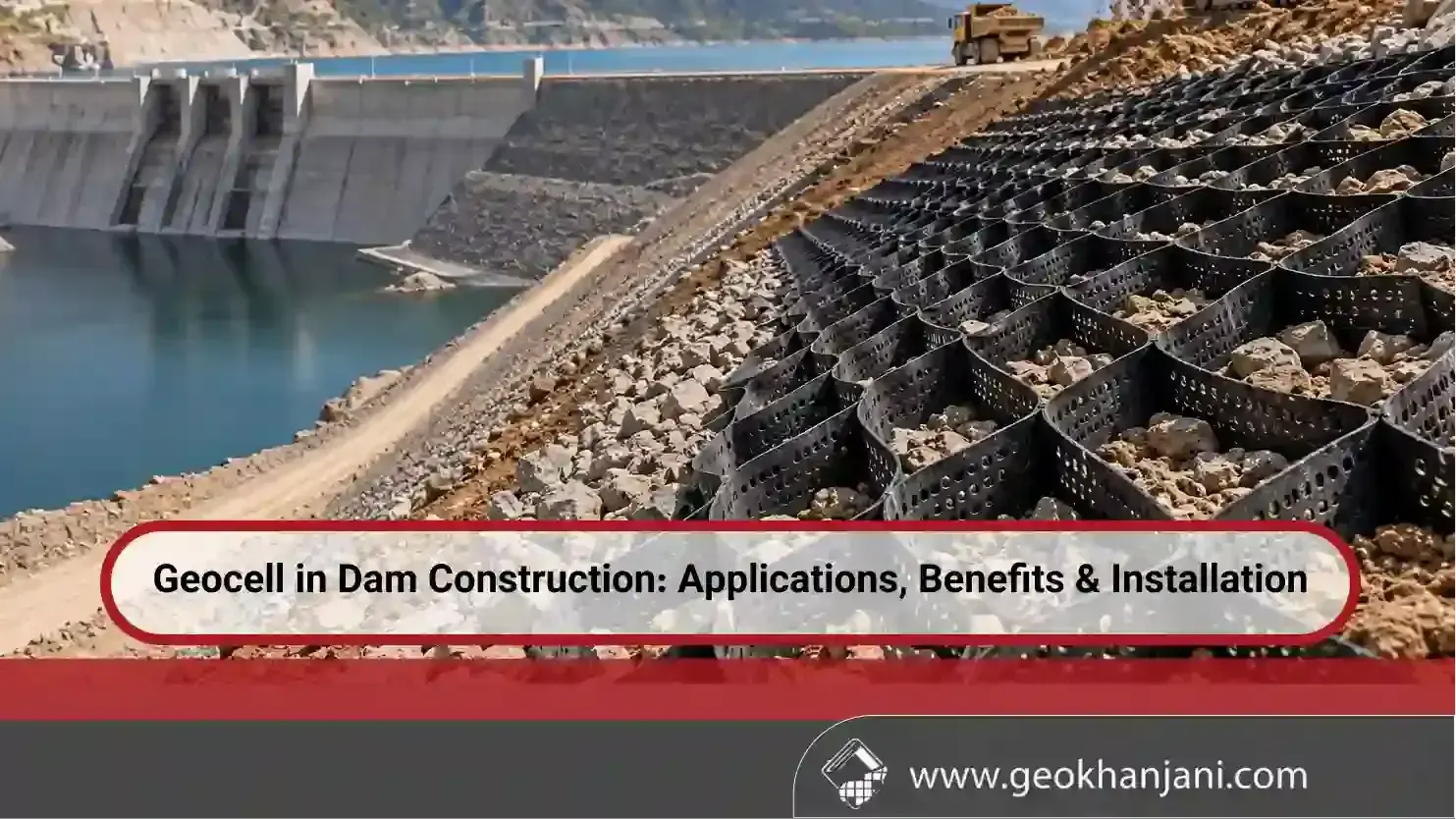
Geocell is a three-dimensional cellular confinement system widely used in civil engineering, geotechnical construction, erosion control, and slope stabilization. In dam construction, geocell systems can provide an effective method for improving the stability and durability of soil surfaces exposed to water flow, rainfall, wave action, and hydraulic erosion.
Unlike conventional geosynthetic products that primarily provide planar reinforcement or separation, geocell creates a three-dimensional confinement structure. When filled with soil, sand, gravel, or other suitable materials, the interconnected cells form a mechanically stabilized layer that restricts lateral soil movement and improves the performance of the protected surface.
The application of geocell in dams is particularly relevant to upstream and downstream slopes, spillways, drainage channels, embankments, access roads, and areas vulnerable to surface erosion.
What Is Geocell?
Geocell is a three-dimensional honeycomb-like geosynthetic structure manufactured from polymeric materials, most commonly high-density polyethylene (HDPE). The system consists of interconnected cellular panels that are expanded on site to form a network of individual cells.
After installation, the cells are filled with an appropriate material according to the engineering requirements of the project.
Typical infill materials include:
- Compacted soil
- Sand
- Gravel
- Crushed aggregate
- Concrete
- Vegetated soil
The confinement generated by the cell walls increases the resistance of the infill material against lateral displacement. This makes geocell suitable for applications where conventional soil surfaces may be vulnerable to erosion, rutting, or instability.
Why Is Geocell Used in Dam Construction?
Dams are exposed to several environmental and hydraulic forces. Water flowing along slopes, fluctuations in water levels, rainfall, seepage-related surface effects, and concentrated runoff can gradually remove soil particles from exposed surfaces.
If erosion is not controlled, it can lead to:
1. Surface degradation
2. Formation of rills and gullies
3. Loss of slope material
4. Reduction in slope stability
5. Damage to drainage systems
6. Increased maintenance requirements
Geocell can address these problems by confining the fill material and creating a mechanically stabilized surface layer.
The system does not replace the structural design of a dam. Instead, it functions as a geotechnical and erosion-control component within an appropriately designed dam protection system.
 Why Is Geocell Used in Dam Construction
Main Applications of Geocell in Dams
1. Upstream Slope Protection
The upstream face of an earth or rockfill dam may experience hydraulic forces caused by reservoir water, wave action, and fluctuations in the water level.
Geocell can be used as part of a surface protection system to stabilize the soil or granular cover layer.
Depending on the hydraulic conditions, the cells can be filled with:
- Gravel
- Crushed stone
- Concrete
- Selected granular material
The cellular confinement limits movement of the infill and helps maintain the integrity of the protective layer.
For projects with significant wave or hydraulic loading, geocell should be combined with an engineered surface protection system rather than considered as a standalone solution.
2. Downstream Slope Stabilization
The downstream face of an embankment dam is commonly exposed to rainfall and surface runoff.
Uncontrolled runoff can create channels across the slope. Over time, these channels may become deeper and remove significant quantities of soil.
Geocell can provide a confined surface layer that reduces the susceptibility of the slope to surface erosion.
When filled with vegetated soil, the system can also support vegetation growth. Plant roots may contribute additional surface reinforcement while the geocell provides mechanical confinement.
3. Spillway and Overflow Channel Protection
Spillways and drainage channels are exposed to concentrated water flow and can experience high erosion rates.
Geocell systems can be used to construct a confined erosion-resistant surface in selected applications.
Depending on hydraulic conditions, geocells may be filled with concrete or aggregate.
The appropriate system must be determined based on parameters such as:
- Flow velocity
- Hydraulic depth
- Channel geometry
- Slope gradient
- Expected discharge
- Soil characteristics
- Required service life
For high-energy spillways, conventional reinforced concrete or other specialized hydraulic protection systems may be required. Geocell should therefore be selected based on engineering calculations rather than simply based on the presence of water.
4. Erosion Control on Embankments
One of the most common applications of geocell around dams is erosion control.
An embankment can be particularly vulnerable to erosion during heavy rainfall. The problem becomes more significant when the slope has a high inclination or consists of poorly resistant soil.
Geocell creates interconnected confinement zones that reduce the ability of surface material to migrate downslope.
This makes it useful for:
- Dam embankments
- Reservoir boundaries
- Drainage slopes
- Flood protection embankments
- Levees
- Hydraulic structures
5. Protection of Drainage Channels
Effective drainage is essential for the long-term performance of an embankment dam.
Surface drainage channels must withstand repeated water flow without excessive erosion.
Geocell can be installed along drainage channels and filled with aggregate or concrete to create a confined protective layer.
The cellular structure helps keep the infill material in place while maintaining the designed geometry of the channel.
6. Dam Access Roads and Maintenance Routes
Geocell is not limited to hydraulic protection.
It can also be used in the construction or stabilization of roads and working platforms around dam projects.
When filled with aggregate, geocell can improve load distribution and reduce lateral movement of the granular layer.
Potential applications include:
- Construction access roads
- Maintenance roads
- Temporary haul roads
- Equipment platforms
- Working areas
This can be particularly useful where the underlying soil has relatively low bearing capacity.
How Does Geocell Improve Soil Performance?
The main engineering principle behind geocell is three-dimensional confinement.
When an external load is applied to conventional granular material, the particles tend to move laterally.
The walls of the geocell restrict this movement.
As a result, the infill behaves as a mechanically stabilized composite layer.
The basic mechanism can be represented as:
Applied Load → Lateral Movement → Cellular Confinement → Improved Load Distribution
In slope protection, the same confinement mechanism helps reduce downslope movement of surface material.
This is one of the major differences between geocell and planar geosynthetics.
Geocell Installation on a Dam Slope
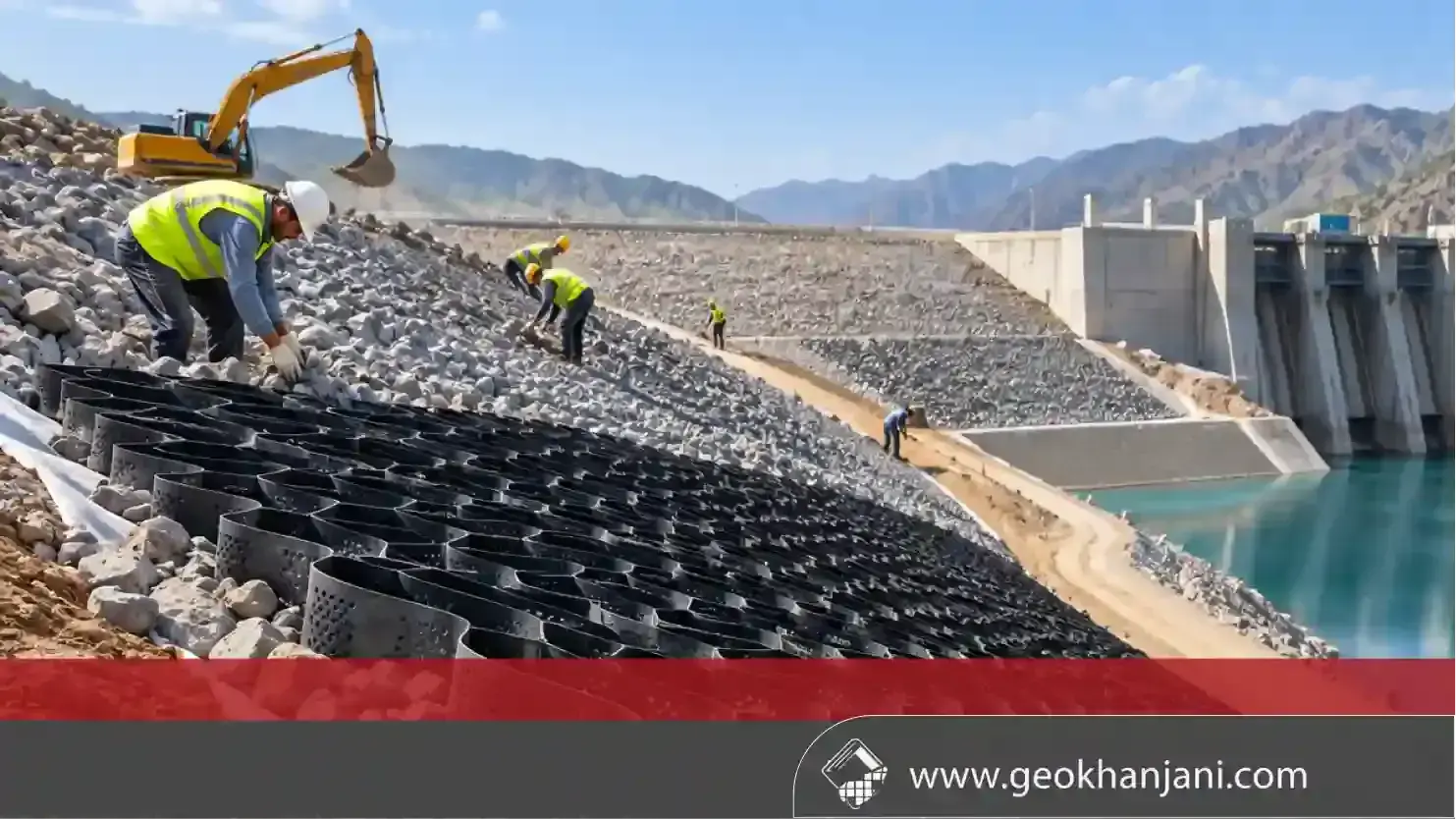
A typical geocell installation procedure may include several stages.
Step 1: Site Preparation
The slope must first be prepared according to the engineering design.
Loose soil, vegetation, debris, and unstable materials should be removed where necessary.
The surface is then graded to the required geometry.
Step 2: Subgrade Compaction
The prepared surface should be compacted to achieve the required density and stability
Any soft zones or unsuitable materials should be treated according to the project specifications.
Step 3: Installation of Geotextile
In many systems, a geotextile layer may be placed beneath the geocell.
The geotextile can provide functions such as:
- Separation
- Filtration
- Reduction of soil migration
- Protection of the subgrade
The need for geotextile depends on the soil conditions and the hydraulic design.
Step 4: Anchoring the Geocell
The expanded geocell panels are positioned over the prepared surface.
On inclined slopes, anchoring is critical.
Anchors, stakes, or other approved fixing systems are used to maintain the designed position of the panels during filling and throughout service.
Step 5: Expanding the Cells
The panels are expanded to the specified dimensions.
The cells should be properly aligned and connected before filling begins.
Incorrect expansion can affect the geometry and performance of the final system.
Step 6: Filling the Cells
The selected infill material is placed inside the cells
The material must be compatible with the design requirements.
For example, aggregate may be selected for erosion protection, while topsoil may be selected when vegetation is part of the design.
Step 7: Compaction and Finishing
The infill material is compacted or finished according to the project specifications.
The final surface should have the required slope, drainage characteristics, and uniformity.
Geocell Filled With Concrete for Dam Protection
Concrete-filled geocell is one of the configurations that can be considered for applications exposed to significant hydraulic forces.
In this configuration, concrete occupies the individual cells and forms an interconnected protective surface.
Potential applications include:
- Drainage channels
- Slope protection
- Hydraulic structures
- Spillway-related areas
- High-erosion zones
However, the concrete mix, cell dimensions, thickness, reinforcement requirements, joints, and hydraulic resistance should be determined based on the project design.
Geocell does not automatically make a slope suitable for high-velocity water flow. Hydraulic calculations remain essential.
Geocell and Vegetated Dam Slopes
For environmentally oriented projects, geocell can be combined with vegetation.
In this approach, the cells are filled with suitable topsoil and seeded.
The geocell provides initial mechanical confinement, while vegetation can gradually establish a biological erosion-control layer.
This approach may be suitable for slopes where the expected hydraulic forces are compatible with vegetated protection.
The effectiveness depends on:
- Plant species
- Climate
- Soil properties
- Slope angle
- Rainfall
- Water flow
- Establishment period
- Maintenance
Vegetation should therefore be considered as part of an engineered erosion-control system rather than as a universal substitute for hard protection.
Advantages of Using Geocell in Dam Projects
Improved Erosion Resistance
The cellular structure reduces movement of the infill material and can significantly improve resistance to surface erosion compared with an unconfined soil layer.
Slope Stabilization
Geocell provides lateral confinement that helps stabilize surface and near-surface materials on inclined slopes.
Flexible Construction
Geocell systems can accommodate moderate surface irregularities and can be adapted to different slope geometries.
Reduced Aggregate Migration
The cell walls prevent granular materials from freely moving downslope.
This can be particularly valuable on steep surfaces.
Load Distribution
When used beneath roads and working platforms, geocell distributes loads over a wider area and improves the performance of granular layers.
Material Optimization
Depending on the design, locally available fill materials may be used within the cells, potentially reducing the volume of higher-quality aggregate required.
Long-Term Surface Protection
HDPE geocell systems can provide durable confinement when properly selected, installed, and protected from environmental conditions.
Geocell vs. Conventional Dam Slope Protection
Different dam projects require different protection systems.
Common approaches include:
Protection System | Typical Function |
Riprap | Hydraulic and erosion protection |
Concrete lining | High-resistance hydraulic protection |
Geotextile | Filtration and separation |
Geomembrane | Fluid containment |
Geocell | Confinement and erosion control |
Vegetation | Surface erosion control |
Gabions | Erosion protection and structural stabilization |
These systems can also be combined.
For example, a dam slope may use a geotextile for filtration, geocell for confinement, and aggregate or vegetation as the surface material.
Can Geocell Replace Geomembrane in a Dam?
Geocell and geomembrane have fundamentally different functions.
A geomembrane is primarily used as a low-permeability barrier for fluid containment and seepage control.
A geocell is primarily used for three-dimensional soil confinement, load distribution, and erosion control.
For example, a reservoir may require a geomembrane liner to reduce water seepage, while geocell may be used on selected slopes or drainage areas to stabilize the surface.
In some engineered systems, geocell and geomembrane can therefore work together rather than replace one another.
Factors to Consider When Selecting Geocell for Dam Construction
Selecting a geocell system requires more than choosing the cell height or material.
Important parameters include:
Cell Height
Common geocell heights vary according to the application.
Higher cells may provide greater confinement depth, but the appropriate dimension depends on the design requirements.
Polymer Type
HDPE is commonly used because of its combination of flexibility, chemical resistance, and durability.
Cell Dimensions
Cell size influences the confinement behavior and interaction with the selected infill material.
Surface Texture
Textured or structured cell walls can improve interaction between the geocell and the infill material.
Connection System
The method used to connect adjacent panels must provide sufficient structural integrity during installation and service.
Anchor Type
Anchoring must be designed according to slope angle, soil properties, expected hydraulic forces, and the geocell configuration.
Infill Material
The fill should be selected according to the hydraulic, mechanical, and environmental requirements of the project.
Quality Control During Installation
Quality control is essential for geocell applications in dam construction.
Inspection should consider:
- Subgrade preparation
- Slope geometry
- Geocell dimensions
- Panel connections
- Anchor spacing
- Cell expansion
- Infill quality
- Compaction
- Surface finishing
- Drainage details
Particular attention should be given to transitions between geocell-protected areas and adjacent structures.
Poorly designed transitions can become weak points where erosion or material loss begins.
Final Considerations
Geocell is a versatile geosynthetic technology that can play an important role in dam and hydraulic infrastructure projects. Its primary value comes from the three-dimensional confinement of soil and granular materials.
In dam construction, geocell can be considered for slope erosion control, embankment protection, drainage channels, spillway-related areas, reservoir slopes, access roads, and maintenance platforms.
Its performance, however, depends on correct engineering design, appropriate infill material, adequate anchoring, proper installation, and compatibility with the hydraulic conditions of the site.
For projects involving significant water flow or critical dam structures, geocell should be designed as one component of an integrated protection system rather than treated as a standalone solution.
Conclusion
The use of geocell in dam construction provides an effective approach to controlling surface erosion and improving the stability of soil and granular layers. By creating a three-dimensional confinement network, geocell limits lateral material movement and helps maintain the integrity of protected surfaces.
Depending on project requirements, geocell can be combined with geotextiles, geomembranes, aggregate, concrete, drainage systems, or vegetation to create a comprehensive geotechnical protection system.
For engineers and contractors, the key to successful geocell application is not simply selecting a geocell product, but designing the complete system according to the slope geometry, soil properties, hydraulic conditions, loading, drainage requirements, and expected service life.
For information about geocell products and geosynthetic solutions for civil engineering and infrastructure projects, you can visit Geokhanjani and review the available products and technical options.