Thermal Bonded Geotextile
Thermal Bonded Geotextile is a high quality material that is made by bonding fibers together using heat. This process creates an stable geotextile that is good at withstanding tension and abrasion. Thermal Bonded Geotextile is also very good at filtering water. Is strong enough to last a long time.
Thermal Bonded Geotextile is used in different projects, such as building roads and highways, airports and drainage systems. It is also used in landscaping. To protect the environment. Thermal Bonded Geotextile is a choice for these projects because it is strong and can withstand a lot of stress.
It is made to be used in situations like in civil engineering and environmental projects. Thermal Bonded Geotextile provides benefits, including separation, filtration, protection and reinforcement. It is also good at draining water. Is often used in transportation infrastructure, landfill engineering and coastal protection projects.
Thermal Bonded Geotextiles Applications
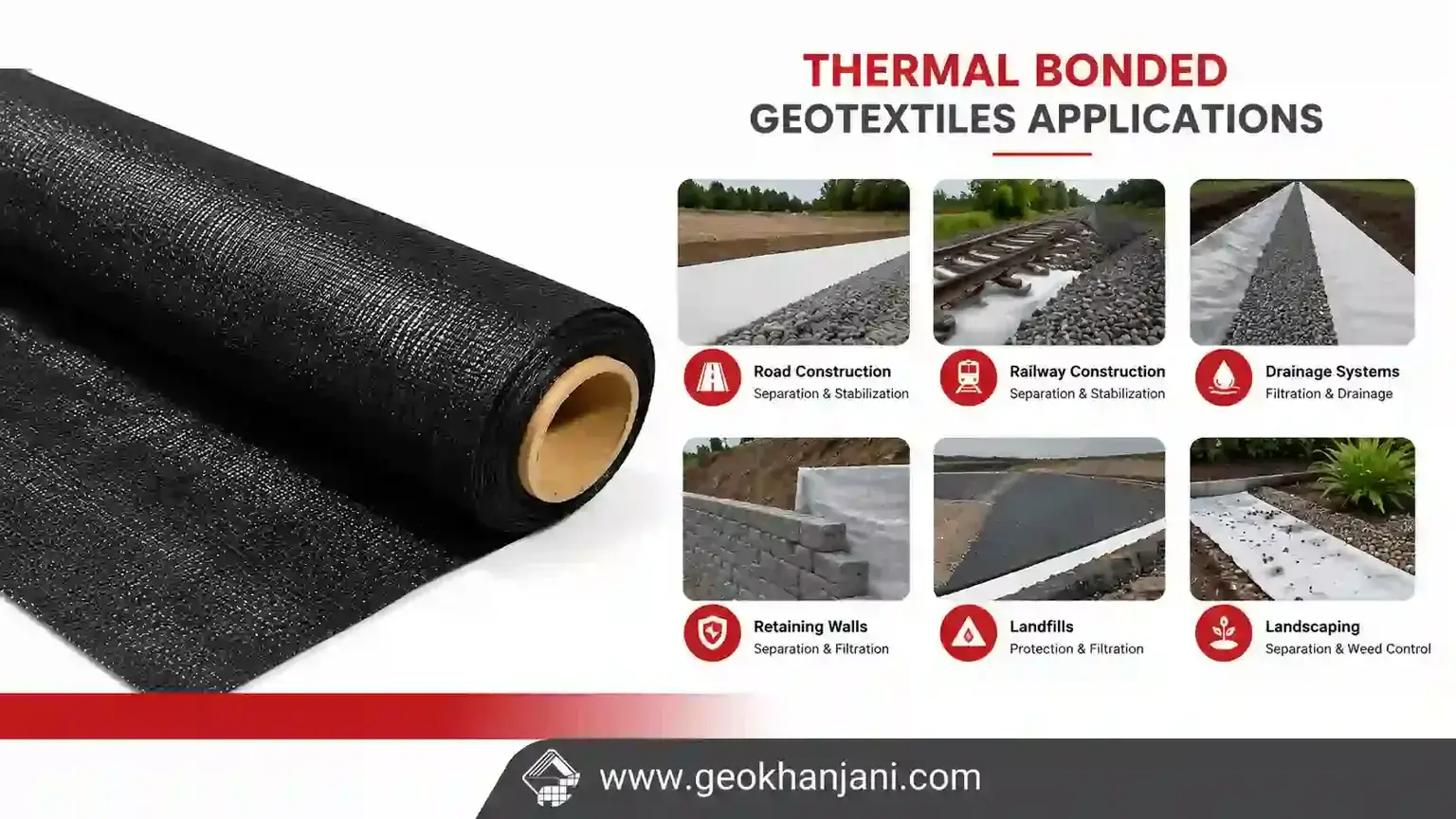 Thermal Bonded Geotextiles Applications
Thermal Bonded Geotextiles can be used in different ways including:
- Building. Highways
- Stabilizing railway ballast
- Making airport pavements
- Creating drainage systems
- Building French drains
- Filling retaining walls
- Making landfills
- Protecting geomembranes
- Lining canals
- Making reservoirs and ponds
- Protecting coastlines and riverbanks
- Stabilizing slopes
- Controlling erosion
- Making roofs
- Doing landscaping projects
- Stabilizing foundations
- Building platforms
- Making mining infrastructure
Thermal Bonded Geotextiles Key Features
Thermal Bonded Geotextiles have many good qualities, including:
- High tensile strength, which means Thermal Bonded Geotextile is very strong
- Excellent dimensional stability, which means Thermal Bonded Geotextile does not change shape easily
- A smooth and uniform surface, which makes Thermal Bonded Geotextile easy to work with
- filtration performance, which means Thermal Bonded Geotextile is very good at filtering water
- High permeability, which means Thermal Bonded Geotextile allows water to pass through easily
- Effective soil separation, which means Thermal Bonded Geotextile can separate soil from materials
- Outstanding puncture resistance, which means Thermal Bonded Geotextile can withstand punctures
- Excellent abrasion resistance, which means Thermal Bonded Geotextile can withstand wear and tear
- Chemical resistance, which means Thermal Bonded Geotextile can withstand chemicals
- UV stabilization, which means Thermal Bonded Geotextile can withstand sunlight
- A long service life, which means Thermal Bonded Geotextile lasts a time
- It is lightweight and easy to install which makes Thermal Bonded Geotextile easy to use
- It is environmentally friendly which means Thermal Bonded Geotextile does not harm the environment
- It is compatible with geomembranes and drainage composites which makes Thermal Bonded Geotextile easy to use with materials
Thermal Bonded Geotextiles Benefits
Using Thermal Bonded Geotextiles has many benefits, including:
- It extends the life of pavements, which means roads and highways longer
- It prevents soil contamination, which means the soil stays clean
- It improves drainage efficiency, which means water flows easily
- It reduces maintenance costs, which means it saves money
- It increases stability, which means buildings and roads are stronger
- It protects waterproofing membranes, which means they last longer
- It minimizes erosion, which means the soil stays in place
- It enhances load distribution, which means it can withstand loads
- It improves project sustainability, which means it is good for the environment
- It provides cost- long-term performance, which means it saves money in the long run
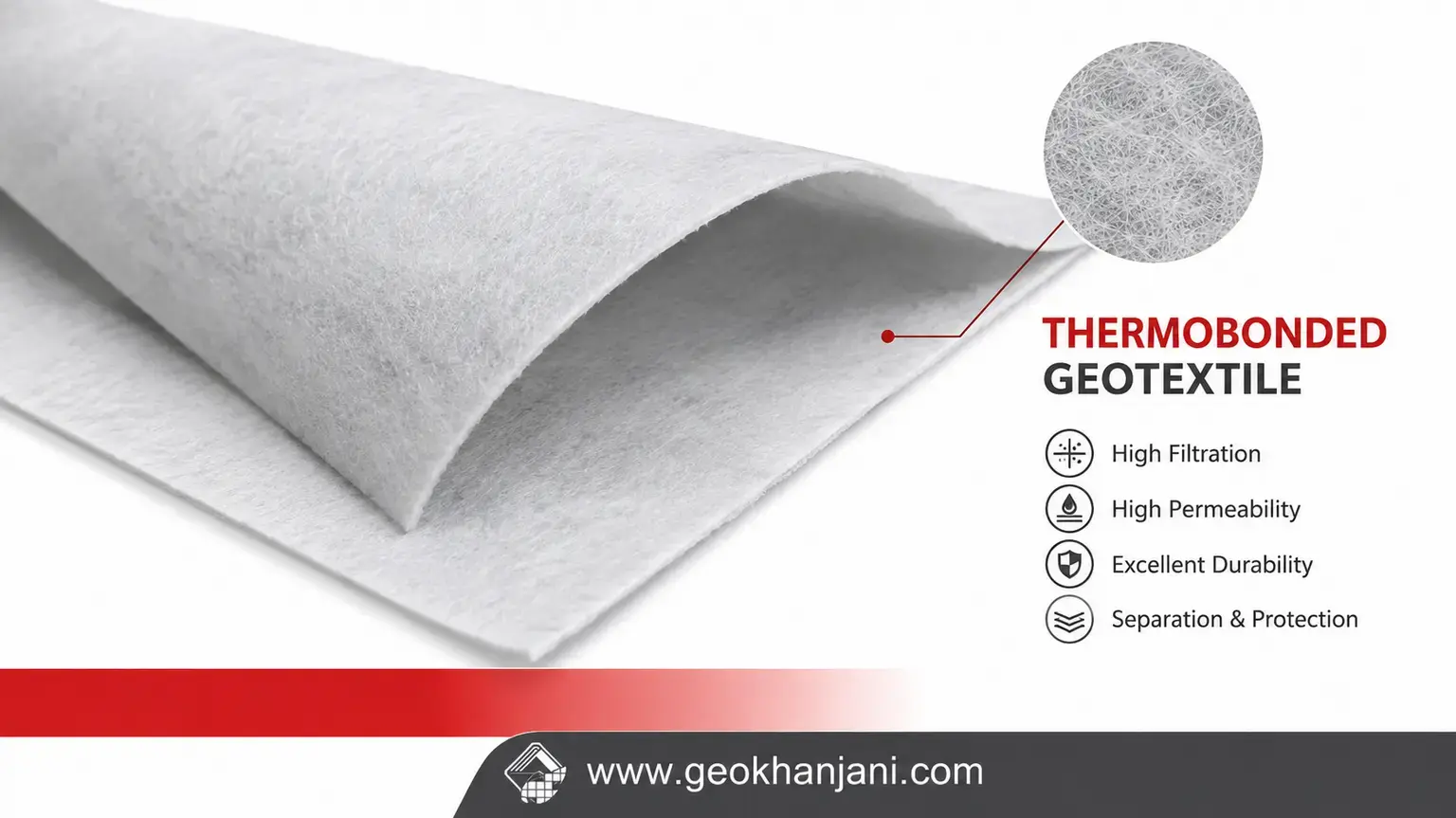
Manufacturing Process
Thermal Bonded Geotextiles are made by extruding high-quality polypropylene or polyester fibers into a nonwoven web. The fibers are then bonded together using heat, which creates an stable fabric.
This process is different from methods, which use needles to punch the fibers together. Thermal bonding creates an more stable fabric, which is better for filtration and other applications.
Typical Technical Properties
Some typical properties of Thermal Bonded Geotextiles include:
- The material is polypropylene or polyester
- The manufacturing method is bonding
- The structure is nonwoven
- The color can be white, black, grey. Customized
- The roll width can be up to 6 meters
- The roll length can be customized
- The mass, per unit area can be 80-600 g/m²
- It has water permeability
- It has chemical resistance
- It is UV stabilized
- It has tensile strength
- It has elongation properties
Why Choose GEOKHANJANI?
GEOKHANJANI provides high-quality Thermal Bonded Geotextiles that meet international standards. Our products are designed to provide mechanical performance, reliable filtration and long-term durability.
Our technical experts can help you choose the product specify it and install it. This ensures that your project performs well and meets your needs.