Slope Geocell – Complete English Translation
Introduction
In civil engineering and infrastructure projects, one of the most significant challenges is ensuring long-term slope stability while preventing soil erosion. Conventional solutions such as reinforced concrete retaining walls, gabions, and shotcrete often involve high material costs, extensive labor, prolonged construction schedules, and limited adaptability to steep or environmentally sensitive terrains.
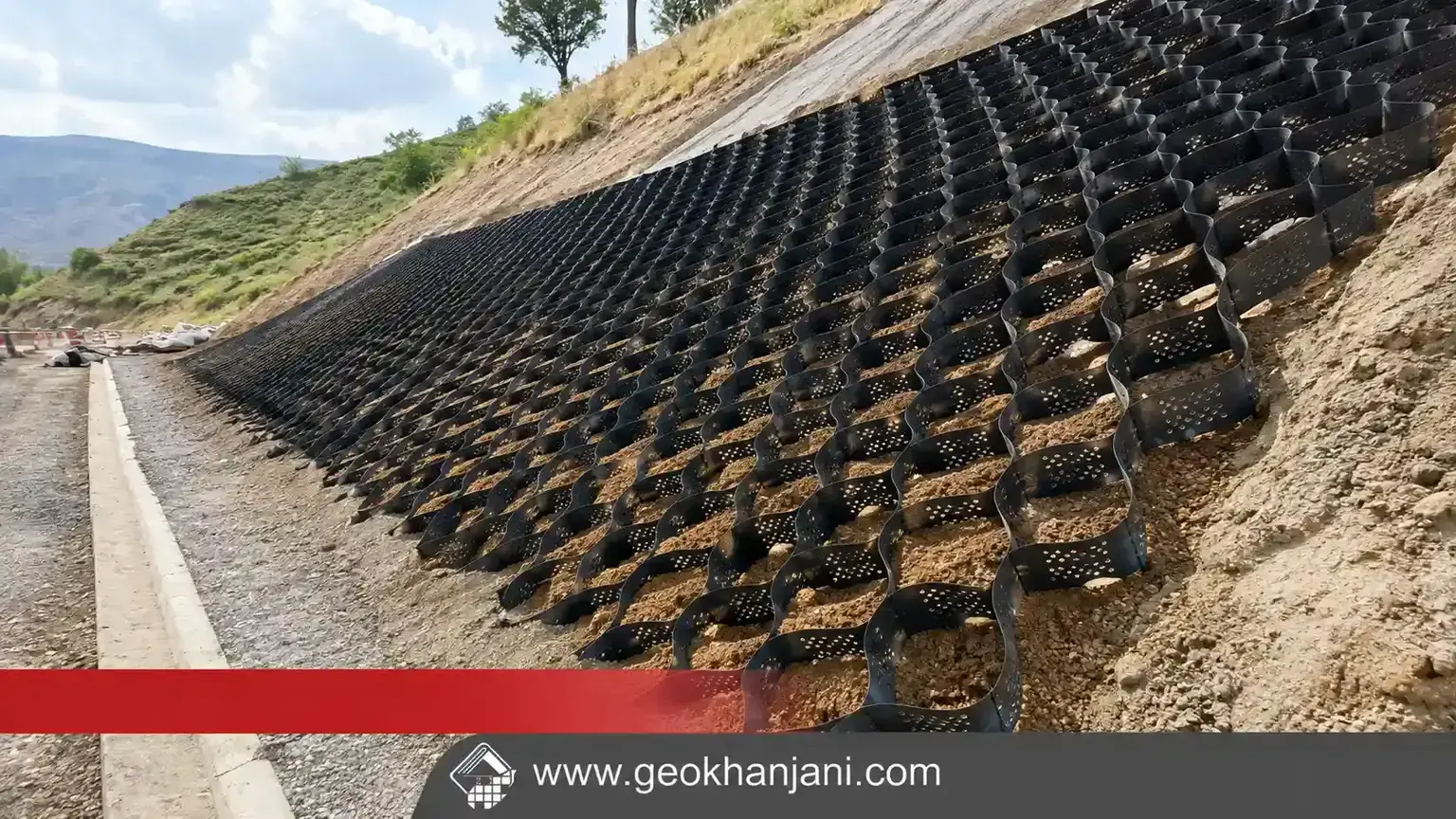
Slope Geocell offers a modern, cost-effective, and environmentally sustainable alternative for slope stabilization and erosion control. Engineered as a three-dimensional cellular confinement system, geocells securely confine soil, gravel, or aggregate within interconnected cells, significantly reducing lateral displacement and improving the mechanical performance of the infill material. This confinement mechanism creates a stable protective layer while allowing natural drainage and vegetation growth.
With proper installation, slope geocell systems mitigate erosion, reduce slope failure risks and maintenance requirements, and provide long-term stabilization for highways, railways, dams, mining, landscaping and other geotechnical projects.
 How Slope Geocells Work
How Slope Geocells Work
The unique three-dimensional honeycomb structure confines infill materials, distributes loads, increases shear strength and supports vegetation while maintaining natural drainage.
Soil Stabilization Mechanisms
• Cellular confinement
• Uniform load distribution
• Increased shear strength
• Soil–Root–Geocell interaction
Drainage and Permeability
Perforated cell walls reduce hydrostatic pressure, improve drainage, enhance aeration and promote vegetation growth.
Slope Angle and Applications
Standard systems are suitable for slopes up to 45°, while engineered systems may be designed for slopes approaching 70°. Applications include highways, railways, dams, riverbanks, mining, landscaping and erosion control.
Construction Materials
HDPE, advanced polymer alloys such as Neoloy®, and UV-resistant performance additives.
Design Parameters
Cell depth, cell size, wall thickness and perforated/non-perforated wall configuration.
Types
Surface protection geocells, reinforcement geocells, vegetated systems and concrete-filled geocells.
Case Study
A 27,000 m² StrataWeb geocell installation at a golf course in Gurgaon, India successfully stabilized steep slopes and controlled erosion.
Comparison
Compared with retaining walls and gabions, geocells offer faster installation, lower lifecycle cost, vegetation support and superior environmental compatibility.
Advantages
Excellent erosion control, enhanced stability, rapid installation, lower costs, UV resistance, flexibility, long service life and sustainability.
Limitations
Requires proper geotechnical design, suitable anchoring and evaluation of weak soils and steep slopes.
Economic Benefits
Reduced material use, lower labor and maintenance costs, and excellent long-term return on investment.
Installation
1. Site preparation
2. Anchor installation
3. Geocell expansion
4. Panel fixing
5. Cell infill
6. Vegetation establishment.
Why GEOKHANJANI
GEOKHANJANI supplies premium-quality slope geocells with engineering support for infrastructure and geotechnical projects.
Conclusion
Slope Geocells are an advanced, durable and environmentally responsible solution for slope stabilization and erosion control, providing long-term structural performance and economic value.