Water transfer channel
Water transfer channel
Preventing the loss and pollution of fresh water sources and its correct and safe transfer to the places of consumption without changing the quantity and quality have always been discussed in civil and geotechnical engineering. The construction of water transfer channels that are responsible for transferring fluid from the main source to the places of consumption, especially in unfavorable environmental conditions such as the condition of the bed soil, difficult access, weather conditions and many other factors that make the construction of a durable and high-quality water transfer channel necessary. has constructed.
The traditional methods of constructing a water transfer channel, whether covered with dense clay or impermeable concrete, on the one hand, are not applicable on all kinds of soils such as chalky, sandy, silty and corrosive soils, and for this reason, the heavy costs of replacing the soil It imposes on the project, and on the other hand, it is quickly destroyed by environmental factors and brings maintenance and repair costs during the system's operation period. The difficulties of compaction and correct acoustic performance of these materials, which strongly affects their permeability and durability, in addition to the sensitivity of these methods to changes in temperature and moisture percentage, ice packs, plant growth, animal attacks, microscopic factors, and many others, the need to provide a reliable method and With durability, it has made the construction of the water transfer channel inevitable.
Therefore, the construction of the water transfer channel using geosynthetic materials (geomembrane, geotextile and geocomposites) has attracted the attention of those involved in construction projects all over the world today as a substitute for traditional and well-known old methods. The construction of the water transfer channel by
Why Are Water Transfer Channels Important?
Water is often stored in one location but needed somewhere else. For example, agricultural water may be stored in a reservoir or farm pond and then transported to fields located several hundred meters or several kilometers away.
Without an appropriate transfer system, a significant amount of water can be lost through soil infiltration, evaporation, erosion, or uncontrolled flow.
A properly designed water transfer channel provides a defined route for water and allows engineers to control important factors such as:
- Water flow rate
- Channel dimensions
- Flow velocity
- Channel slope
- Water level
- Seepage
- Erosion
- Maintenance requirements
- Long-term system durability
This makes water transfer channels particularly valuable in regions where water conservation and efficient irrigation are important.
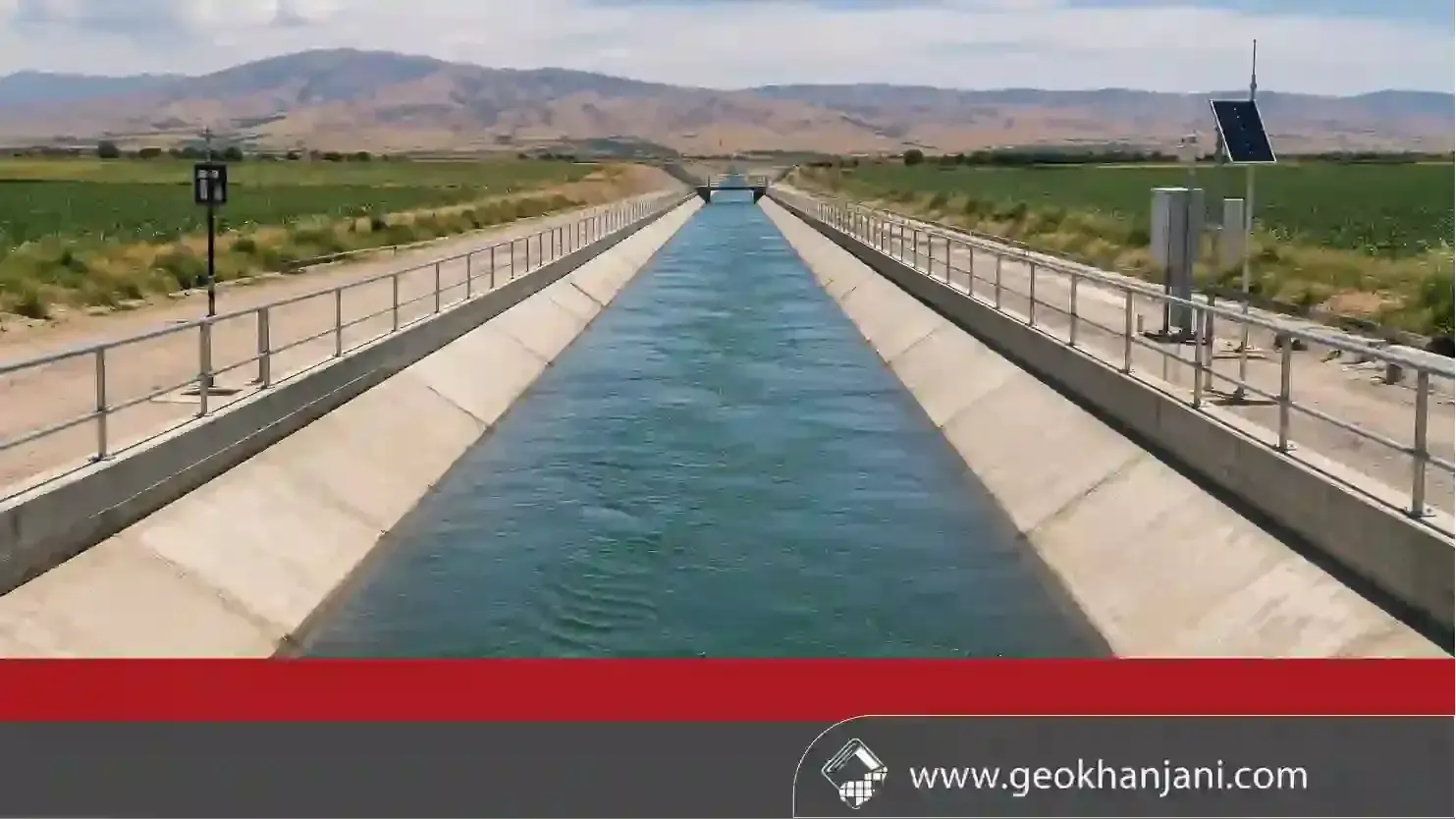 Water Transfer Channels
Main Applications of Water Transfer Channels
Water transfer channels can be used in a wide variety of projects. Their design and construction depend on the type of water being transported and the required flow capacity.
1. Agricultural Irrigation
One of the most common applications of water transfer channels is agricultural irrigation.
Water can be transferred from a reservoir, dam, well, or agricultural pond to different fields through a dedicated channel. A properly lined channel can reduce water losses caused by infiltration and help farmers use available water more efficiently.
Geomembrane-lined irrigation channels are particularly useful where the surrounding soil has high permeability.
2. Connecting Water Storage Ponds
Large agricultural or industrial projects often use multiple water storage ponds. A water transfer channel can connect these ponds and allow water to move between them.
For example, water collected in one storage pond can be transferred to another pond for temporary storage or later use.
3. Reservoir and Dam Water Transfer
Water transfer channels can also be used to transport water from reservoirs and dams to irrigation networks or treatment facilities.
In these applications, the channel must be carefully designed to withstand the expected flow rate, hydraulic pressure, environmental conditions, and potential erosion.
4. Industrial Water Management
Industrial facilities often require large quantities of water for cooling, processing, washing, or other operations.
Water transfer channels can provide a controlled method of moving water between storage areas, processing facilities, treatment systems, and discharge points.
5. Mining Projects
Mining operations frequently require systems for managing process water, runoff, and other non-potable water sources.
Lined channels can help transport water while reducing infiltration into surrounding soil. In projects where water quality and environmental protection are important, the selection of the appropriate lining system becomes particularly critical.
6. Water Treatment Facilities
Water transfer channels may also be used to transport raw water, treated water, or process water between different stages of a treatment facility.
The channel material should be selected according to the characteristics of the water and the environmental conditions of the project.
Benefits of a Properly Designed Water Transfer Channel
A well-designed water transfer channel can provide several technical and economic benefits.
Reduced Water Loss
One of the most important advantages is reducing water loss through seepage. In unlined soil channels, water can gradually infiltrate into the surrounding ground.
Installing an impermeable geomembrane liner can substantially reduce this type of loss and help deliver more water to the intended destination.
Improved Water Distribution
A properly engineered channel provides a controlled pathway for water. This improves the consistency and reliability of water distribution, particularly in agricultural irrigation systems.
Reduced Soil Erosion
High water velocity can cause erosion of the channel bottom and side slopes. Over time, erosion can change the channel geometry and reduce its efficiency.
A suitable lining system can protect the channel structure and reduce erosion-related problems.
Lower Maintenance Requirements
Unlined channels may require regular maintenance because of vegetation growth, sediment accumulation, erosion, and changes in the channel profile.
A properly lined channel can reduce many of these problems and potentially lower long-term maintenance costs.
Long Service Life
When appropriate materials are selected and installed correctly, a water transfer channel can provide reliable performance for many years.
The service life depends on factors such as the quality of construction, exposure to sunlight, mechanical stresses, water characteristics, and the type of lining material used.
Geomembrane Lining for Water Transfer Channels
One of the most important technologies used in modern water transfer channels is geomembrane lining.
A geomembrane is a flexible, low-permeability synthetic membrane used to control the movement of liquids. HDPE and LLDPE geomembranes are commonly considered for water containment and transfer applications because of their durability and resistance to water penetration.
When installed along the bottom and side slopes of a channel, the geomembrane creates an impermeable barrier between the water and the underlying soil.
This helps prevent seepage and protects the surrounding ground from continuous water infiltration.
Why Use Geomembrane in a Water Transfer Channel?
There are several reasons why geomembranes are suitable for channel lining applications.
1. Excellent Waterproofing
Geomembranes provide a highly effective barrier against water penetration. This is especially important in agricultural areas where water conservation is a major concern.
2. Flexibility
Flexible geomembranes can adapt to the shape and contours of properly prepared channel surfaces. This makes them suitable for channels with sloped sides and irregular geometries.
3. Resistance to Environmental Conditions
High-quality geomembranes can provide good resistance to moisture, soil conditions, and environmental exposure. For outdoor projects, UV resistance is also an important consideration.
4. Chemical Resistance
Depending on the selected polymer and formulation, geomembranes can offer resistance to a wide range of chemicals. This is particularly useful for industrial and mining applications where the transferred water may have specific chemical characteristics.
5. Reduced Seepage
The main objective of geomembrane lining is to prevent water from escaping through the channel bottom and sidewalls.
This can improve water-use efficiency and reduce the amount of water required to deliver a specific volume to the final destination.
Geotextile Protection Under the Geomembrane
Although geomembranes are durable, the substrate beneath the liner must be properly prepared.
Sharp rocks, construction debris, roots, or uneven surfaces can create localized stresses and potentially damage the geomembrane during installation or operation.
For this reason, a geotextile protection layer is often installed beneath the geomembrane.
The geotextile acts as a protective cushion between the prepared soil and the geomembrane. It can help distribute localized stresses and reduce the risk of puncture or mechanical damage.
The appropriate geotextile type and weight should be selected according to the characteristics of the soil, expected loading conditions, and project requirements.
Important Factors in Water Transfer Channel Design
The performance of a water transfer channel depends heavily on its design.
Several factors should be evaluated before construction.
Channel Capacity
The channel must be capable of transporting the required volume of water without overtopping or excessive flow velocity.
Channel Dimensions
The width, depth, and side slope should be determined according to the required flow capacity, available land, terrain, and hydraulic conditions.
Channel Slope
The longitudinal slope influences the velocity of water. Excessive velocity may increase erosion risks, while insufficient slope can cause sedimentation and poor water movement.
Soil Conditions
The characteristics of the surrounding soil should be evaluated before construction. Highly permeable soils can lead to significant seepage and may make geomembrane lining particularly beneficial.
Environmental Exposure
Outdoor channels are exposed to sunlight, temperature fluctuations, rain, wind, and other environmental conditions. The selected geomembrane should therefore be suitable for the expected exposure conditions.
Installation Method
Geomembrane installation quality is just as important as material selection. Seams should be welded using appropriate equipment and inspected to ensure reliable waterproofing.
Geomembrane Welding in Water Transfer Channels
Large geomembrane sheets are normally joined together using specialized welding equipment.
Two common methods include hot wedge welding and extrusion welding.
Hot wedge welding is widely used for long, continuous seams because it can create strong and consistent joints between compatible geomembrane sheets.
Extrusion welding is commonly used for details, penetrations, corners, repairs, and locations where hot wedge equipment may not be practical.
Proper welding temperature, speed, pressure, surface preparation, and equipment calibration are important for achieving reliable seams.
Quality control should also be performed throughout the installation process.
Common Problems in Poorly Designed Water Transfer Channels
If a channel is not properly designed or constructed, several problems may occur.
Water Seepage
Unlined or poorly lined channels can lose substantial quantities of water through the soil.
Erosion
High flow velocity can erode the channel bottom and side slopes.
Geomembrane Damage
Poor substrate preparation, improper installation, or inadequate protection can damage the geomembrane.
Leakage at Seams
Even a high-quality geomembrane can fail to provide effective waterproofing if the seams are poorly welded.
Sediment Accumulation
Improper hydraulic design can cause sediment to accumulate inside the channel and reduce its effective capacity.
Structural Instability
Poorly designed side slopes may become unstable, particularly in weak or saturated soils.
How to Improve Water Transfer Channel Performance
The performance and durability of a water transfer channel can be improved by following several important principles:
1. Conduct a proper site investigation before construction.
2. Determine the required water flow rate and channel capacity.
3. Design the channel dimensions according to hydraulic conditions.
4. Prepare and compact the substrate properly.
5. Remove sharp stones, roots, and construction debris.
6. Use geotextile protection where necessary.
7. Select a suitable geomembrane type and thickness.
8. Install the geomembrane according to professional installation procedures.
9. Perform proper geomembrane welding and seam testing.
10. Inspect the completed system before commissioning.
11. Provide appropriate drainage and erosion-control measures where required.
12. Establish a regular inspection and maintenance program.
Water Transfer Channel vs. Traditional Unlined Channel
Traditional soil channels can be relatively inexpensive to construct, but they may experience significant water losses through seepage.
A geomembrane-lined channel generally requires a higher initial investment, but it can provide better water retention and reduce long-term losses and maintenance requirements.
The best solution depends on project-specific factors such as soil permeability, water availability, construction budget, expected service life, flow rate, and environmental conditions.
For projects where water conservation is a priority, an engineered lined channel can provide significant long-term benefits.