pvc welding-rod
PVC Welding Rod is a thermoplastic filler designed for welding, fabrication, and repair of compatible PVC sheets, pipes, tanks, liners, and industrial plastic components.
Slime Glue is a water-based polymer adhesive used as the main ingredient in slime production. This guide explains its properties, applications, manufacturing process, slime-making method, quality factors, storage, price considerations, and buying tips.
Categories:
Slime Glue
Slime Glue is a water-based adhesive specially formulated as a base material for making soft, stretchy, and elastic slime. It provides the polymer structure needed for slime formation and can be combined with a suitable activator to create the characteristic flexible and gel-like texture.
Unlike ordinary household adhesives, slime glue is formulated with the final texture and activation process in mind. A good slime glue should mix easily with the activator, provide consistent elasticity, and produce a smooth texture without excessive stickiness.
Many commercial slime glues use polyvinyl alcohol (PVOH/PVA) or related water-soluble polymer systems as their main polymer component. The exact formulation varies between manufacturers and products.
Slime glue is a specially formulated, water-based glue used as the primary polymer component in slime production.
Before activation, it generally has a liquid or moderately viscous consistency. After an appropriate activator is introduced, interactions between the polymer chains change the material's flow behavior, producing a soft and elastic slime.
The quality of the glue has a major effect on the final product. Different glue formulations can produce different slime textures, including clear, fluffy, stretchy, glossy, buttery, or more firm textures.
Most slime glues are water-based, making them easy to mix and allowing tools and surfaces to be cleaned with water while the adhesive is still wet.
A suitable slime glue should combine evenly with the activator without forming unwanted lumps.
The polymer system allows the finished slime to stretch and deform while maintaining its overall structure.
The final texture can be influenced by the amount of activator, mixing time, and additional ingredients used in the slime formulation.
Slime glue can be produced as a transparent or white liquid. Clear formulations are particularly popular for making transparent slime and for adding pigments, glitter, or decorative particles.
Viscosity is an important characteristic because it affects pouring, mixing, dosing, and the final slime texture. Commercial slime glues can be formulated at different viscosity levels depending on their intended use.
A well-formulated product should be easy to dispense, mix, and process without requiring complicated equipment.
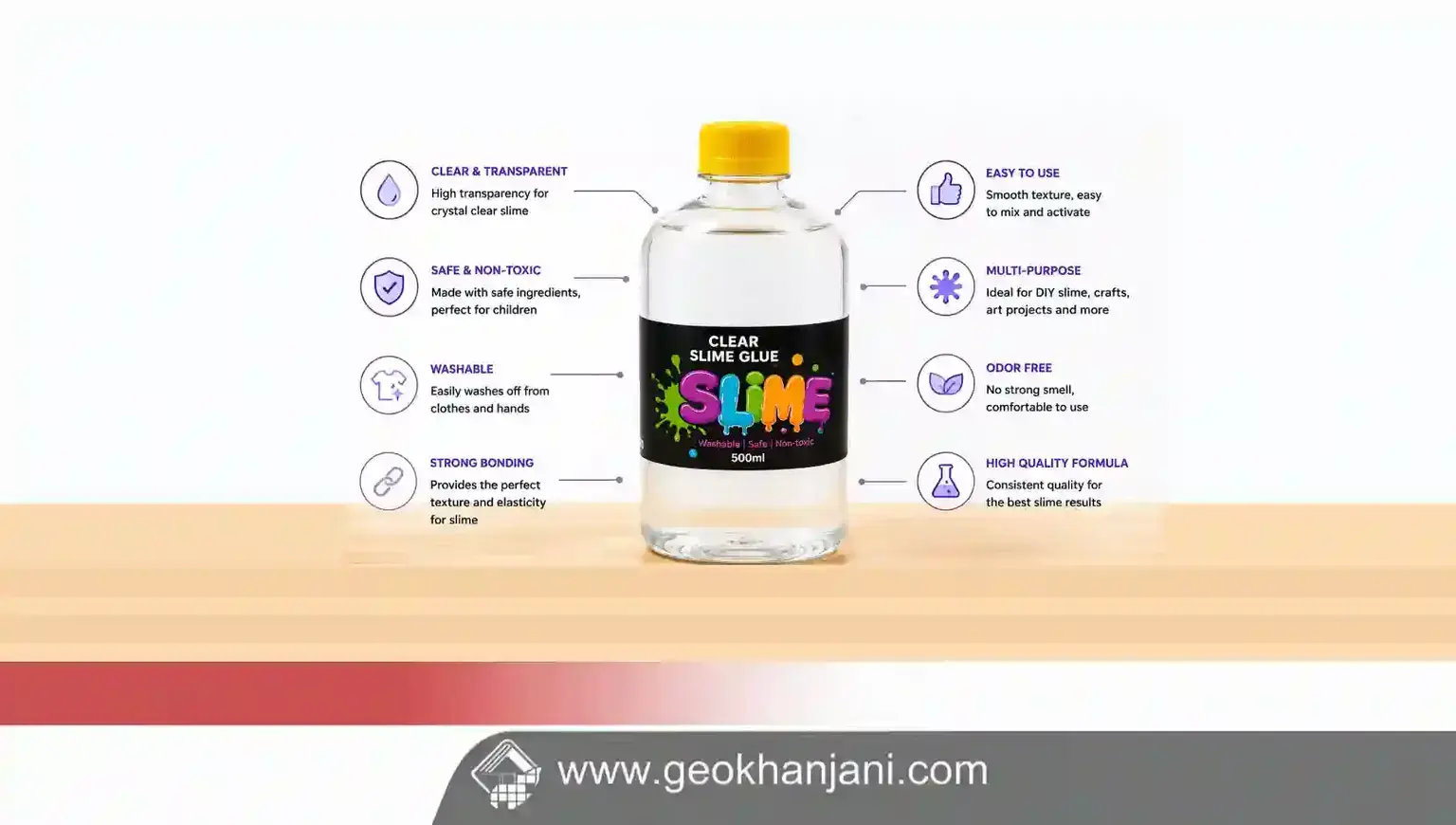 Key Features of Slime Glue
The main application of slime glue is the production of slime for recreational, educational, and creative activities.
Common applications include:
- DIY slime kits
- Children's craft activities
- School and educational projects
- Sensory play products
- Slime workshops
- Handmade slime production
- Commercial slime manufacturing
- Creative and decorative slime products
- Clear slime
- Glitter slime
- Colored slime
- Fluffy slime
- Stretchy slime
Slime glue can also be used as a base in different slime formulations where the final texture is adjusted through activators and additional ingredients.
The key to slime formation is the interaction between the polymer in the glue and the activator.
Before activation, polymer chains are dispersed within the water-based adhesive. When a suitable activator is introduced, interactions between these polymer chains increase and a three-dimensional network begins to form.
As the network develops, the mixture becomes thicker and more elastic.
This transformation changes the material from a flowing adhesive into the soft, stretchable substance commonly known as slime.
The exact chemistry depends on the polymer and activator system used in the product. For this reason, the recommended activator and mixing ratio should always follow the manufacturer's instructions.
A simple slime-making process generally involves three main stages:
Pour the required amount of slime glue into a clean mixing container.
If color is required, pigments or suitable coloring materials can usually be mixed into the glue before activation. This helps distribute the color more evenly.
Add a compatible slime activator in small amounts while continuously mixing.
It is better to add the activator gradually rather than all at once. This makes it easier to control the final consistency.
Continue mixing until the material begins to separate from the sides of the container.
The mixture can then be kneaded by hand until it reaches the desired texture.
If the slime remains excessively sticky, a small additional amount of compatible activator may be required. If it becomes too firm, the formulation may require adjustment with additional glue or another compatible ingredient.
Different commercial products require different activator systems and ratios, so the product instructions should be followed rather than using one universal recipe.
A typical slime-making process uses:
- Slime Glue
- Compatible Slime Activator
- Optional coloring
- Optional glitter or decorative additives
The exact quantities depend on the glue and activator formulation.
For example, some commercial slime products recommend starting with a measured amount of glue and gradually adding activator while mixing until the desired consistency is achieved.
Industrial production of slime glue involves several controlled stages.
The production begins with the selection of the polymer system, water, preservatives, viscosity modifiers, and other formulation components.
The polymer is selected according to the required viscosity, clarity, elasticity, and activation behavior.
Water quality is important because impurities can influence stability and product consistency.
Purified or appropriately treated water is therefore used according to the formulation requirements.
The polymer is gradually introduced into the water under controlled mixing conditions.
Depending on the polymer system, temperature and mixing speed may need to be controlled to achieve uniform hydration or dissolution.
Other ingredients can then be incorporated to adjust properties such as:
- Viscosity
- Stability
- Appearance
- Preservation
- Flow behavior
- Activation response
The ingredients should be added in a controlled sequence to prevent incompatibility or uneven dispersion.
The batch is mixed until the formulation reaches a uniform appearance and consistent viscosity.
Air entrainment should also be controlled because excessive bubbles can negatively affect the appearance of clear slime glue.
Before filling, the finished adhesive is typically checked for parameters such as:
- Appearance
- Color
- Odor
- Viscosity
- pH
- Density
- Stability
- Activation performance
- Compatibility with the intended activator
Commercial products can have specific specifications. For example, one commercial PVA-based slime glue lists a neutral pH and controlled viscosity as part of its product specifications.
After quality approval, the adhesive is transferred into suitable containers.
Packaging should protect the product from contamination and excessive evaporation while providing convenient dispensing for the end user.
Not every water-based glue produces the same slime.
Important quality characteristics include:
The polymer has a major influence on elasticity, activation behavior, and final texture.
The viscosity should be consistent from batch to batch so that users can achieve predictable results.
For clear slime, optical clarity and low contamination are particularly important.
The glue should respond consistently to the recommended activator without requiring excessive quantities.
The product should maintain its intended properties during storage and normal use.
For children's craft products, washability can be an important practical characteristic. Some commercial slime glues are specifically formulated to be washable.
Clear slime requires a glue formulation with suitable transparency and low levels of materials that can cause cloudiness.
A clear slime glue can be combined with colorants, glitter, or other decorative materials to create different visual effects.
However, the final clarity also depends on the activator, mixing method, additives, and the amount of air introduced during processing.
For commercial slime manufacturing, consistency is more important than simply producing a workable slime.
Manufacturers should control:
- Raw material quality
- Batch formulation
- Mixing conditions
- Polymer concentration
- Viscosity
- pH
- Activation behavior
- Packaging
- Storage stability
Consistent production helps ensure that every batch produces a similar slime texture and performance.
Slime glue should be stored according to the manufacturer's recommendations.
In general, it should be:
- Kept in a tightly closed container
- Protected from contamination
- Stored within the recommended temperature range
- Protected from excessive heat or freezing
- Kept away from incompatible materials
Always check the product's technical and safety documentation for specific storage requirements.
When purchasing slime glue, price should not be the only consideration.
you can buy it on geokhanjani website
Important factors include:
- Polymer type
- Viscosity
- Transparency
- Activation performance
- Batch consistency
- Packaging size
- Intended application
- Storage stability
- Product safety information
- Manufacturer specifications
For commercial slime production, requesting technical documentation and testing a sample batch before making a large purchase can help verify compatibility with the intended activator and production process.
The price of slime glue depends on several factors, including polymer quality, formulation, viscosity, transparency, packaging, production volume, and order quantity.
Clear specialty formulations may have different costs from standard white formulations because of their raw material selection and processing requirements.
For bulk orders, the final price may also depend on packaging type, quantity, and delivery requirements.
PVC Welding Rod is a thermoplastic filler designed for welding, fabrication, and repair of compatible PVC sheets, pipes, tanks, liners, and industrial plastic components.
Polypropylene Welding Rod is a reliable thermoplastic filler material designed for welding and repairing polypropylene sheets, pipes, tanks, containers, and industrial plastic components. It provides strong material compatibility and is suitable for hot-air and extrusion welding applications.
Polyethylene Welding Rod is a thermoplastic welding material designed for joining and repairing polyethylene products, including HDPE geomembranes, plastic sheets, tanks, pipes, and industrial components. It is used with suitable hot-air welding guns or extrusion welding machines to create strong and durable welded connections.
Slime Glue is a water-based polymer adhesive used as the main ingredient in slime production. This guide explains its properties, applications, manufacturing process, slime-making method, quality factors, storage, price considerations, and buying tips.
Professional Extrusion Welder for HDPE, LLDPE, PVC, and PP geomembrane welding. Ideal for repairs, waterproofing, mining, landfills, reservoirs, and industrial lining projects.
Three-Component Epoxy Adhesive is a high-performance structural bonding system designed for demanding construction and industrial applications. It offers excellent adhesion to concrete, steel, stone, and other construction materials while providing superior mechanical strength, chemical resistance, and long-term durability.
Geomembrane sheet welding devices are produced from a non-polar thermoplastic polymer, which is very stable chemically. These devices create a melting point of over 140 degrees Celsius. Therefore, it can be extruded at about 200°C.