A practical guide to maintaining geomembrane roll identification through receiving, storage, handling, and deployment, with clear links to installation records.
- Geomembrane Roll Traceability: From Site Delivery to Installed Panels
- Define the Required Records Before Delivery
- Inspect Identification and Visible Condition Together
- Keep Batch Numbers and Roll Numbers Distinct
- Match Documents to the Material They Describe
- Prepare Storage Before the Truck Arrives
- Record Movements and Changes in Status
- Connect the Roll to the Deployment Record
- Use a Register That Supports Decisions
- Include Traceability in the Supply Enquiry
Geomembrane Roll Traceability: From Site Delivery to Installed Panels
A truck arrives with several geomembrane rolls. The delivery note lists the correct product, and the outer surfaces appear undamaged. A few days later, the rolls have been moved, packaging has been removed, and installation has started. Someone then asks which roll supplied a particular panel—and the answer is unclear.
This is the practical problem that roll traceability should prevent. A useful system connects the material received at the gate to its supporting documents, storage location, installation record, and final position in the lining system.
Traceability does not replace material testing or installation inspection. It makes their results easier to associate with the correct material and location. For contractors, owners, and inspectors, that connection becomes particularly valuable when a discrepancy needs investigation.
Define the Required Records Before Delivery
Before ordering material, agree on the identification and documentation required by the project. Establish who receives the rolls, who checks the documents, and who authorizes material for deployment.
The receiving team should have access to the approved product specification and purchase requirements. Otherwise, it may record a shipment accurately without noticing that the supplied material differs from the approved selection.
When reviewing geomembrane products, identify the required material, nominal thickness, surface configuration, dimensions, and relevant documentation. Keep the approved selection available to the people handling the delivery.
A short receiving procedure should also explain how to manage missing labels, damaged packaging, quantity differences, and documents that cannot yet be matched to individual rolls.
Inspect Identification and Visible Condition Together
Receiving inspection should address both identity and observable condition. A readable label does not demonstrate that a roll is undamaged, while an apparently clean roll may still have incomplete identification.
IAGI’s polyethylene geomembrane installation specification calls for manufacturer labels containing information such as product identification, thickness, roll number, dimensions, and weight. The project specification should determine the applicable requirements for the actual delivery. iagi.org
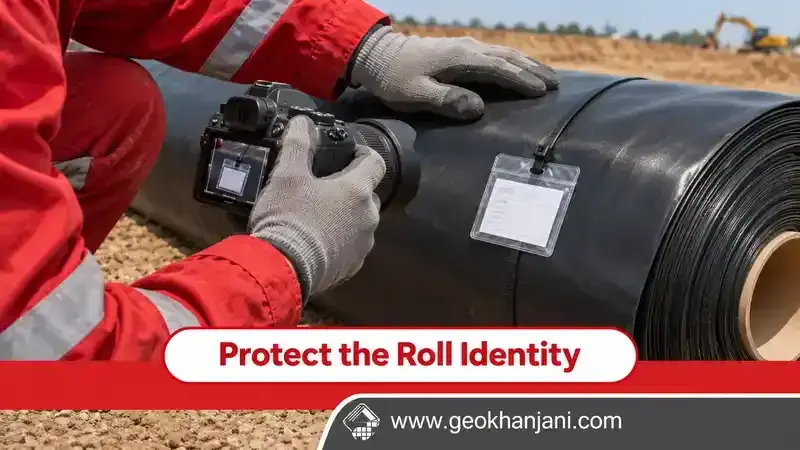
Record each roll separately rather than relying only on the total quantity shown on the delivery note. Photograph the identification and take wider photographs where needed to document condition and location.
Check accessible surfaces for visible signs of transport or handling damage. Describe observations precisely without assuming their cause. Where concerns exist, refer them to the responsible person before the material is released for use.
Keep Batch Numbers and Roll Numbers Distinct
A production batch or lot reference and an individual roll number serve different purposes. Their definitions and relationship should be confirmed with the manufacturer.
A batch reference may connect material to a production grouping. A roll number identifies a particular supplied unit. Neither should silently replace the other in site records.
For example, a receiving register might contain separate fields for the manufacturer’s lot reference, manufacturer’s roll number, and the contractor’s internal stock code. If an internal code is introduced, preserve the original references alongside it.
Avoid creating replacement manufacturer numbers when information is missing. Record the uncertainty and request clarification through the project’s agreed process.
Match Documents to the Material They Describe
A certificate or test report is useful only when its scope can be understood. Check whether it identifies an individual roll, a production lot, a shipment, or a general product type.
Do not assume that every document supplied with a truck applies equally to every roll on it. Match references and flag inconsistencies for review.
A practical document register can include the document name, revision or issue date, relevant roll or lot references, and its review status. Keep a clear distinction between manufacturer quality-control records and any project-required conformance testing.
ASTM’s guide on geosynthetic identification, storage, and handling explicitly states that it does not replace project-specific requirements or quality-assurance programs. It should therefore be used within the project framework rather than treated as a complete acceptance procedure. store.astm.org
Prepare Storage Before the Truck Arrives
The storage location should be planned before unloading begins. Consider access, ground condition, nearby construction activities, and how rolls will later be retrieved.
Follow the manufacturer’s instructions and project requirements for supports, stacking, protection, and handling equipment. There is no universal stacking arrangement suitable for every roll size, product, and storage condition.
USACE guidance includes checking identification during delivery and protecting geomembrane materials from damaging conditions during storage. publications.usace.army.mil
Keep identification accessible and organize the area so that rolls awaiting review can be distinguished from material released for installation.
Where the project also uses protection geotextiles, maintain separate product records. Similar-looking wrapped rolls should not depend on memory or storage position alone for identification.
Record Movements and Changes in Status
A receiving register becomes less useful if nobody updates it after unloading. Record significant movements between storage areas and changes in the material’s review status.
Useful status descriptions might include “received—review pending,” “released for deployment,” or “held for clarification.” Use terminology agreed by the project rather than introducing unexplained abbreviations.
If a roll is moved because access changes, update its location. If identification becomes unreadable, retain the last reliable record and document the steps taken to resolve the issue.
Apply the same discipline to other rolled products, including geonet drainage materials. Their records should remain distinct from the geomembrane inventory.
Connect the Roll to the Deployment Record
The critical link is made when material leaves storage and becomes part of the installation. At that point, record which roll supplied each panel or panel section.
A single roll may supply more than one installed piece. Similarly, a partly used roll may return to storage. The record should describe these situations clearly enough that another person can reconstruct what happened.
For offcuts retained for later use, preserve their origin and relevant dimensions using a suitable identification method. Do not rely on a handwritten note that becomes separated from the material.
Update the panel layout as installation progresses. A neat final drawing reconstructed entirely from memory can contain gaps that were easy to avoid with daily records.
Use a Register That Supports Decisions
The register should help the team answer questions, rather than simply accumulate information.
Record field | Practical purpose |
|---|---|
Manufacturer and product designation | Identifies the supplied product |
Lot or batch reference | Connects material to the manufacturer’s production reference |
Individual roll number | Identifies the physical unit |
Delivery reference and date | Links the roll to the shipment |
Document references | Connects supporting records |
Condition observations | Records visible concerns at the relevant stage |
Storage location and status | Helps locate material and control release |
Installed panel references | Connects inventory to the lining layout |
Add fields required by the project, but avoid collecting details that nobody can maintain reliably. A simple register updated consistently is more useful than a complex spreadsheet left incomplete.
Include Traceability in the Supply Enquiry
Clarify documentation requirements before comparing quotations. State whether the enquiry includes delivery identification, certificates, receiving support, deployment records, or final installation documentation.
When assessing geomembrane pricing, compare equivalent scopes. A material-only quotation and a proposal including installation records represent different deliverables.
For a project enquiry with GeoKhanjani, provide the application, dimensions, proposed material, site access conditions, and documentation requirements. Identify any project-specific acceptance procedures at the same time.
A traceable installation allows the team to move in both directions: from a supplied roll to its installed locations, and from an installed panel back to the relevant material records.