A practical guide to assessing hydrophilic waterstops exposed to water before concreting, with checks for product condition, installation and documented acceptance.
- • Hydrophilic Waterstop Premature Swelling: What to Check Before Concreting
- • Why early swelling needs a separate decision
- • Identify the formulation before judging its condition
- • Separate surface dampness from product expansion
- • Follow the specified response to premature swelling
- • Check contact, restraint, and concrete confinement
- • Confirm that the joint type is suitable
- • Protect the interval before the next pour
- • Document a clear release or hold decision
- • Compare purchasing options on the same scope
- • Make acceptance part of the waterproofing plan
Hydrophilic Waterstop Premature Swelling: What to Check Before Concreting
Why early swelling needs a separate decision
A hydrophilic waterstop is intended to expand when water reaches it within a suitable concrete joint. Rainwater reaching an exposed strip before the next pour creates a different situation. The inspector must establish whether the installed material still complies with its approved instructions, rather than treating visible expansion as proof that sealing has already started successfully. Start with the specified waterstop system, its identification, and the joint drawing. A product name alone cannot determine whether a wet strip is acceptable.
Identify the formulation before judging its condition
Hydrophilic strips include different polymeric and bentonite based formulations. Their response to moisture, drying, repeated exposure, and project water can differ. Record the manufacturer, exact profile, batch, nominal dimensions, and applicable technical document. When reviewing a hydrophilic waterstop, request installation and storage instructions for the actual supplied product. Do not transfer a swelling percentage, waiting period, or reuse rule from another brand. Photographs help document condition, but cannot establish chemical compatibility or remaining sealing performance.
Separate surface dampness from product expansion
Describe what was observed: wet packaging, standing water, softened edges, increased dimensions, distortion, or loss of contact with the concrete. Record when exposure occurred and whether the water came from rainfall, washing, groundwater, or another source. Compare dimensions with an unused sample from the same identified product where available. This comparison supports investigation; it does not create a universal acceptance tolerance. Keep affected stock and installed lengths identifiable so that a questionable section is not mixed with material awaiting approval.
A useful site log distinguishes observation from interpretation. Write that a strip measured wider than its identified reference, rather than declaring it exhausted or fully functional. Note whether the comparison sample remained sealed and dry. Measurements taken after the strip has been compressed, stretched, or removed from its adhesive may be misleading. Keep the original installation location and photographs linked to the measurement record.
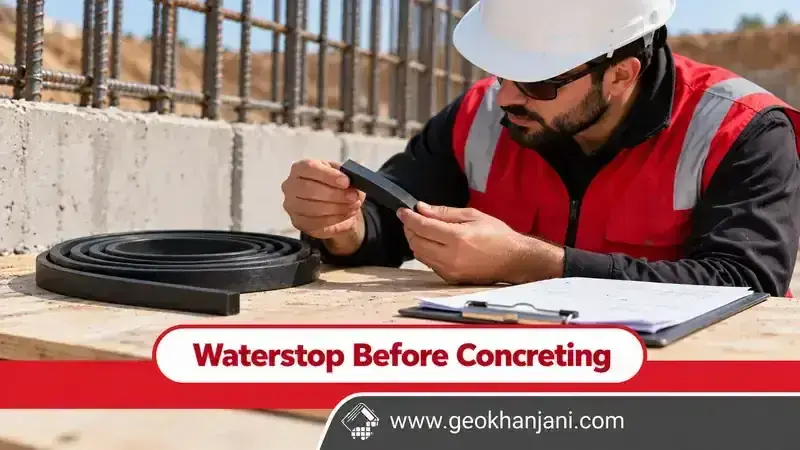 Checking Premature Swelling of a Hydrophilic Waterstop
Follow the specified response to premature swelling
Some manufacturer instructions explicitly require removal and replacement of prematurely swollen material. Others describe different material behaviour, including reversible dimensional change under particular conditions. These statements are product specific. Do not assume that drying a swollen strip restores its suitability for installation. Stop the affected work, preserve the exposure record, and obtain a documented disposition under the current product instructions and project quality procedure. If replacement is required, include the adjoining connection details in the repair plan. Concrete placement should follow completion and acceptance of that action.
Check contact, restraint, and concrete confinement
Even an unexpanded strip needs a sound installation. Check substrate cleanliness, continuous seating, approved adhesive or fixing method, and required curing before concreting. Verify the specified concrete cover and clearance through congested reinforcement. A small strip positioned near an exposed edge is not automatically adequately confined. Confirm that concrete can be placed and consolidated around it without displacing the profile. Requirements differ by product and joint geometry, so copy neither a generic cover dimension nor an adhesive cure time from an unrelated detail.
Confirm that the joint type is suitable
A construction joint and a movement joint present different demands. Do not substitute a swellable strip for a movement accommodating detail merely because both products are called waterstops. Review the expected movement and approved system. Where the design specifies a PVC waterstop, use its designated profile, anchorage, and connection method. Any transition between systems needs an approved detail. Changing the material after reinforcement is installed can also change access, cover, and concrete placement requirements.
Protect the interval before the next pour
Plan installation around the pour sequence and the adhesive requirements, then minimise unnecessary exposure. Protect unopened stock and installed lengths against water using arrangements that do not damage or contaminate the strip. Reinspect after rainfall, washdown, pumping changes, or delayed concreting. At basement interfaces, coordinate this work with the wider foundation waterproofing and drainage design. Water management can reduce exposure, but does not justify concealing damaged material or accepting a discontinuous waterstop line.
For example, imagine a wall pour postponed after a storm. The first action is to identify the exposed joint lengths and protect the remaining material. The next action is inspection against the applicable instructions, followed by any required replacement and documented reinspection. Simply moving the concrete booking does not complete this process. This is a hypothetical workflow, not a reported GeoKhanjani project or a universal repair specification.
Document a clear release or hold decision
Use an inspection record that identifies the joint, drawing revision, product batch, exposure history, observed condition, photographs, and required action. Separate three outcomes: accepted against documented requirements, held pending technical clarification, or rejected for replacement. Assign responsibility and a completion date to every open item. After corrective work, record a fresh inspection rather than overwriting the original observation. The inspection release should identify the accepted installed section and its condition immediately before concrete placement, especially when weather or scheduling has changed.
Compare purchasing options on the same scope
A lower strip price may exclude compatible adhesive, approved accessories, protected storage, or replacement allowance. Ask suppliers to identify what their quotation includes and provide the relevant technical documents. For projects also using sheet waterproofing, compare the separate geomembrane pricing and enquiry basis against the same material and installation scope. This Persian pricing page concerns geomembranes, not waterstop prices. A combined budget should keep these components distinct while recognising their interfaces, inspection needs, and sequencing constraints.
Before ordering, ask who will answer technical queries if exposure occurs, which document defines replacement, and how replacement stock will be identified. Confirm that the supplied adhesive and strip belong to a compatible system. These questions help make quotations comparable and give the site team a usable basis for decisions when the programme changes. Keep a copy of the agreed documents with the purchase record so later substitutions can be checked before site installation.
Make acceptance part of the waterproofing plan
The practical question is whether the installed system meets its documented requirements at the moment it becomes inaccessible. Early swelling is one condition to investigate alongside continuity, confinement, fixation, and concrete quality. Use the excavation waterproofing and drainage guide for the wider system context, then resolve the joint detail through the responsible designer and product documentation. For a GeoKhanjani enquiry, send the joint drawing, expected water conditions, pour sequence, and required documents so the proposed supply can be assessed against a clear specification.