A field documentation framework for geotextile damage and contamination before covering, connecting visible observations with location, disposition, repair review and area release.
- Inspect the Installed Layer, Not Just the Delivery Label
- Define the Area and the Intended Function
- Describe Damage Without Guessing Its Cause
- Treat Contamination as a Review Question
- Check Overlaps and Joints Against Their Own Requirements
- Keep the Disposition Connected to the Observation
- Review Interfaces with Adjacent Layers
- Release a Defined Area and Continue Observing the Work
- Use a Short Record That Answers the Next Reviewer's Questions
Geotextile Damage and Contamination: Inspection Before Covering
Inspect the Installed Layer, Not Just the Delivery Label
A geotextile can arrive with the correct identification and still develop a problem between deployment and covering. A small tear, disturbed overlap or local contamination may become difficult to investigate once aggregate or another layer hides the location. Inspection before covering therefore needs a clear connection to the installed area. This article proposes a practical documentation workflow for reviewing visible observations. It does not replace project specifications, determine repair dimensions or establish material suitability from photographs. Start with the specified function when reviewing geotextile materials, then check the installed condition against the approved requirements.
The scope here is deliberately different from product selection or roll receiving. The question is what to do with information gathered after the fabric is laid and before the next operation conceals it. The review should explain which area was inspected, what was observed and what remains unresolved. A clean delivery record cannot answer those questions by itself.
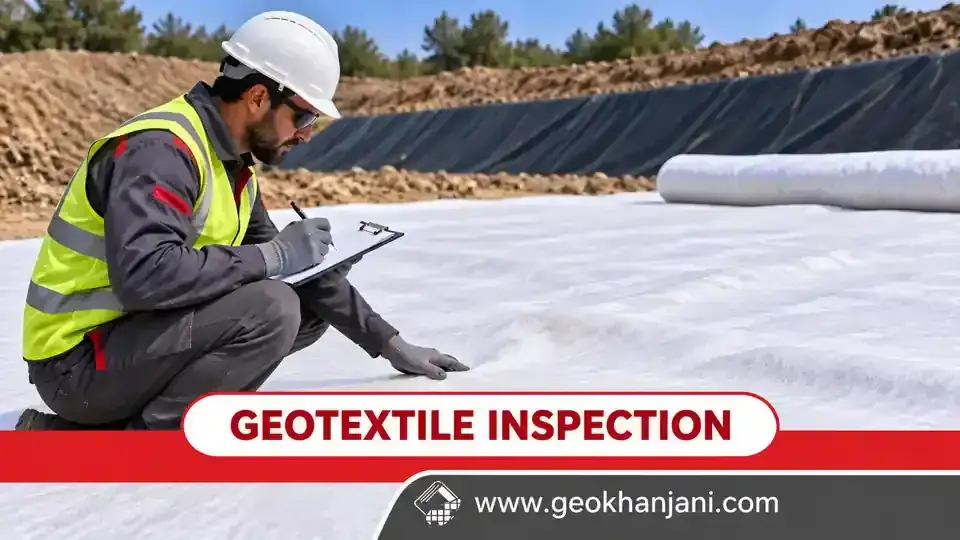
AI-generated educational illustration; not an actual GeoKhanjani project or an approved installation detail.
Define the Area and the Intended Function
Give the inspection area an identifier that matches the site layout or existing quality records. Avoid creating a separate location system that cannot be reconciled with the work. An observation beside a drain, at a panel overlap or near a working access route needs enough context to be found again. Record boundaries that remain understandable after the covering front moves.
Also identify the geotextile's specified function. A nonwoven geotextile used as a protection layer should not be assessed solely by a statement about filtration, and a separator should not be accepted because it appears thick. The inspector's task is to compare the work with the relevant documents, rather than infer the design from the fabric's appearance.
Describe Damage Without Guessing Its Cause
Describe what is visible: an opening, a cut edge, a displaced joint or a local stain. Record the extent and location using the method required by the project. A photograph can support that description, particularly when its direction and reference point are clear. It should not be the only route to locating the observation.
Avoid writing that a machine caused the damage unless the evidence supports that conclusion. Separating observation from interpretation allows the responsible reviewer to evaluate the condition without inheriting an unverified cause. Likewise, do not label every irregular appearance as a structural failure. The required response depends on the product, its function and the approved specification.
Treat Contamination as a Review Question
Visible dirt or mud should be recorded in context. A surface photograph cannot establish how contamination affects hydraulic properties, nor can an apparently clean surface prove that the material meets every performance requirement. Identify the affected area and refer the condition for the assessment required by the project. Do not improvise chemical cleaning or washing procedures without an approved basis.
If further work could conceal the observation, make its status visible to the responsible site team through the agreed procedure. This is a communication checkpoint, not a universal instruction to reject or clean every marked area. The proposed record should distinguish a newly reported condition from a condition that has received a documented technical disposition.
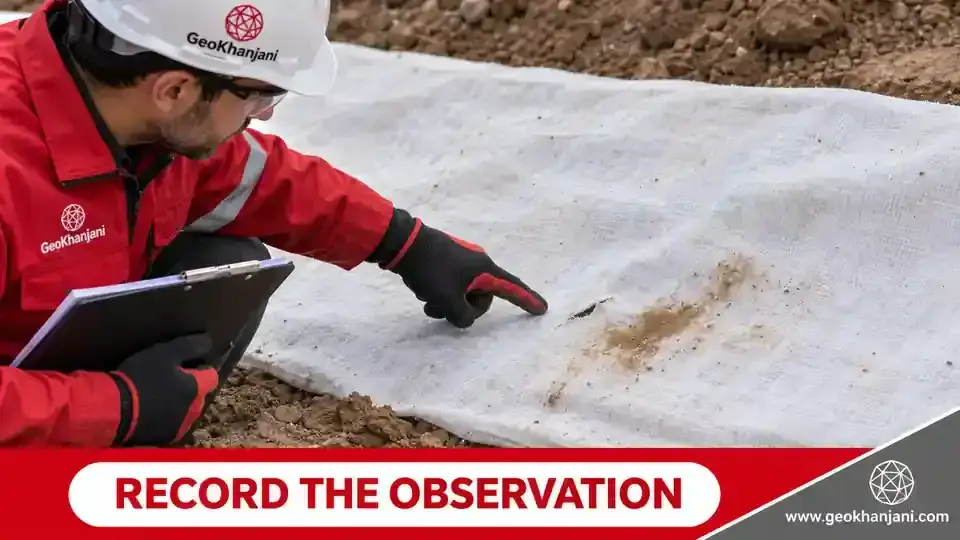
AI-generated illustration of a condition requiring review; not a recommended installation condition or a measured test result.
Check Overlaps and Joints Against Their Own Requirements
The NRCS geotextile construction specification addresses placement, joining and the response to damaged or disturbed fabric. Its detailed requirements are application-dependent. Use the project's adopted requirements rather than lifting one overlap or patch dimension from an unrelated example. The inspection record should identify the applicable reference and the condition actually checked.
For a woven geotextile, confirm the specified joining arrangement and any orientation requirements from the design documents. Do not transfer a method used for a different product merely because both materials are called geotextiles. A roll label can establish identity, but it does not establish the quality of an installed joint.
Keep the Disposition Connected to the Observation
If repair, replacement or another action is directed, retain the instruction and its link to the original location. The record should make it possible to distinguish the observed condition, the specified action and the completed work. A note saying repaired is incomplete if a later reviewer cannot identify what was repaired or which method applied.
Record the follow-up inspection required by the project procedure. Completing a patch does not automatically establish acceptance of an entire section, and accepting one observation does not close unrelated issues nearby. The NRCS inspection handbook also emphasises protecting geosynthetics through installation and covering and handling damage according to the specification. The paperwork should preserve that continuity rather than stop at the first inspection.
Review Interfaces with Adjacent Layers
Where the geotextile is part of a drainage arrangement, identify its connection with the designed geonet drainage layer or other components. The presence of one layer does not demonstrate that every interface is complete. Document which detail was reviewed and avoid extending that conclusion to areas outside the inspection boundary.
Where it protects a geomembrane lining system, keep geotextile observations separate from liner seam acceptance. An accepted protection layer does not prove watertightness. Equally, a passing geomembrane seam test does not resolve a tear or contamination question in the covering fabric. Each record should answer its own technical question.
Release a Defined Area and Continue Observing the Work
Before the next layer is placed, identify the area covered by the required review and any outstanding restrictions. A general statement that the geotextile is ready can be misunderstood if part of the site still has an unresolved observation. Use a current section list or layout so that the covering crew receives the same information as the inspection team.
Inspection before covering does not eliminate the possibility of damage during covering. The project's monitoring requirements still apply as work advances. A change in equipment, material delivery or access route may need evaluation under the approved method. Do not interpret a completed inspection form as permission for every subsequent construction operation.
Educational AI-generated image; patch appearance and dimensions are illustrative and do not constitute a repair specification.
Use a Short Record That Answers the Next Reviewer's Questions
A practical record can contain the area identifier, product reference, inspection time, observation, supporting photographs, disposition, follow-up reference and current status. This is an editorial checklist that the project team can adapt; it is not a mandatory form imposed by this article. Existing project records may already provide the same information without another document.
At handover, distinguish reported, under review, action completed and accepted according to the project's own terminology. State who follows unresolved items. If a location reference changes, preserve the link to the previous identifier. These small documentation choices help the next reviewer follow the work while keeping technical decisions with the responsible project authority.