A 20-roll example shows how to convert geotextile prices from kilograms to square metres and when core weight reverses the cheaper offer.
- Geotextile Price per Kilogram vs per Square Metre: A Roll Weight Guide
- Put the billing unit next to the product name
- Convert kilograms to square metres with one equation
- Work through a 20-roll order
- Separate the fabric, core and wrapping
- Find the break-even fabric mass
- Make the delivery record match the purchase order
- A quotation request you can copy
Geotextile Price per Kilogram vs per Square Metre: A Roll Weight Guide
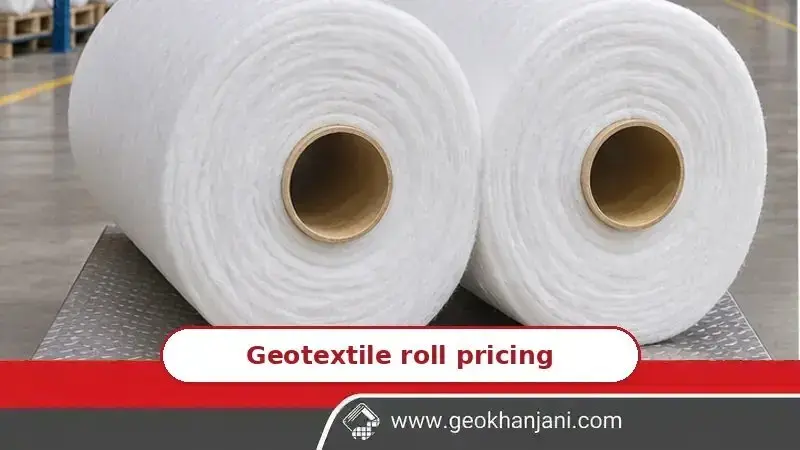
Illustrative warehouse view of nonwoven geotextile rolls.
A buyer needs 8,000 square metres of nonwoven geotextile. One supplier quotes $3.00 per kilogram and another quotes $0.92 per square metre. Which offer costs less? At a nominal mass of 300 grams per square metre, the first price converts to $0.90 per square metre. That gives the buyer a useful starting point. The invoice can still come out higher if the supplier charges for the core, bills actual kilograms, or supplies a roll size that changes the order quantity.
The example below uses illustrative prices and a single specified product grade. Its purpose is to bring the two offers onto the same commercial basis before issuing a purchase order. Start with the approved geotextile product specification. A conversion between kilograms and square metres makes prices comparable only after the proposed materials meet the same project requirements.
Put the billing unit next to the product name
A quote headed “300 GSM nonwoven” identifies a nominal mass per unit area. It does not tell the buyer whether the supplier will invoice nominal cloth area, measured net kilograms, gross shipping kilograms or a fixed sum per roll. Ask for a sentence that names the billing unit and says how the final quantity will be determined. Keep that sentence next to the quoted rate when copying prices into a comparison sheet.
For example, “$3.00 per kilogram of net fabric, based on the dispatch weight record” gives purchasing and receiving staff something they can check. “About 120 kg per roll” gives them an estimate for planning. It leaves open whether the truck scale includes a pallet, whether each roll has been weighed individually and whether the supplier intends to invoice the estimate or the measured quantity. Resolve those questions before comparing totals.
Convert kilograms to square metres with one equation
For a nominal comparison, divide the quoted grams per square metre by 1,000 to obtain kilograms per square metre. Then multiply by the price per kilogram. At 300 g/m², each nominal square metre corresponds to 0.300 kg. At $3.00/kg, the calculated fabric price is $0.90/m². In the other direction, divide $0.92/m² by 0.300 kg/m² to obtain roughly $3.07/kg. Carry the unrounded values into the order calculation and round the final monetary amounts.
Write “nominal conversion” above this column. If the order is invoiced on actual net mass, the final result depends on the kilograms delivered for the agreed area. When the supplier offers a fixed price per square metre, record the agreed basis for determining area as well. A number printed on a roll label is useful evidence, but the contract should say how to resolve a discrepancy between nominal dimensions and a delivery record.
Work through a 20-roll order
Assume each supplier offers rolls 4 metres wide and 100 metres long. Each nominal roll area is 400 m². An order of 20 rolls therefore provides 8,000 m² of manufactured fabric. In this example, the project has already allowed for cutting and overlaps when setting the purchase quantity. Using installed coverage as the denominator for one offer and manufactured roll area for the other would change the comparison.
Quotation item | Worked example |
|---|---|
Nominal area per roll | 4 m × 100 m = 400 m² |
Nominal fabric mass | 400 m² × 0.300 kg/m² = 120 kg |
Offer A, net kilograms | 120 kg × $3.00 = $360 per roll |
Offer B, roll area | 400 m² × $0.92 = $368 per roll |
On nominal figures, Offer A costs $7,200 and Offer B costs $7,360. The difference is $160 for the order, or $8 per roll. A buyer can now ask a precise question: how much additional billable mass would use up that $160 advantage? At $3.00/kg the answer is about 53.33 kg across the order, or 2.67 kg per roll. That small difference makes it worth establishing exactly what goes on the scale.
Separate the fabric, core and wrapping
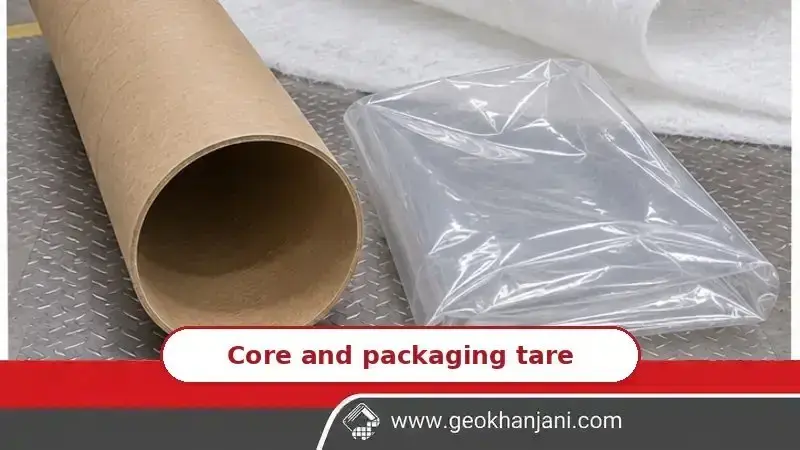
Account for the core and wrapping when reconciling gross and net weight.
Suppose the gross scale reading for one roll is 124 kg. Its core and packaging together weigh 4 kg, giving 120 kg of net fabric. Billed on net mass, that roll costs $360. Billed on gross mass at the same numerical rate, it costs $372. Across 20 identical rolls the difference is $240. The gross-billed offer would total $7,440, or $80 more than the area-based offer. These totals assume identical freight and tax treatment for both suppliers.
Ask whether the tare is measured per roll, taken from an agreed standard core or calculated for a complete pallet. Where a dispatch note gives one gross weight for several rolls, record pallet and wrapping allowances at the same level. Subtracting a pallet once in the warehouse record and again in a spreadsheet understates the billed material. If the supplier charges a fixed amount for returnable cores, show the charge and any refund conditions on their own lines.
Find the break-even fabric mass
Even when both parties agree to bill net fabric, the nominal conversion may differ from the final cost. In this example, $0.92/m² divided by $3.00/kg gives a break-even mass of about 0.3067 kg/m², or 306.7 g/m². For a 400 m² roll that is about 122.67 kg of net fabric. Above that mass, the kilogram-based offer costs more per square metre, assuming the same billable area and all other terms remain equal.
This is a purchasing threshold. Assessment of material conformity is a separate decision. ASTM D5261 describes a test for the mass per unit area of geotextiles. A receiving team that divides the shipping weight by the printed roll area has made a commercial cross-check. If the result raises a technical question, identify the roll and lot and follow the sampling and testing provisions specified for the project. A single calculation from warehouse figures cannot establish the distribution of mass within a roll. ASTM D5261 test method
Make the delivery record match the purchase order
Match the receiving sheet to the roll label before removing the packaging.
For each roll, enter its ID, product designation, nominal width and length, gross weight if supplied, agreed tare basis and billable quantity. Include the unit beside every quantity. A receiving note with “124” in a column headed only “quantity” is hard to reconcile after the wrap and core have been discarded. Keep the roll identity with any weight ticket and the relevant batch documentation. An example of procurement documentation requiring roll identification can be found in this public lagoon lining design report.
For a lined reservoir, the geotextile and the waterproofing liner may arrive on the same delivery. Give them separate invoice lines and separate quantities. The geomembrane product range and geomembrane price page concern the liner component. Applying its square-metre rate to a geotextile protection layer would make the project total difficult to audit. Keep the supplier’s product designation alongside each item; the product catalogues can help the receiving team match names to the order.
A quotation request you can copy
“Please quote 20 rolls of the specified nonwoven geotextile, nominally 4 m × 100 m per roll and 300 g/m². State the price and billing unit, the basis for determining billable area or net fabric weight, and how you treat cores, packaging and pallets. List freight, taxes and returnable charges separately. Identify the roll and lot records that will accompany delivery. If the proposed roll size differs, show the revised roll count and total supplied area.”
Attach the project material requirements and the delivery location to that request. If procurement needs a revised offer, keep the original quantity basis in the correspondence so a change in roll count is visible. Buyers can send their roll schedule and intended application through GeoKhanjani’s contact page.