Agricultural Pond Calculation from Start to Finish: Capacity, Water Demand, Excavation and Lining
83
0
Agricultural pool sizing requires more than calculating length, width and depth. This guide explains how to estimate water demand, determine effective storage capacity, account for evaporation and freeboard, plan pond dimensions, estimate excavation requirements and calculate geomembrane lining needs.
- • Agricultural pool Sizing and Calculation: A Practical Guide to Capacity, Water Demand, Excavation and Lining
- • What Does Agricultural Pond Sizing Mean?
- • Start With Water Demand, Not Pond Dimensions
- • Determine the Required Storage Period
- • Calculate Basic Irrigation Storage
- • Allow for Water Losses
- • How Evaporation Affects Pond Capacity
- • Example of an Evaporation Allowance
- • Effective Storage vs. Total Pond Volume
- • Include Sediment Storage Where Necessary
- • Choosing the Pond Depth
- • Pond Length-to-Width Ratio
- • Why Side Slopes Matter
- • Estimating Pond Footprint
- • Excavation Planning
- • Why a Topographic Survey Can Improve Accuracy
- • Cut-and-Fill Considerations
- • Choosing the Waterproofing System
- • Geomembrane Selection for Agricultural Ponds
- • Estimating Liner Requirements
- • Why Roll Width Matters
- • Welding Seams and Installation Allowances
- • Pipe Penetrations Need Special Attention
- • Freeboard and Emergency Overflow
- • Agricultural Pond Safety Considerations
- • A Practical Sizing Example
- • From Storage Target to Physical Dimensions
- • How to Reduce Unnecessary Construction Costs
- • Agricultural Pond Calculation Checklist
- • Conclusion
Agricultural pool Sizing and Calculation: A Practical Guide to Capacity, Water Demand, Excavation and Lining
An agricultural pool is more than just an excavated basin used to store water. It's a storage system that has to be sized according to irrigation demand, available water supply, site conditions and expected water losses.
Picking pond dimensions without first calculating the required storage capacity can leave you with either insufficient water during the irrigation season, or unnecessary construction costs. A reliable agricultural pond calculation should start with the amount of water that actually needs to be stored, rather than starting with a random length, width or depth.
This guide walks through a practical approach to agricultural pond sizing, covering water demand, effective storage capacity, evaporation allowance, pond dimensions, excavation considerations and waterproof lining requirements.
What Does Agricultural Pond Sizing Mean?
Agricultural pond sizing is the process of figuring out how large a storage pond needs to be for a particular agricultural application. The calculation involves more than just determining geometric volume.
A practical sizing study may consider crop water requirements, irrigated land area, irrigation frequency, available water supply, storage duration, evaporation, operational losses, freeboard, site limitations, excavation requirements and waterproofing requirements.
The goal is to create enough usable storage without making the pond unnecessarily large.
Start With Water Demand, Not Pond Dimensions
One of the most common mistakes in pond planning is choosing dimensions first and only asking about capacity later. A better approach is to start with the water requirement.
For example, say an agricultural operation needs approximately 80 cubic meters of water per irrigation cycle, and irrigation is required five times during a critical period. The theoretical water requirement would be 80 times 5, which equals 400 cubic meters.
That doesn't necessarily mean a pond with exactly 400 cubic meters of geometric volume will be enough. Additional allowances may be needed depending on the project.
Determine the Required Storage Period
The required pond capacity depends heavily on how long the stored water needs to last. A pond may be designed to store water for several days, bridge gaps between irrigation deliveries, collect seasonal runoff, hold water during periods of high availability, or provide backup storage during supply interruptions.
For example, if water is available every three days, the pond may only need to bridge a short supply gap. If water is available only once every few weeks, significantly more storage will likely be needed. Storage duration is therefore one of the most important variables in agricultural pond sizing.
Calculate Basic Irrigation Storage
A simple preliminary equation looks like this: required storage equals water demand per cycle multiplied by the number of cycles.
Suppose water demand per cycle is 120 cubic meters, and 4 cycles are required. That gives 120 times 4, or 480 cubic meters. The preliminary storage requirement is therefore 480 cubic meters.
At this stage, the value represents only the basic irrigation requirement. It doesn't yet account for evaporation, operational losses or freeboard.
Allow for Water Losses
Stored water can be lost before it ever reaches the field. Depending on the project, losses may include evaporation, conveyance losses, operational losses, minor leakage, overflow and sedimentation-related reduction in useful volume.
How significant each loss is depends on the location and pond design. In hot, dry climates, evaporation in particular can become a major factor. For this reason, design storage shouldn't automatically be set equal to calculated irrigation demand.
How Evaporation Affects Pond Capacity
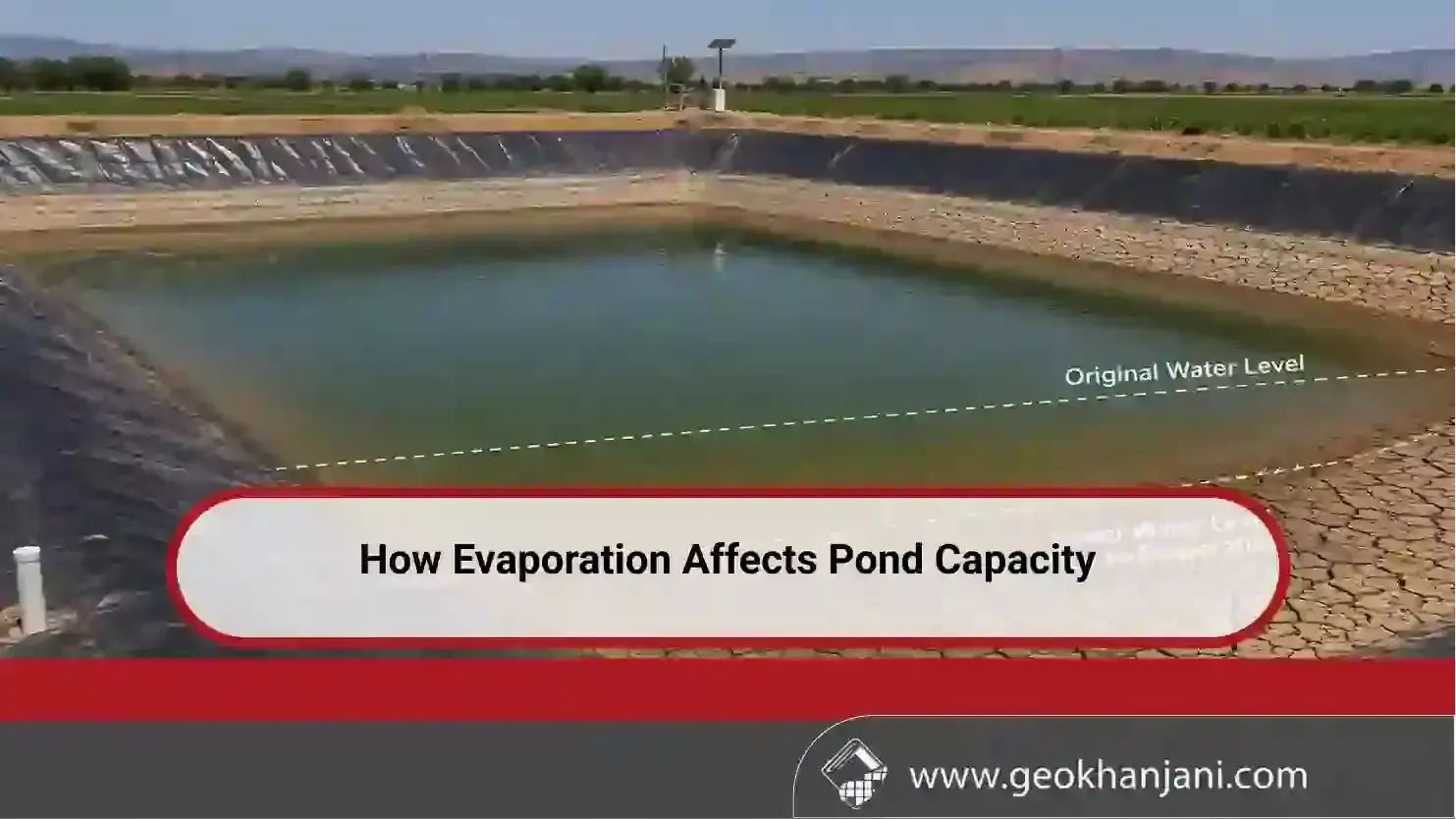
Evaporation is influenced by air temperature, wind speed, humidity, solar radiation, water surface area and seasonal conditions.
A larger water surface generally means a larger area from which evaporation can occur, which creates an important design consideration: increasing pond surface area may increase evaporation losses. So maximizing surface area isn't always the best strategy.
A deeper configuration can sometimes provide the required volume with a smaller exposed water surface, provided the site and engineering conditions allow for it.
 How Evaporation Affects Pond Capacity
Example of an Evaporation Allowance
Suppose a pond needs 500 cubic meters of useful irrigation storage. If preliminary planning assumes an additional 8 percent allowance for expected water losses, the extra volume would be 500 times 0.08, or 40 cubic meters. The adjusted target becomes 500 plus 40, or 540 cubic meters.
This is just a simplified planning example — actual evaporation and loss allowances should be based on local climate data and project conditions.
Effective Storage vs. Total Pond Volume
One of the most important concepts in pond sizing is the difference between effective storage and total geometric capacity.
Effective storage is the amount of water that can actually be used for the intended purpose. Total geometric volume is the theoretical volume contained within the designed pond geometry.
These two figures can differ because of freeboard, sediment storage, minimum operating level, a sloping bottom, pump intake requirements and dead storage. Designing a pond with a geometric volume exactly equal to the required irrigation demand can therefore leave you short of usable water.
Include Sediment Storage Where Necessary
Agricultural ponds may take in soil particles and organic material through runoff. Over time, sediment buildup can eat into available storage capacity.
If a pond is expected to receive significant sediment, the design should include an allowance for sediment storage. How much depends on catchment characteristics, soil erosion, runoff intensity, vegetation and maintenance frequency.
A pond that's properly sized on day one can gradually lose useful capacity if sediment isn't accounted for.
Choosing the Pond Depth
Pond depth affects several aspects of the project. Increasing depth can add storage without requiring a proportional increase in surface area.
That said, deeper excavation also affects earthwork quantities, side slope requirements, excavation equipment, groundwater conditions, liner installation and stability. So the deepest possible pond isn't automatically the best solution — depth should be chosen as part of the overall site and engineering design.
Pond Length-to-Width Ratio
The length-to-width ratio influences both construction and water surface area. A very narrow, elongated pond can create a large perimeter relative to its storage volume, while a more compact shape can sometimes reduce how much boundary area needs to be excavated and lined.
Of course, available land may dictate the shape regardless. A long agricultural plot, for instance, may make an elongated pond more practical than a square one. The best geometry is the one that meets storage requirements while fitting the site efficiently.
Why Side Slopes Matter
Agricultural ponds are often built with sloped sides rather than vertical walls. Side slopes influence excavation volume, top and bottom dimensions, lining area, access, stability and overall construction requirements.
As the side slope widens, the pond's footprint grows — meaning the slope choice affects both land use and how much lining material is needed.
Estimating Pond Footprint
Say the desired water storage calls for a pond with an approximate bottom area of 300 square meters. Once side slopes extend outward around the perimeter, the total land footprint will end up larger than 300 square meters. That's why land requirements shouldn't be estimated from bottom dimensions alone.
Extra space may also be needed for equipment access, maintenance, drainage, pipe installation, safety clearance and material handling.
Excavation Planning
Excavation is often the largest single component of agricultural pond construction. How much soil gets removed depends on pond depth, bottom dimensions, side slopes, existing ground elevation, terrain, required freeboard and access for machinery.
For preliminary planning, the pond can be divided into geometric sections. For more accurate quantities, a topographic survey combined with cross-sectional calculations is preferable.
Why a Topographic Survey Can Improve Accuracy
A site can look flat and still hide significant elevation differences. A topographic survey can reveal high points, low points, natural drainage, existing slopes, cut-and-fill requirements and the most suitable pond location. This kind of information can prevent unexpected excavation costs once construction begins.
Cut-and-Fill Considerations
Not every project requires all excavated soil to be hauled off-site. Depending on the terrain, excavated material may be reused for embankments, access roads, site leveling, protective berms or other earthworks. Whether reuse is feasible depends on soil type and project requirements, but a good cut-and-fill strategy can meaningfully improve overall site efficiency.
Choosing the Waterproofing System
Water stored in an agricultural pond can gradually seep into the surrounding soil if the basin is highly permeable. A waterproof lining system can significantly cut down this loss.
One common solution is a geomembrane liner — flexible polymeric sheets designed to provide a low-permeability barrier. They can be used for a range of water containment applications when properly selected and installed.
Geomembrane Selection for Agricultural Ponds
Choosing a geomembrane involves more than comparing price per square meter. Important considerations include polymer type, thickness, mechanical properties, UV exposure, chemical compatibility, installation conditions, the expected service environment and subgrade characteristics. The right specification really depends on the project.
Estimating Liner Requirements
The amount of geomembrane needed depends on the total surface that has to be covered — bottom, side slopes, connection details and installation allowance.
For example, if the bottom requires 350 square meters and the side slopes require another 260 square meters, that's 350 plus 260, or roughly 610 square meters of geometric lining area. The final quantity ordered will typically be higher once the actual sheets are arranged and welded together.
Why Roll Width Matters
Geomembrane is commonly supplied in rolls, and roll width can influence how panels are arranged. Say a pond has a surface that's 20 meters wide — if a roll configuration can cover a large portion of that width efficiently, fewer cuts and seams will be needed. An unsuitable panel arrangement, on the other hand, can create extra waste.
Liner quantity should really be calculated from the actual panel layout, not just by multiplying pond dimensions.
Welding Seams and Installation Allowances
Geomembrane sheets are generally joined using specialized thermal welding methods. The installation design should account for seam arrangement, panel orientation, welding access, overlap requirements, penetrations and anchoring details. The final material quantity should reflect these practical installation needs.
Pipe Penetrations Need Special Attention
Agricultural ponds often contain pipes for water inlet, water outlet, irrigation supply, drainage and overflow. Wherever a pipe passes through the liner, the waterproofing system needs a properly detailed connection.
These locations should be planned into the liner layout before installation begins — adding penetrations after the main lining work is done tends to increase complexity and the risk of installation errors.
Freeboard and Emergency Overflow
A pond needs a controlled water level, and the design should account for freeboard above the normal operating level. Depending on the pond's configuration and water sources, an overflow or emergency discharge arrangement may also be needed — this becomes especially important where the pond takes in runoff or rainfall in addition to controlled water inflow.
Agricultural Pond Safety Considerations
Water storage ponds should also be looked at from a safety angle. The design should account for stable side slopes, safe access, controlled overflow, secure pipe connections, maintenance access, and appropriate warning or protective measures where necessary. Exact requirements depend on local regulations and site conditions.
A Practical Sizing Example
Consider an agricultural operation with these preliminary requirements: an irrigation demand of 100 cubic meters per cycle, 5 required storage cycles, and an estimated additional allowance of 10 percent.
Basic storage comes out to 100 times 5, or 500 cubic meters. The additional allowance is 500 times 0.10, or 50 cubic meters. Adding those together gives a preliminary target of about 550 cubic meters.
The final pond geometry would then be developed to deliver that effective storage while also accommodating freeboard and site constraints.
From Storage Target to Physical Dimensions
Once the target capacity is set, several possible pond geometries can be compared. A design team might weigh a shallow, wide option against a moderately deep, compact one, or a long, narrow one. Each could offer roughly the same storage capacity but differ in excavation quantities, water surface area, liner requirements, land footprint and construction cost. Comparing these options can help identify the more efficient configuration.
How to Reduce Unnecessary Construction Costs
Cost optimization should focus on the pond as a whole rather than any single material. Useful strategies include selecting a suitable location, minimizing unnecessary excavation, using efficient dimensions, reducing liner cutting waste, planning pipe locations in advance, preparing the subgrade properly, choosing suitable lining specifications, and coordinating earthwork with liner installation.
The cheapest individual component doesn't necessarily add up to the lowest total project cost.
Agricultural Pond Calculation Checklist
Before finalizing the design, it's worth checking a few things.
On water requirements: is irrigation demand known, is storage duration defined, and have expected losses been considered?
On capacity: is effective storage established, is freeboard included, and has a sediment allowance been considered where necessary?
On site conditions: has topography been reviewed, are soil conditions understood, and is equipment access available?
On geometry: are length and width defined, is depth appropriate, and are side slopes established?
On excavation: are approximate earthwork quantities known, and have cut-and-fill opportunities been considered?
On waterproofing: has a suitable liner system been selected, are bottom and sidewall areas included, has the panel layout been reviewed, and are pipe penetrations detailed?
Conclusion
Effective agricultural pond sizing starts with the water requirement, not with an arbitrary set of dimensions. The required storage should be established based on irrigation demand and storage duration, then adjusted with allowances for relevant losses and operational needs. That target capacity can then be translated into physical dimensions that suit the site.
Depth, length, width and side slopes shape not just water capacity but also excavation quantities, land use and lining requirements. For lined ponds, total surface area and a practical geomembrane panel layout should be worked out before ordering materials.
A successful agricultural pond ultimately comes down to coordinating water demand, storage capacity, site conditions, earthwork and waterproofing. Weighing these factors together makes it possible to build a pond that provides the water storage you need while avoiding unnecessary excavation, excess material waste and inefficient use of land.