Ultimate tensile strength alone is not enough to select a geogrid. This guide explains which creep, installation damage, durability, and traceability documents to review before ordering.
- • Geogrid Long-Term Design Strength: Documents to Check Before Ordering
- • Identify what the quoted strength represents
- • Request product-specific creep evidence
- • Relate installation damage evidence to construction
- • Check durability against the actual environment
- • Keep manufacturing labels separate from acceptance
- • Build a comparison register before negotiating
- • Make clarification requests specific
- • Connect approved documents to delivered rolls
- • Assign decisions and close information gaps
Geogrid Long-Term Design Strength: Documents to Check Before Ordering
Choosing reinforcement for a retaining wall or reinforced slope requires more than comparing the largest tensile strength printed on a quotation. The purchasing team needs evidence that connects the proposed product to the design assumptions, construction conditions, and delivered rolls. A clear document review helps the designer assess suitability and helps procurement avoid comparing products on incompatible terms.
Start with the intended structural function. The geogrid product range includes different constructions and applications, so a shared product name does not establish equivalent performance. This guide explains how to organise the information needed before an order is accepted.
Identify what the quoted strength represents
Ask whether the stated value is ultimate tensile strength, a characteristic value, a minimum average roll value, or a design value. Record the test method, units, loading direction, and statistical basis. These descriptions are not interchangeable. Two numbers that look identical can describe different acceptance criteria.
Long-term design strength addresses sustained loading and relevant reductions under the adopted design method. Ultimate strength alone does not establish that value. Ask the designer which method governs the project and which factors must be included. A supplier table prepared for another methodology should not be transferred into the calculation without checking its definitions and assumptions.
Request product-specific creep evidence
Creep describes increasing deformation under sustained force. Polymer response depends on loading, time, temperature, and material structure. Consequently, a brief tensile test cannot explain every aspect of performance during a long service period. The evaluation must address the intended design life and reference conditions.
When reviewing polyester geogrid, request the relevant creep or creep rupture assessment and its product identification. A general statement that polyester has favourable creep behaviour does not establish a design value for every product. Confirm who issued the assessment, which product family it covers, and whether its assumptions match the proposed application.
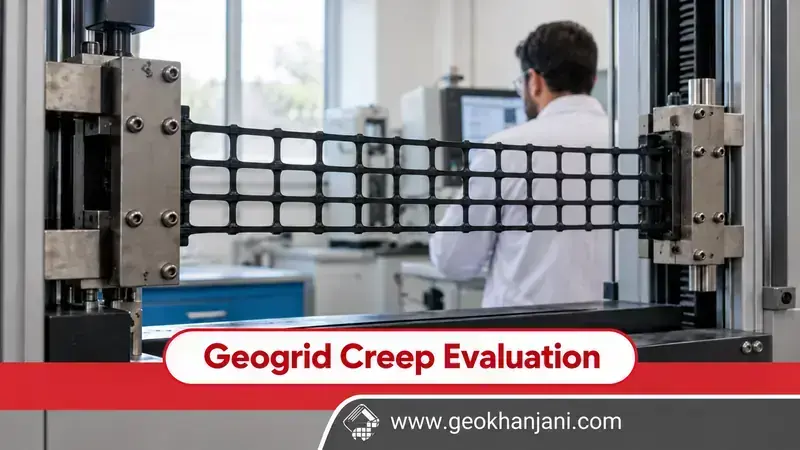 Geogrid Creep Evaluation
Relate installation damage evidence to construction
Backfill placement and compaction can reduce reinforcement strength. Relevant evidence therefore describes the tested product, aggregate characteristics, cover conditions, and construction procedure. A reduction factor without its supporting conditions provides an incomplete basis for comparison.
Use the separate geogrid installation damage inspection guide when planning field checks. Document review and site inspection answer different questions: one examines the evidence behind design assumptions, while the other records what happened during construction. Neither should be treated as a substitute for the other. Ask the designer how departures from the assessed installation conditions will be handled before filling begins.
Check durability against the actual environment
Durability assessment should reflect the polymer, exposure conditions, temperature, and relevant soil chemistry. Different polymers can require different degradation mechanisms to be considered. A statement about service life needs a defined product and a stated assessment basis.
For connective geogrids, ask the supplier to identify the polymer and construction behind the commercial description. Establish which durability documents apply to that exact option. If environmental information is missing, record the gap and obtain the required project data. Do not replace unavailable information with assumptions copied from a different manufacturer's brochure.
Keep manufacturing labels separate from acceptance
Terms describing manufacturing methods help identify a product, but they do not independently demonstrate suitability for a reinforced soil structure. Acceptance requires the properties and evidence specified for the intended function. Product geometry and appearance cannot provide the missing design assessment.
If injection geogrid is proposed, request the exact product designation and supporting technical documentation. Check its intended application before comparing it with another reinforcement. Products offered for different functions should not be ranked solely by nominal tensile strength or price. Ask for clarification whenever a quotation uses a broad family name instead of an identifiable grade.
Build a comparison register before negotiating
Create one row for each proposed product. Include the manufacturer, product code, polymer, principal loading direction, strength definition, test method, and units. Add separate fields for creep evidence, installation damage assessment, durability documentation, and the design conditions supplied to the seller.
Mark missing information as pending rather than inserting a value from a similar product. Record document dates and revision numbers so the reviewer can identify the evidence supporting each proposal. When a revised document arrives, retain the superseded version and clearly identify the current reference. This simple practice prevents a purchasing decision from relying on an outdated attachment.
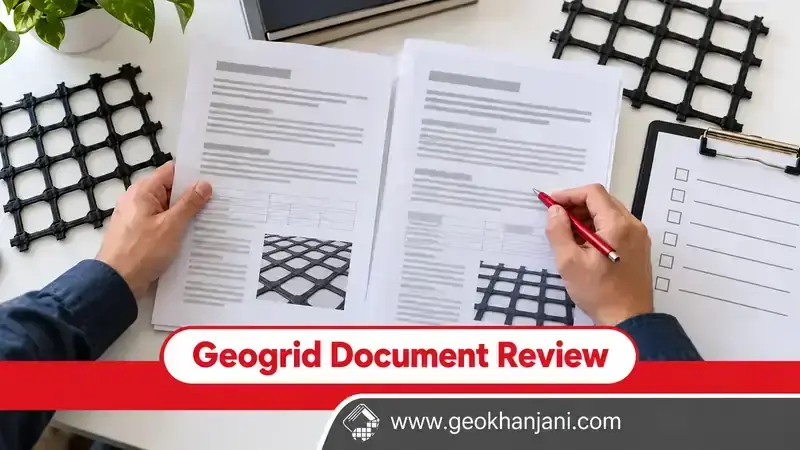 Geogrid Document Review
Make clarification requests specific
Send questions that can be answered with a document reference. Instead of asking whether a grid is strong enough, ask which report supports the proposed design value and where the relevant product code appears. Instead of asking for a quality certificate, identify the acceptance information required by the purchase specification.
Keep commercial and technical clarifications connected through the same quotation reference. If the seller changes the grade, manufacturing source, or product construction during negotiation, reopen the technical review before confirming the order. A lower price for a substituted product does not automatically preserve the original approval. Record the change, obtain the supporting information, and ask the responsible reviewer to confirm whether the revised offer remains acceptable for this project application.
Connect approved documents to delivered rolls
Before ordering, agree how the delivered material will be identified. The purchase order should reference the approved product designation and the documents used for acceptance. Confirm what labels, batch references, and delivery records will be available rather than assuming every supplier provides the same paperwork.
At delivery, compare the labels and quantities with the order and inspect visible packaging damage. Photograph identification details before rolls are moved into storage. Keep uncertain material identifiable while clarification is obtained. A matching label supports traceability, but it does not replace the specified acceptance process or prove compliance with every engineering requirement.
Assign decisions and close information gaps
A useful review ends with a clear decision record. List outstanding questions, the person responsible for answering each one, and the evidence required to close it. Procurement can organise the information and check completeness; the responsible designer should evaluate technical suitability under the project requirements.
For example, two offers may show similar ultimate strengths while only one includes identifiable supporting assessments. The immediate task is to resolve the evidence gap, not to declare either option technically equivalent. Once the documents are complete, compare the accepted alternatives commercially. This sequence makes the buying decision easier to explain and preserves a reliable record for construction and later enquiries.