Geomembrane Thickness Reports: Nominal, Average and Core Thickness Explained
120
0
Understand nominal, average and textured core thickness before comparing geomembrane reports. Check the method edition, individual results and roll identification against the project specification.
- • Begin with the specified product and surface
- • Separate nominal thickness from reported measurements
- • Understand what textured core thickness describes
- • Check the method edition and procedure
- • Review the full result set before comparing suppliers
- • Use a comparison register that preserves context
- • Investigate discrepancies without losing traceability
- • Connect technical acceptance with the quotation
A geomembrane quotation may describe a liner as 1.5 mm thick, while its laboratory report lists several measurements and an average. Another supplier may quote a textured sheet using the same nominal thickness. These documents can look comparable without describing exactly the same measurement. Before accepting a delivery, buyers need to understand what was measured, how it was measured, and which acceptance requirements apply.
This guide explains how to review thickness documentation without turning a catalogue number into an unsupported quality claim. Start with the approved specification, then compare the product identification, test procedure, results and acceptance decision. Thickness is one part of geomembrane quality; it does not independently establish chemical compatibility, installation quality or service life.
Begin with the specified product and surface
Identify the polymer family, surface configuration and product designation before opening the results table. The requirements for smooth HDPE should not automatically be applied to textured LLDPE, reinforced materials or composite products. Reviewing the available geomembrane types helps establish the product family, but acceptance must refer to the actual material ordered.
Ask whether the report covers a production roll, a submitted sample or a broader product range. Record the roll number and laboratory sample reference together. If the supplier replaces the approved product, request the corresponding documents before comparing measurements. Similar names and matching colours do not establish that two reports describe equivalent materials.
Separate nominal thickness from reported measurements
Nominal thickness identifies the specified product designation. An average is calculated from a defined set of measurements. Individual results describe the specimens or positions tested. These quantities answer different questions and should remain separate during review.
For an HDPE geomembrane, the applicable specification may include both average and individual requirements. A satisfactory average therefore does not automatically resolve every individual result. Equally, a reading below the nominal designation should be assessed against the agreed acceptance rules rather than treated as an automatic rejection. Obtain the complete criteria before deciding whether a reported variation is permitted.
Understand what textured core thickness describes
Surface projections make textured material more complicated to measure than a smooth sheet. Core thickness and surface texture are different characteristics. A measurement that includes projections is not automatically interchangeable with a core measurement taken using a prescribed procedure.
When reviewing a textured geomembrane, ask the laboratory to identify the measured characteristic clearly. Do not add an asperity value to a core result and present the sum as an equivalent smooth sheet thickness. Texture geometry also does not independently establish interface shear performance. Where slope stability depends on interface resistance, the designer needs appropriate interface evidence for the materials and conditions involved.
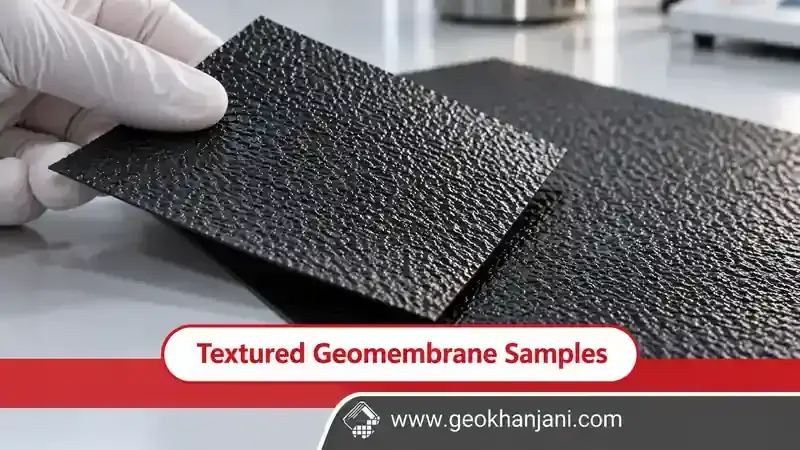 Textured Geomembrane Samples
Check the method edition and procedure
A standard number without its edition can leave an important gap. ASTM D5994/D5994M-26 covers smooth geomembrane thickness and textured geomembrane core thickness through different procedures. Its public description explains that the smooth procedure corresponds to the approach previously used in D5199 before 2025.
This does not mean every existing contract should be silently rewritten. Identify the edition required by the project and the procedure actually used by the laboratory. If they differ, obtain a documented technical decision. Gauge geometry and applied force matter because the measurement depends on the prescribed contact conditions. An ordinary handheld reading is not automatically equivalent to a laboratory result obtained under controlled conditions.
Review the full result set before comparing suppliers
Request the reported individual values, the calculated summary, the specimen count and the unit system. Ask which acceptance limit applies to each reported quantity. A certificate showing only one favourable number may not provide enough information for the comparison requested.
For an LLDPE geomembrane, use the relevant material specification rather than borrowing HDPE requirements simply because the nominal thickness matches. Manufacturing specifications and project requirements also serve different purposes. If the project imposes additional limits or independent conformance testing, include those requirements in the purchase documents and communicate them to the supplier before production or shipment.
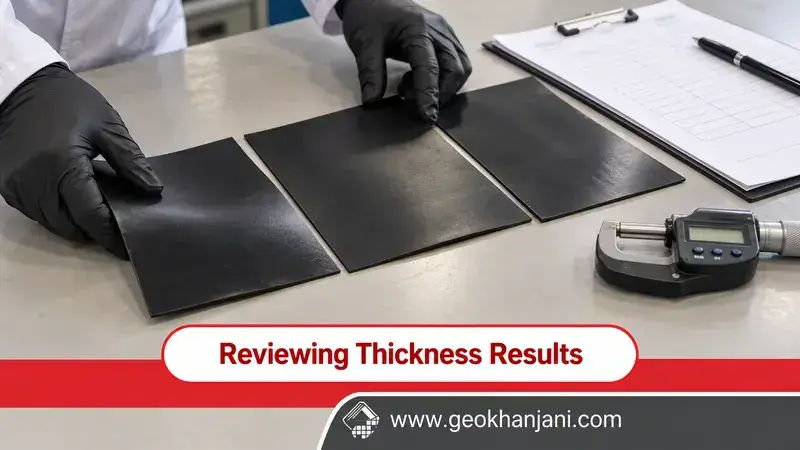 Reviewing Geomembrane Thickness Results
Use a comparison register that preserves context
Build one row for each offered product. Include the nominal designation, polymer, surface, roll reference, method edition, procedure, average, relevant individual results and acceptance basis. Add a final column for missing information. This is a practical purchasing tool, not a replacement for the laboratory report.
Consider a hypothetical enquiry involving two liners with the same nominal designation. One submission contains a traceable report; the other contains only a catalogue table. The immediate action is to request comparable evidence, not to declare one manufacturer superior. A broader discussion of domestic and imported geomembrane quality explains why origin alone is an unreliable shortcut.
Investigate discrepancies without losing traceability
If readings appear inconsistent, preserve the original report and identify the question precisely. Possible questions include an unclear measurement description, missing roll identification, mixed units or an unexplained calculation. Record the response and any revised document under a controlled version.
Where further testing is necessary, agree who selects the sample, how it is identified, which laboratory performs the work and how results will be evaluated. Avoid replacing a questioned result with an untraceable measurement from another roll. The decision should remain connected to the material being supplied. Refer unresolved acceptance questions to the responsible project engineer before installation consumes the evidence needed for investigation.
Connect technical acceptance with the quotation
State the required documents and review responsibilities when requesting prices. GeoKhanjani’s Persian geomembrane price and enquiry page is a commercial starting point; confirm the product, thickness basis, delivery terms and testing scope for the actual order. A price comparison becomes more useful when each offer includes the same documentation obligations.
A useful enquiry attachment is a blank document schedule completed by both parties. List the required report, the party providing it, the delivery stage and the person reviewing it. Mark unavailable information explicitly instead of leaving empty cells. This simple written arrangement helps distinguish an outstanding document from an accepted deviation, and gives the receiving team a consistent record when the shipment arrives at the project site for inspection and storage.
Before releasing the order, confirm that every decision can be traced from the specification to the offered product and its supporting report. Keep thickness acceptance alongside the other required material and installation checks. Clear documentation gives purchasing teams a defensible comparison and helps site staff receive the product that was actually approved.