The Complete Guide to Geomembrane Welding: Hot Wedge & Extrusion Methods, Equipment, and Quality Control
101
0
This guide explains the two most widely used geomembrane welding methods—Hot Wedge Welding and Extrusion Welding—along with the equipment required, key installation parameters, and the quality control procedures that ensure reliable, long-lasting seams.
- • Introduction
- • Why Proper Geomembrane Welding Matters
- • Hot Wedge Welding
- • Hot Wedge Welding Procedure
- • Advantages of Hot Wedge Welding
- • Limitations of Hot Wedge Welding
- • Extrusion Welding
- • Extrusion Welding Procedure
- • Advantages of Extrusion Welding
- • Limitations of Extrusion Welding
- • Equipment Required for Geomembrane Welding
- • Quality Control and Quality Assurance
- • Common Welding Mistakes
- • Best Practices for Successful Geomembrane Welding
- • Conclusion
Introduction
Geomembranes play a critical role in modern containment systems, providing an impermeable barrier for applications ranging from mining and landfill engineering to water reservoirs, wastewater treatment facilities, agriculture, and industrial projects. While selecting a high-quality geomembrane is essential, the long-term performance of the entire lining system ultimately depends on the quality of its welded seams.
Even the highest-grade HDPE geomembrane can fail if the seams are improperly welded. Defective welds may lead to leakage, environmental contamination, costly repairs, and premature failure of the containment system. For this reason, professional installation, proper welding techniques, and comprehensive quality assurance procedures are just as important as choosing the right geomembrane material.
This guide explains the two most widely used geomembrane welding methods—Hot Wedge Welding and Extrusion Welding—along with the equipment required, key installation parameters, and the quality control procedures that ensure reliable, long-lasting seams.
Why Proper Geomembrane Welding Matters
Geomembrane sheets are manufactured in standard roll widths, making field seaming necessary to create a continuous waterproof barrier. These seams must perform as effectively as the geomembrane itself, maintaining both mechanical strength and impermeability throughout the service life of the project.
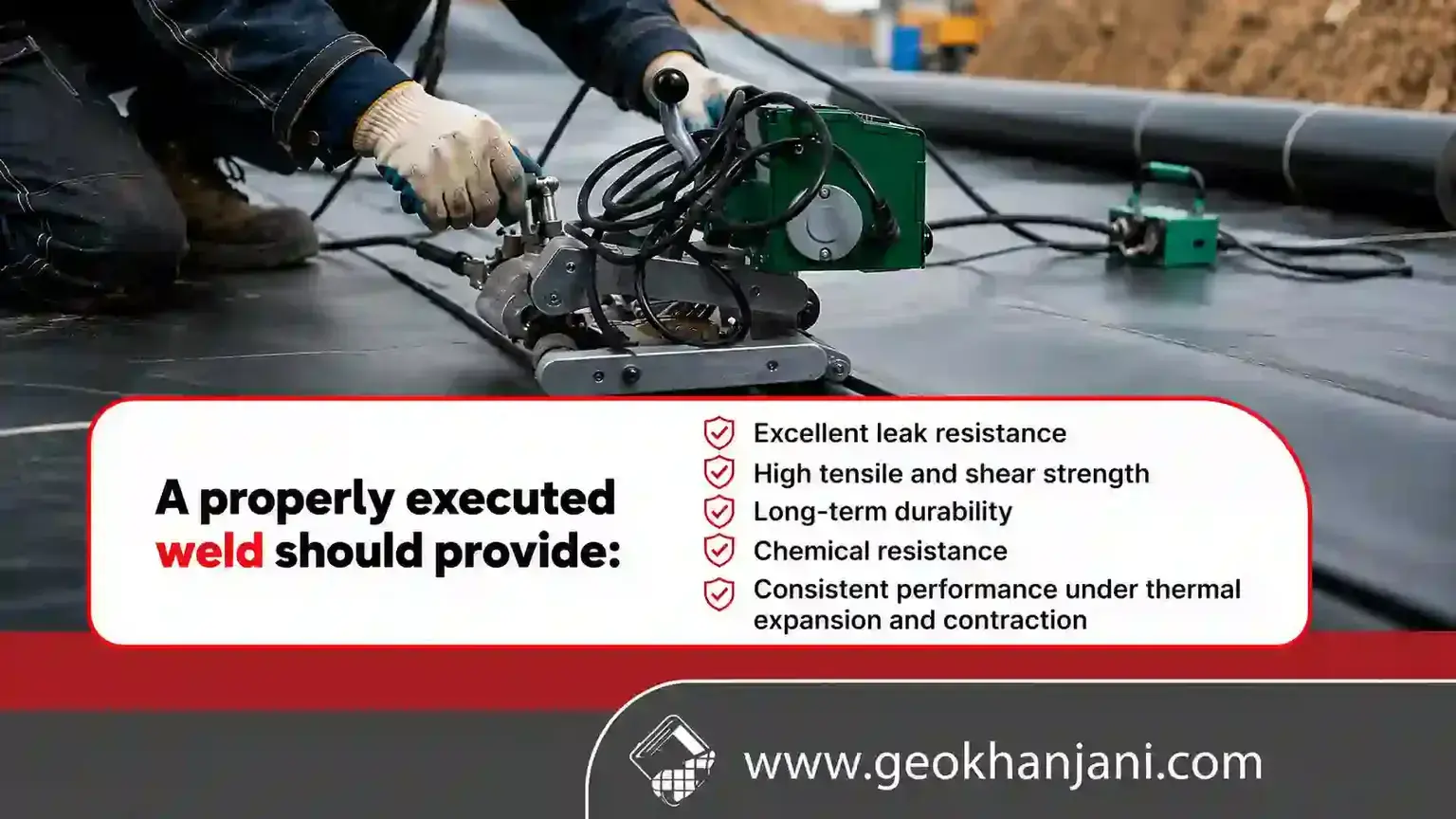 A properly executed weld should provide
A properly executed weld should provide:
- Excellent leak resistance
- High tensile and shear strength
- Long-term durability
- Chemical resistance
- Consistent performance under thermal expansion and contraction
To achieve these objectives, geomembrane welding is typically performed according to internationally recognized standards such as ASTM and GRI guidelines.
Hot Wedge Welding
Hot Wedge Welding, also known as dual-track wedge welding, is the industry standard for joining HDPE geomembranes on large-scale projects.
In this process, a heated metal wedge passes between two overlapping geomembrane sheets. As the material softens, pressure rollers immediately compress both layers together, creating a molecular bond. The result is a strong, uniform seam with two parallel weld tracks separated by an air channel used for pressure testing.
Hot Wedge Welding Procedure
The typical installation process includes:
- Cleaning and preparing the geomembrane surfaces.
- Overlapping the sheets, usually by 100–150 mm.
- Setting the appropriate welding temperature.
- Adjusting travel speed.
- Calibrating roller pressure.
- Performing the weld.
- Conducting an initial visual inspection.
The correct combination of temperature, speed, and pressure varies depending on the geomembrane thickness, ambient temperature, wind conditions, and material type.
Advantages of Hot Wedge Welding
Hot Wedge Welding has become the preferred method for field installation because it offers several significant advantages:
- High installation speed
- Consistent seam quality
- Excellent mechanical strength
- Reliable waterproof performance
- Air-channel testing capability
- Reduced dependence on operator technique
For large ponds, landfills, mining facilities, and reservoirs, this method delivers the highest productivity while maintaining strict quality standards.
Limitations of Hot Wedge Welding
Although highly efficient, Hot Wedge Welding is not suitable for every situation. It is generally unsuitable for:
- Tight corners
- Pipe penetrations
- Complex geometries
- Small repair areas
- Locations with limited equipment access
In these cases, extrusion welding becomes the preferred solution.
Extrusion Welding
Extrusion Welding is primarily used for repairs, detail work, and areas where wedge welding equipment cannot operate effectively.
Instead of directly fusing two sheets together, an extrusion welder melts HDPE welding rod or pellets and deposits molten material onto the prepared joint. Simultaneously, hot air softens the geomembrane surfaces, allowing the extruded material to bond securely with the liner.
This process creates a robust connection that is ideal for complicated installations and repair work.
Extrusion Welding Procedure
A successful extrusion weld generally involves the following steps:
- Cleaning the welding area thoroughly
- Grinding the geomembrane surface to remove oxidation
- Preheating the joint with hot air
- Applying molten HDPE using the extrusion welder
- Forming a smooth and continuous weld bead
- Allowing the weld to cool naturally
Proper surface preparation is essential. Failure to remove the oxidized surface layer can significantly reduce bond strength.
Advantages of Extrusion Welding
Extrusion welding offers several important benefits:
- Excellent for repair work
- Ideal for pipe boots and penetrations
- Suitable for complex details and corners
- Effective for patch installation
- Allows field modifications during construction
Because of its flexibility, extrusion welding is commonly used alongside Hot Wedge Welding rather than replacing it.
Limitations of Extrusion Welding
Compared with Hot Wedge Welding, extrusion welding has a few disadvantages:
- Slower installation speed
- Greater dependence on operator skill
- No air-channel pressure testing
- More demanding surface preparation
As a result, it is generally reserved for detail work instead of long production seams.
Hot Wedge vs. Extrusion Welding
Although both methods create permanent geomembrane seams, they serve different purposes.
Hot Wedge Welding is best suited for long, straight field seams where speed and consistency are priorities. Extrusion Welding, on the other hand, is designed for repairs, transitions, fittings, corners, and difficult-to-access areas.
Professional geomembrane installations often use both techniques to achieve complete system integrity.
Equipment Required for Geomembrane Welding
Successful geomembrane welding requires specialized equipment designed specifically for thermoplastic liners.
Essential equipment includes:
Hot Wedge Welding Machine
This automatic machine controls welding temperature, travel speed, and roller pressure to produce consistent field seams.
Extrusion Welder
Used for repairs, pipe connections, patching, and detailed fabrication work.
Air Compressor
Provides compressed air for pressure testing and certain welding operations.
Air Pressure Testing Kit
Used to verify the integrity of dual-track Hot Wedge welds by pressurizing the air channel.
Surface Preparation Tools
These typically include grinders, scrapers, wire brushes, lint-free cloths, and approved cleaning agents.
Inspection Instruments
Quality control technicians often use infrared thermometers, pressure gauges, thickness gauges, and calibration equipment to monitor installation conditions throughout the project.
Factors Affecting Weld Quality
Several variables influence the quality of a geomembrane seam.
Ambient Temperature
Extreme temperatures can affect polymer flow and cooling characteristics, making parameter adjustments necessary.
Surface Cleanliness
Dust, moisture, oil, or debris can interfere with molecular bonding and significantly weaken the weld.
Welding Speed
Excessive travel speed may prevent proper melting, while very slow speeds can overheat the material.
Roller Pressure
Insufficient pressure results in poor fusion, whereas excessive pressure may force molten material out of the seam.
Welding Temperature
Maintaining the correct temperature is critical. Underheating produces weak welds, while overheating may damage the geomembrane.
Quality Control and Quality Assurance
Quality Assurance (QA) and Quality Control (QC) are fundamental components of every geomembrane installation project.
Testing procedures generally fall into two categories:
Non-Destructive Testing (NDT)
Destructive Testing (DT)
Both methods are essential to confirm seam integrity before a containment system is placed into service.
Non-Destructive Testing
Air Pressure Test
The Air Pressure Test is the most common inspection method for dual-track Hot Wedge seams.
Compressed air is introduced into the channel between the two welds and held at a specified pressure for a defined period. A stable pressure reading confirms the seam is free from leaks.
Vacuum Box Test
Vacuum testing is commonly used where air-channel testing is not possible, such as extrusion welds or repair patches.
A soap solution is applied over the weld before placing a vacuum chamber on the surface. The appearance of bubbles indicates leakage that requires repair.
Visual Inspection
Every seam should undergo careful visual examination to identify:
- Surface defects
- Burn marks
- Incomplete fusion
- Wrinkles
- Inconsistent weld width
- Material damage
Visual inspection is the first step in every quality control program.
Destructive Testing
Destructive testing involves removing sample coupons from selected welds for laboratory or field evaluation.
The two most common tests include:
Peel Test
Measures the bond strength between the two geomembrane sheets and verifies proper fusion.
Shear Test
Determines the seam's ability to withstand tensile forces applied parallel to the weld.
Projects typically follow ASTM testing procedures to ensure all seams meet the specified acceptance criteria.
Common Welding Mistakes
Many seam failures can be traced to avoidable installation errors, including:
- Incorrect welding temperature
- Poor surface preparation
- Dirty or wet geomembrane surfaces
- Improper equipment calibration
- Excessive welding speed
- Welding during unsuitable weather conditions
- Using incompatible welding materials
- Inadequate operator training
Careful planning and experienced technicians significantly reduce the likelihood of these issues.
Best Practices for Successful Geomembrane Welding
To maximize seam performance, installers should:
- Use certified, high-quality geomembrane materials.
- Calibrate welding equipment daily.
- Perform trial welds before production welding begins.
- Record welding parameters throughout installation.
- Conduct routine non-destructive testing.
- Perform destructive testing at specified intervals.
- Ensure all technicians are properly trained and experienced.
- Following these practices helps improve installation quality while minimizing long-term maintenance costs.
Conclusion
The effectiveness of any geomembrane lining system depends not only on the quality of the liner itself but also on the integrity of every welded seam. Hot Wedge Welding remains the preferred method for long production seams because of its speed, consistency, and ability to accommodate air pressure testing. Extrusion Welding complements this process by providing a dependable solution for repairs, penetrations, corners, and other complex details.
When combined with proper equipment, skilled technicians, and a rigorous quality control program, these welding methods create durable, leak-resistant containment systems capable of performing reliably for decades. Whether the project involves mining, environmental protection, water storage, agriculture, or industrial containment, investing in professional geomembrane welding is essential to achieving long-term performance and minimizing operational risks.