Learn how domestic and imported HDPE geomembranes compare in quality, durability, manufacturing standards, and cost, and discover the key factors that matter when selecting the right liner for engineering projects.
- • Domestic vs. Imported HDPE Geomembranes: What Actually Determines Quality
- • Why Country of Origin Isn't the Deciding Factor
- • Raw Material Quality
- • Compliance with International Standards
- • Comparing Mechanical Performance
- • Tear resistance:
- • UV Resistance
- • Thickness Consistency
- • Welding Performance
- • Quality Control During Manufacturing
- • Comparing Costs
- • Common Mistakes Buyers Make
- • How to Choose the Right Geomembrane
- • Conclusion
Domestic vs. Imported HDPE Geomembranes: What Actually Determines Quality
Choosing the right HDPE geomembrane is one of the most consequential decisions in any containment or waterproofing project. Whether the job is a landfill, a mining site, an aquaculture pond, a reservoir, a wastewater plant, or an industrial lagoon, how well that project holds up over time comes down largely to the quality of the geomembrane installed.
There's a common assumption that imported geomembranes are automatically better than locally made ones. In reality, where a product was manufactured tells you very little on its own. Domestic producers that invest in modern production lines and rigorous quality control can turn out geomembranes that meet international standards and perform just as reliably as anything imported.
This guide walks through the real differences between domestic and imported HDPE geomembranes — looking at technical performance, manufacturing quality, durability, and overall value for the project.
Why Country of Origin Isn't the Deciding Factor
How an HDPE geomembrane performs has far more to do with how it was made than where it was made. A number of factors shape that performance: the quality of the virgin polyethylene resin, carbon black concentration, the additive formulation used, production technology, consistency of thickness, quality control procedures, and compliance with international standards.
A domestic geomembrane made to GRI GM13 requirements can easily outperform a lower-quality imported one.
Raw Material Quality
Every high-performing geomembrane starts with premium raw material. Manufacturers producing quality sheet typically use virgin HDPE resin, high-purity carbon black, UV stabilizers, antioxidants, and processing stabilizers.
Lower-quality products, by contrast, often lean on excessive recycled content, which shows up later as reduced mechanical strength and a shorter service life. Whether you're looking at a domestic or imported option, ask directly about the raw materials used rather than leaning on brand reputation alone.
Compliance with International Standards
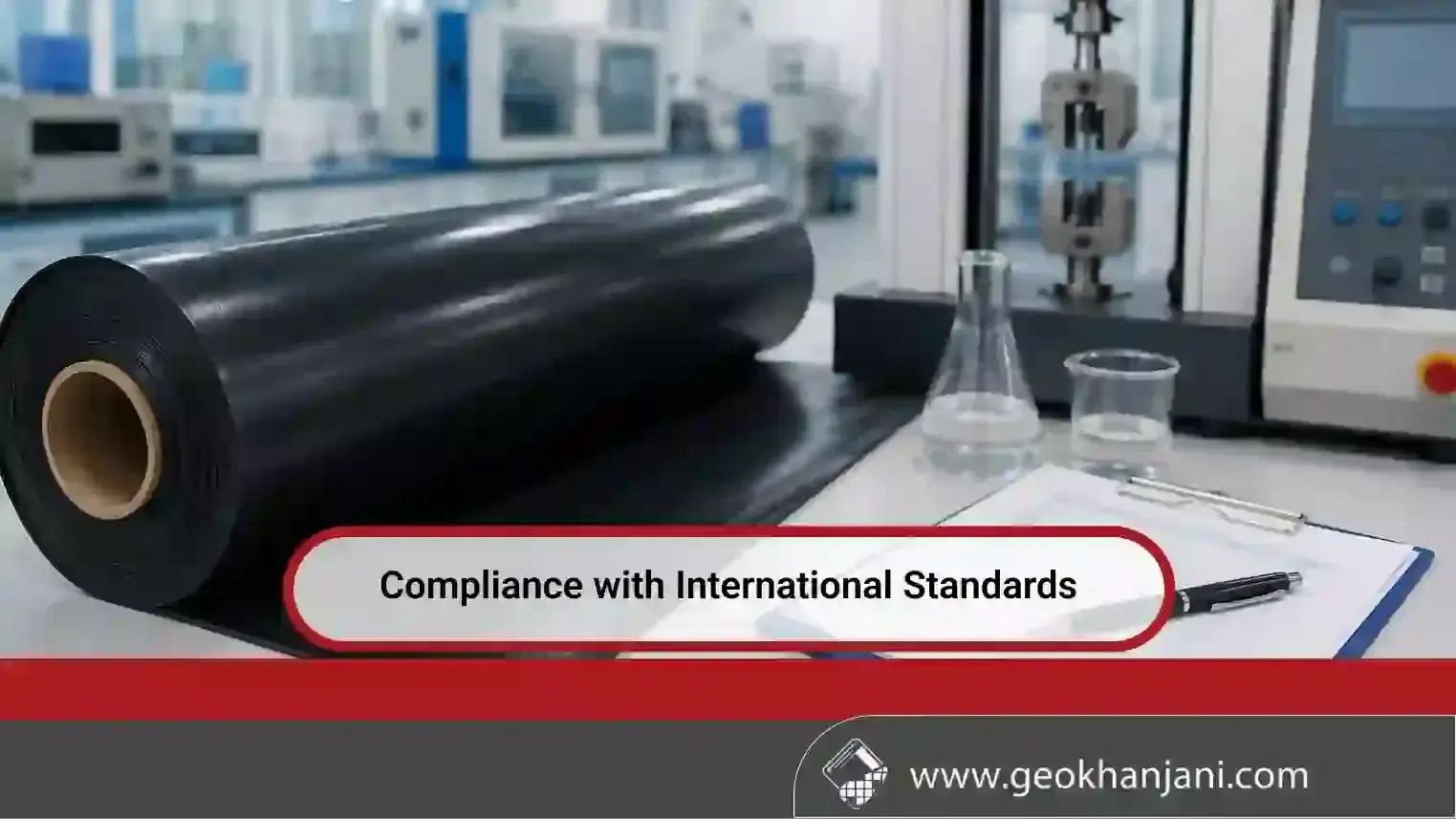
One of the clearest signals of quality is whether a product actually complies with recognized industry standards. A geomembrane worth considering should meet GRI GM13, ASTM testing methods, and ISO quality management requirements. A serious manufacturer will hand over complete lab reports demonstrating this compliance — not just claim it.
 Compliance with International Standards
Comparing Mechanical Performance
Several mechanical properties determine how long a liner lasts in the field.
Tensile strength:
higher tensile strength helps the liner survive installation stress and long-term loading without failing.
Elongation at break:
good elongation gives the material flexibility without giving up structural integrity.
Tear resistance:
strong tear resistance lowers the risk of damage while the liner is being installed.
Puncture resistance:
this matters most when the geomembrane goes over uneven subgrade or coarse material.
Domestic manufacturers running modern extrusion lines can match these mechanical properties just as well as imported products.
UV Resistance
Any geomembrane exposed to sunlight needs to hold up under UV stress. That resistance comes down mainly to the quality of the carbon black, how evenly it's dispersed, the stabilizer package used, and consistency across the manufacturing run. Well-made domestic geomembranes, produced to international specifications, often deliver UV performance on par with imported brands.
Thickness Consistency
Uniform thickness is easy to overlook, but it has a real effect on how the liner performs. Consistent thickness gives you even stress distribution, more reliable welds, better durability, and stronger quality assurance. Automatic thickness-control systems help keep production tolerances tight.
Welding Performance
A geomembrane is only as good as its welded seams. Good-quality material gives you stable welding temperatures, strong seam strength, fewer welding defects, and easier field installation. Poor-quality material, on the other hand, tends to produce inconsistent welds and a higher rate of repairs.
Quality Control During Manufacturing
Manufacturers you can trust build multiple inspection points into their production process — resin verification, melt flow testing, thickness measurement, tensile testing, carbon black content analysis, carbon black dispersion testing, dimensional inspection, visual inspection, and final lab testing. Thorough quality control is often a better predictor of reliability than where the product was manufactured.
Comparing Costs
Imported geomembranes usually carry extra costs that aren't always obvious upfront: international shipping, customs duties, longer lead times, and currency exchange swings. Domestic geomembranes, meanwhile, tend to offer faster delivery, lower logistics costs, easier access to technical support, better product availability, and fewer project delays. Rather than comparing purchase price alone, it's worth looking at the total cost over the life of the project.
Common Mistakes Buyers Make
A lot of procurement decisions come down to price alone. The most frequent mistakes include ignoring lab certifications, buying without confirming GRI GM13 compliance, overlooking seam quality, accepting inconsistent thickness, focusing only on country of origin, and skipping a check on the manufacturer's track record. Avoiding these missteps can make a real difference in how the project performs.
How to Choose the Right Geomembrane
Before buying, it's worth putting these questions directly to the supplier: Does the product comply with GRI GM13? Is it made from virgin HDPE resin? Can you provide lab test reports? What quality control procedures do you follow? Is technical support available? What warranty do you offer? Have you worked on similar projects before?
Conclusion
Comparing domestic and imported HDPE geomembranes shouldn't come down to where the product was made. A domestic geomembrane produced with premium raw materials, modern extrusion technology, and thorough quality control can perform just as well as many imported alternatives — while offering lower logistics costs, faster delivery, and easier access to technical support.
For engineers and project owners, the smarter approach is to judge a product by its technical specifications, manufacturing standards, lab certifications, and real-world performance — not simply by where it came from