Learn how to calculate the amount of geomembrane pond liner required for agricultural and water storage ponds. This guide explains liner area formulas, pond depth and slope calculations, overlap, anchor trench allowances, roll dimensions, and practical examples to help you estimate the right amount of HDPE geomembrane.
- • Geomembrane Pond Liner Calculator: How Much Liner Do You Need?
- • What Is a Geomembrane Pond Liner Calculator?
- • Why Is Accurate Pond Liner Calculation Important?
- • What Measurements Do You Need?
- • How to Calculate a Rectangular Pond Liner
- • More Accurate Calculation Using Slope Length
- • Basic Geomembrane Pond Liner Formula
- • How Much Extra Liner Is Needed for Overlap?
- • Don't Forget the Anchor Trench
- • How Many Geomembrane Rolls Do You Need?
- • What Affects the Amount of Geomembrane You Need?
- • How to Choose the Right Geomembrane Thickness
- • Common Pond Liner Calculation Mistakes
- • Quick Pond Liner Calculation Example
- • Can You Calculate Pond Liner Requirements Online?
- • Final Checklist Before Ordering Geomembrane
- • Conclusion
Geomembrane Pond Liner Calculator: How Much Liner Do You Need?
Calculating the right amount of geomembrane pond liner is one of the first and most important steps when planning a lined pond. Whether you're building an agricultural water reservoir, irrigation pond, fish pond, wastewater pond, or another type of water storage basin, ordering the correct amount of liner can help cut down on material waste, installation problems, and extra costs.
But how much geomembrane do you actually need?
The answer depends on more than the length and width of the pond. You also need to factor in the pond depth, side slopes, liner overlap, and anchor trench allowance.
This guide walks through how to calculate pond liner requirements step by step, with practical formulas and an example you can adapt for your own project.
What Is a Geomembrane Pond Liner Calculator?
A geomembrane pond liner calculator is a method or online tool used to estimate the total surface area of geomembrane needed to cover a pond.
A basic calculation might look simple: pond length times pond width equals the required liner area. But that formula only really works for a flat rectangular surface. Most ponds have sloped sides, which means the actual liner area ends up larger than the surface area measured at the top or bottom of the pond.
A more accurate calculation should factor in pond length, pond width, pond depth, side slope, the anchor trench, overlap between geomembrane sheets, installation and welding requirements, and additional material for irregular areas.
The final quantity should include an allowance for installation, not just the geometric area of the water surface.
Why Is Accurate Pond Liner Calculation Important?
Ordering too little geomembrane can cause serious problems during installation — the available sheets may not be large enough to cover the entire pond, and additional pieces may need to be ordered on short notice.
Ordering too much material, on the other hand, drives up project costs and leaves unnecessary waste.
Accurate geomembrane liner calculation helps you estimate the amount of material required, select suitable geomembrane roll dimensions, reduce unnecessary waste, plan geomembrane welding, estimate project costs, prepare the anchor trench correctly, and avoid shortages during installation.
For large agricultural ponds, even a small error in the calculation can add up to a significant difference in the required liner area.
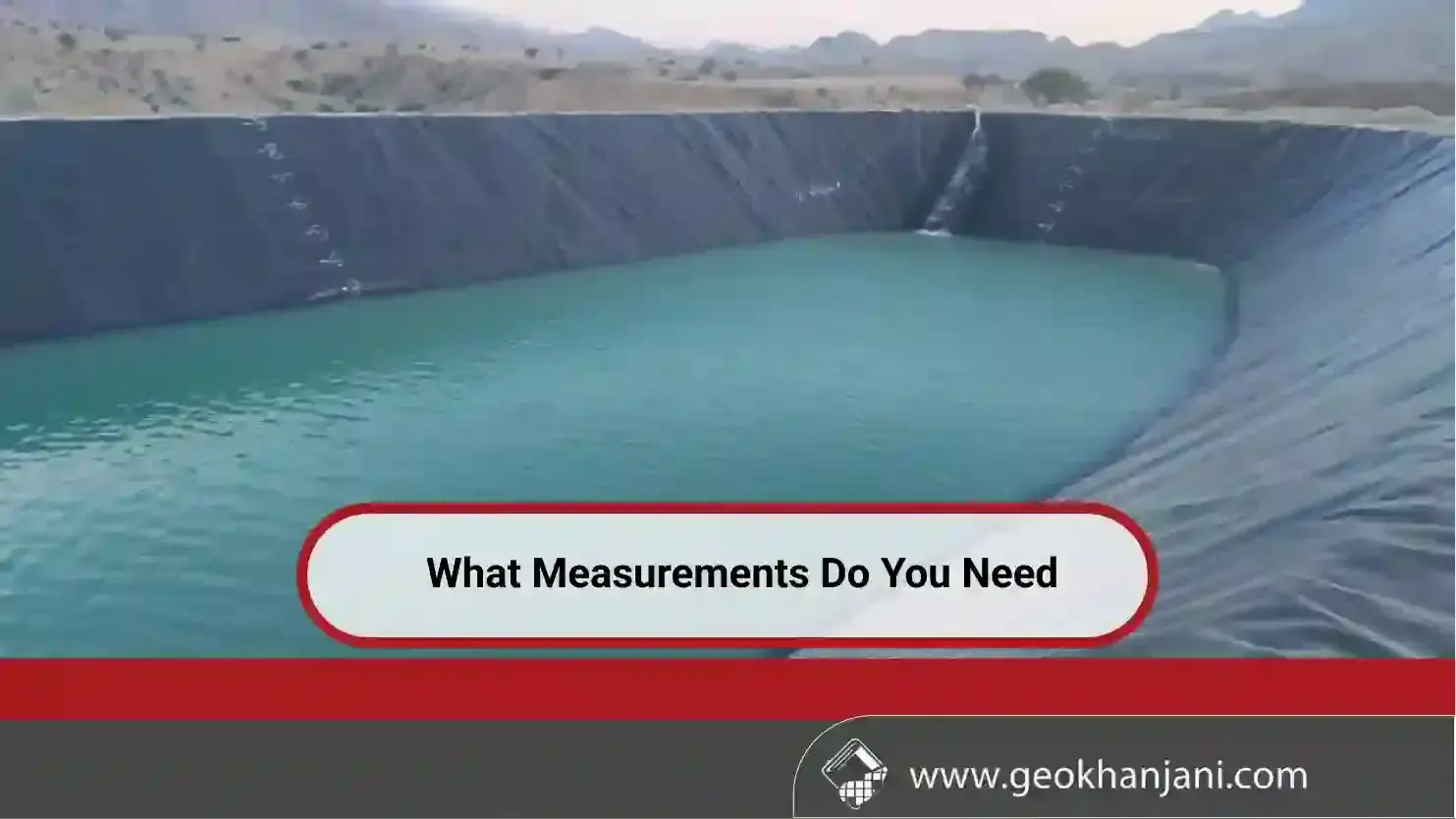
What Measurements Do You Need?
Before calculating how much pond liner you need, gather a few key measurements.
Start with the pond length — measure it at the top, or use the planned design dimensions — and the pond width.
The pond depth matters a lot when the pond has sloped walls, since the liner has to cover the sides from bottom to top. The side slope determines how much additional geomembrane is needed on each side — a pond with steep walls needs less liner than one with very wide slopes.
You'll also need the anchor trench allowance. Geomembrane ponds commonly need an anchor trench around the perimeter, and extra liner has to be available to extend into that trench and secure the membrane.
Finally, account for overlap and welding allowance. When multiple geomembrane sheets are installed, they need to overlap enough for thermal welding, and the required overlap depends on the installation method and project specifications.
 What Measurements Do You Need
How to Calculate a Rectangular Pond Liner
Consider a rectangular agricultural pond that's 20 meters long, 10 meters wide, 2 meters deep, with a 1:1 side slope.
A 1:1 side slope means that for every 1 meter of vertical depth, the slope extends approximately 1 meter horizontally. So each side requires roughly 2 meters of horizontal slope, and with two sides that's 4 meters total.
The effective liner length becomes 20 plus 2 plus 2, or 24 meters. The effective liner width becomes 10 plus 2 plus 2, or 14 meters. Multiplying those gives an approximate liner area of 336 square meters.
That's a simplified calculation — the actual surface area of the slopes can be worked out more precisely using the slope length.
More Accurate Calculation Using Slope Length
For a rectangular pond with sloped sides, you can calculate the actual slope length using the Pythagorean theorem.
If the pond depth is 2 meters and the horizontal slope width is also 2 meters, then the slope length equals the square root of depth squared plus horizontal slope squared — the square root of 2 squared plus 2 squared, which is the square root of 8, or about 2.83 meters.
That 2.83 meters represents the actual length of geomembrane needed to cover the sloped wall.
For a more precise pond liner calculation, work out the bottom area, side slopes, and end slopes separately, then add them together.
Basic Geomembrane Pond Liner Formula
For a simple rectangular pond, a practical estimation formula is: required liner area is approximately equal to the expanded pond length times the expanded pond width, where the expanded dimensions include the sloped sides and installation allowances.
For more detailed projects, total liner area equals the bottom area plus the side slope areas plus the end slope areas plus allowances — where the allowances can include anchor trench material, welding overlap, corners and transitions, irregular sections, and installation waste.
This approach gives a much more realistic estimate than simply multiplying the pond's length by its width.
How Much Extra Liner Is Needed for Overlap?
Geomembrane sheets are often supplied in rolls or panels that have to be welded together on-site, which means the total amount of material ordered isn't always exactly equal to the calculated pond surface area.
For example, if two sheets need to be joined, an additional section of material may be needed to create the welding seam.
The actual overlap should follow the geomembrane manufacturer's installation recommendations and the welding procedure used on the project. Rather than applying one fixed percentage to every project, it's better to calculate the panel layout first and figure out where seams will fall.
For large ponds, a professional panel layout can significantly cut down on unnecessary material waste.
Don't Forget the Anchor Trench
One of the most commonly overlooked parts of pond liner calculation is the anchor trench.
The geomembrane usually extends beyond the top edge of the pond and is secured in an anchor trench around the perimeter. For example, if you need an additional 0.5 meters of material around the perimeter for anchoring, that allowance has to be built into the calculation.
If the pond perimeter works out to 2 times the sum of 20 and 10, or 60 meters, and the required anchoring allowance is 0.5 meters, that additional material around the perimeter needs to be factored into the liner layout.
The exact anchor trench dimensions depend on the project design, soil conditions, geomembrane type, and engineering requirements.
How Many Geomembrane Rolls Do You Need?
Knowing the total area is only part of the calculation — you also need to consider the dimensions of the geomembrane rolls available from the supplier.
Say your calculated liner requirement comes out to 1,000 square meters, and the selected geomembrane roll covers 200 square meters. A simple area calculation would suggest you need 5 rolls. But that doesn't automatically mean five rolls are actually sufficient.
Roll width and length have to match the pond geometry and panel layout — a roll may leave unusable sections or require additional seams. For large projects, it's worth calculating the required panel dimensions and roll layout, not just the total square meters.
What Affects the Amount of Geomembrane You Need?
Several factors can change the final quantity of pond liner.
Pond geometry matters — simple rectangular ponds are easier to calculate than irregular ponds with multiple corners and curves. Pond depth matters too, since a deeper pond generally needs more liner as the side walls get longer, and wide side slopes increase the surface area that has to be covered.
Roll dimensions play a role, since available geomembrane widths and lengths can influence the number of seams and material waste, and the welding layout — where and how many seams there are — can affect the required quantity as well.
The anchor trench requires additional material left around the perimeter, and project irregularities like inlets, outlets, pipes, corners, and steps may require extra material too.
How to Choose the Right Geomembrane Thickness
Calculating the area isn't enough — you also need to select an appropriate geomembrane thickness for the project.
HDPE geomembrane is widely used for agricultural ponds and water containment because of its durability, chemical resistance, and low permeability. Common thicknesses include 0.75 mm, 1.0 mm, 1.5 mm, 2.0 mm, and 2.5 mm.
The appropriate thickness depends on factors like soil condition, subgrade preparation, risk of puncture, pond depth, expected service life, installation conditions, mechanical loads, and project specifications.
A thicker liner isn't automatically the best option for every pond — the selection should be based on the actual conditions of the project.
Common Pond Liner Calculation Mistakes
A common mistake is calculating only the water surface, which doesn't represent the total area the geomembrane has to cover. Ignoring side slopes is another — sloped walls can add a significant amount of liner area.
Forgetting the anchor trench is a frequent oversight too, since the membrane needs extra length beyond the pond edge for proper anchoring. Ignoring welding is another issue — multiple sheets require seams, and the panel layout should account for welding requirements.
Buying based only on square meters can also backfire, since a roll may have enough total area but still be unsuitable because its width or length doesn't fit the pond dimensions. And not considering subgrade preparation is a real risk — sharp stones, roots, debris, and uneven surfaces can damage the geomembrane, so proper subgrade preparation is essential before installation.
Quick Pond Liner Calculation Example
Suppose you're planning an agricultural pond that's 30 meters long, 15 meters wide, 2 meters deep, with a 1:1 side slope, and an anchor allowance set according to the project design
For a 1:1 slope and 2-meter depth, the horizontal slope extension is approximately 2 meters on each side. That makes the approximate top dimensions 30 plus 2 plus 2, or 34 meters in length, and 15 plus 2 plus 2, or 19 meters in width.
A simple upper-level estimate would then be 34 times 19, or 646 square meters.
The exact geomembrane requirement, though, should be calculated using the actual slope lengths and a detailed panel layout. This example shows why a pond liner calculator should factor in pond depth and slopes rather than relying only on the top dimensions.
Can You Calculate Pond Liner Requirements Online?
Yes. An online geomembrane pond liner calculator can make preliminary estimation much faster.
Ideally, the calculator should let you enter the pond length, width, depth, side slope, anchor allowance, and any additional installation allowance. The result should give you an estimated liner area that can then be used for material selection and quotation.
That said, an online calculator should be treated as a planning and estimation tool. Final quantities for large or technically complex projects should be verified using the project drawings and the actual installation layout.
Final Checklist Before Ordering Geomembrane
Before purchasing your pond liner, make sure the pond length and width have been measured correctly, the maximum depth has been determined, and the side slopes have been considered. Confirm that the anchor trench allowance has been included, and that welding and panel layout have been worked out.
Check that the roll width is suitable for the pond, that an appropriate geomembrane thickness has been selected, and that subgrade preparation has been planned. Finally, make sure pipes, outlets, inlets, and other penetrations have been accounted for.
If you're planning to install an HDPE geomembrane pond liner, accurate measurements and proper material selection are essential for a reliable, long-lasting water containment system.
Conclusion
Calculating the required amount of geomembrane pond liner is more than multiplying the pond's length by its width. Depth, side slopes, anchor trenches, welding seams, roll dimensions, and pond geometry can all affect the final quantity.
For a simple preliminary estimate, start by measuring the pond accurately and calculating the bottom and sloped surfaces, then add the necessary allowances for anchoring and installation.
For large agricultural ponds or projects with complex geometry, a detailed panel layout is worth doing before ordering the geomembrane. It can help minimize waste, reduce the number of unnecessary seams, and make sure the available roll dimensions actually suit the pond.