This article provides a technical overview of micropiles as an effective solution for ground improvement, foundation reinforcement, settlement control, and stabilization of weak or unstable soils. It explains micropile load-transfer mechanisms, soil–grout interaction, bonded length, group effects, grouting techniques, seismic applications, and underpinning of existing foundations.
- • What Are Micropiles?
- • How Do Micropiles Improve Weak Soil?
- • Micropile Load Transfer Mechanism
- • The Role of Grouting in Micropile Performance
- • Micropiles for Settlement Control
- • Micropile Groups and Group Effects
- • Micropiles for Foundation Underpinning
- • Micropiles in Seismic Ground Improvement
- • Micropiles and Liquefaction Mitigation
- • Micropile Design Parameters
- • Structural and Geotechnical Design Must Be Integrated
- • Installation Methods
- • Quality Control and Load Testing
- • Micropiles vs. Other Ground Improvement Methods
- • Advantages of Micropile Ground Improvement
- • Limitations and Engineering Challenges
- • Advanced Approach: Micropiles as a Composite Ground-Reinforcement System
- • When Should Micropiles Be Selected?
- • Conclusion
Ground improvement is one of the most important aspects of geotechnical engineering when construction takes place on weak, compressible, heterogeneous, or unstable soils. Conventional foundations may become inefficient when the near-surface soil can't provide sufficient bearing capacity or when excessive total and differential settlement is expected.
Among the available ground improvement and foundation reinforcement techniques, micropiles offer a distinctive solution because they can simultaneously improve load transfer, increase foundation stiffness, control settlement, and enhance the stability of existing or new structures.
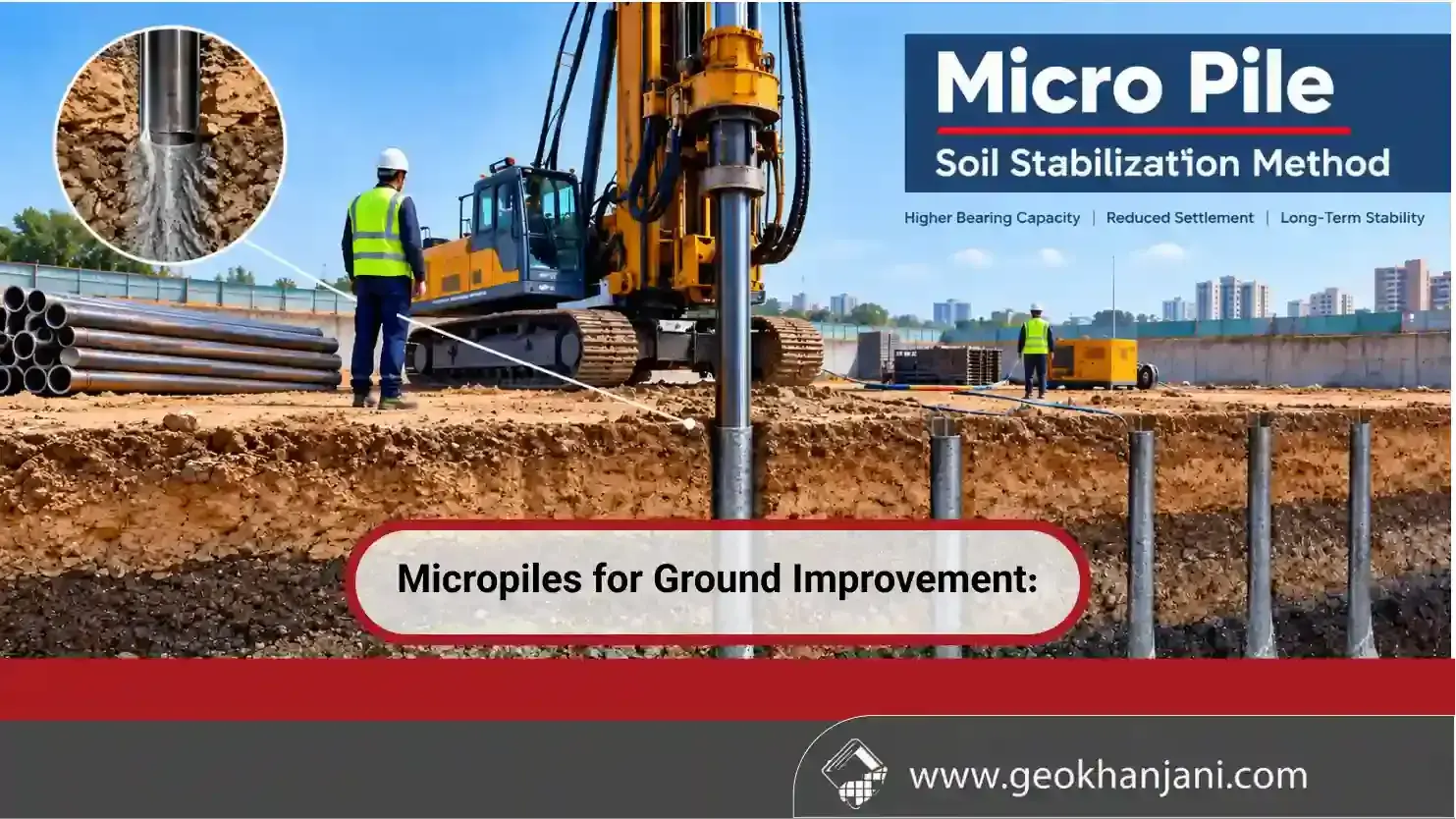
Micropiles are small-diameter, drilled and grouted piles generally built using a high-strength steel reinforcement element surrounded by cement grout. Unlike conventional driven piles, they can be installed using relatively compact drilling equipment, which makes them particularly well suited to restricted-access sites, underpinning projects, urban construction, and locations where vibration needs to be minimized.
The U.S. Federal Highway Administration (FHWA) recognizes micropiles as elements used for foundation support under both static and seismic loading, as well as for slope and excavation stabilization.
That said, describing micropiles simply as "small piles" doesn't really capture their geotechnical behavior. Their performance depends strongly on grout–soil interaction, bond strength, drilling method, installation sequence, micropile spacing, reinforcement configuration, soil stratigraphy, and load-transfer mechanisms.
What Are Micropiles?
A micropile is a relatively small-diameter deep foundation element built by drilling a borehole, installing reinforcement, and injecting cementitious grout.
A typical micropile consists of steel casing or permanent casing, a central reinforcing bar or steel reinforcement, cement grout, a bonded soil–grout interface, and a structural connection to a pile cap or foundation.
Micropiles are commonly installed using rotary or rotary-percussive drilling techniques, and depending on ground conditions, temporary casing, permanent casing, open-hole drilling, or other drilling configurations may be selected.
The most important characteristic of a micropile isn't really its diameter — it's how heavily it relies on grout-to-ground bond and axial load transfer. FHWA's micropile reference manual specifically addresses geotechnical and structural design, load testing, construction, inspection, slope stabilization, and foundation applications.
 What Are Micropiles
How Do Micropiles Improve Weak Soil?
It's worth distinguishing between traditional deep foundation support and micropile-based ground improvement.
A conventional pile is normally designed primarily to transfer structural loads through weak upper soils into stronger bearing layers or rock. A micropile can perform this same function, but when micropiles are installed in groups or grids, they can also change the mechanical response of the soil–foundation system as a whole.
The improvement mechanism can involve load redistribution, reduction of foundation settlement, an increase in composite stiffness, mobilization of shaft resistance, reinforcement of potentially unstable soil masses, reduction of lateral deformation, improvement of seismic response, and transfer of structural loads to deeper, more competent strata.
So micropiles shouldn't automatically be classified as a soil densification technique. They're better understood as reinforcing and load-transfer elements that improve the performance of the soil–foundation system as a whole — a distinction that matters particularly when comparing them with stone columns, dynamic compaction, deep soil mixing, jet grouting, or prefabricated vertical drains.
Micropile Load Transfer Mechanism
The structural behavior of a micropile is primarily controlled by axial and lateral load transfer.
For an axially loaded micropile, the ultimate resistance is conceptually the sum of shaft resistance and end-bearing resistance: Qu = Qs + Qb, where Qu is the ultimate axial resistance, Qs is the shaft resistance, and Qb is the end-bearing resistance.
For many micropile applications, shaft resistance along the bonded length is the dominant component. It can be approximated conceptually as Qs = π × D × Lb × qs, where D is the effective micropile diameter, Lb is the bonded length, and qs is the unit bond resistance.
Because of this, the quality of the grout–ground interface becomes a critical design parameter. Unlike a conventional large-diameter pile that relies substantially on end bearing, a micropile can develop considerable capacity through the bonded interface between grout and the surrounding soil or rock.
The Role of Grouting in Micropile Performance
Grouting is one of the defining characteristics of micropile construction. The grout does several things at once: it transfers load between the reinforcement and surrounding ground, protects the steel reinforcement against corrosion, creates the structural body of the micropile, develops bond with the surrounding soil or rock, and improves the effective diameter of the load-transfer zone.
Depending on the micropile system and ground conditions, grouting may be performed under pressure. Pressure grouting can increase the interaction between the grout body and the surrounding ground, though its effectiveness depends on soil permeability, construction method, grout properties, injection pressure, and geological conditions.
This means two micropiles with identical steel reinforcement and nominal diameter won't necessarily develop the same geotechnical capacity.
Micropiles for Settlement Control
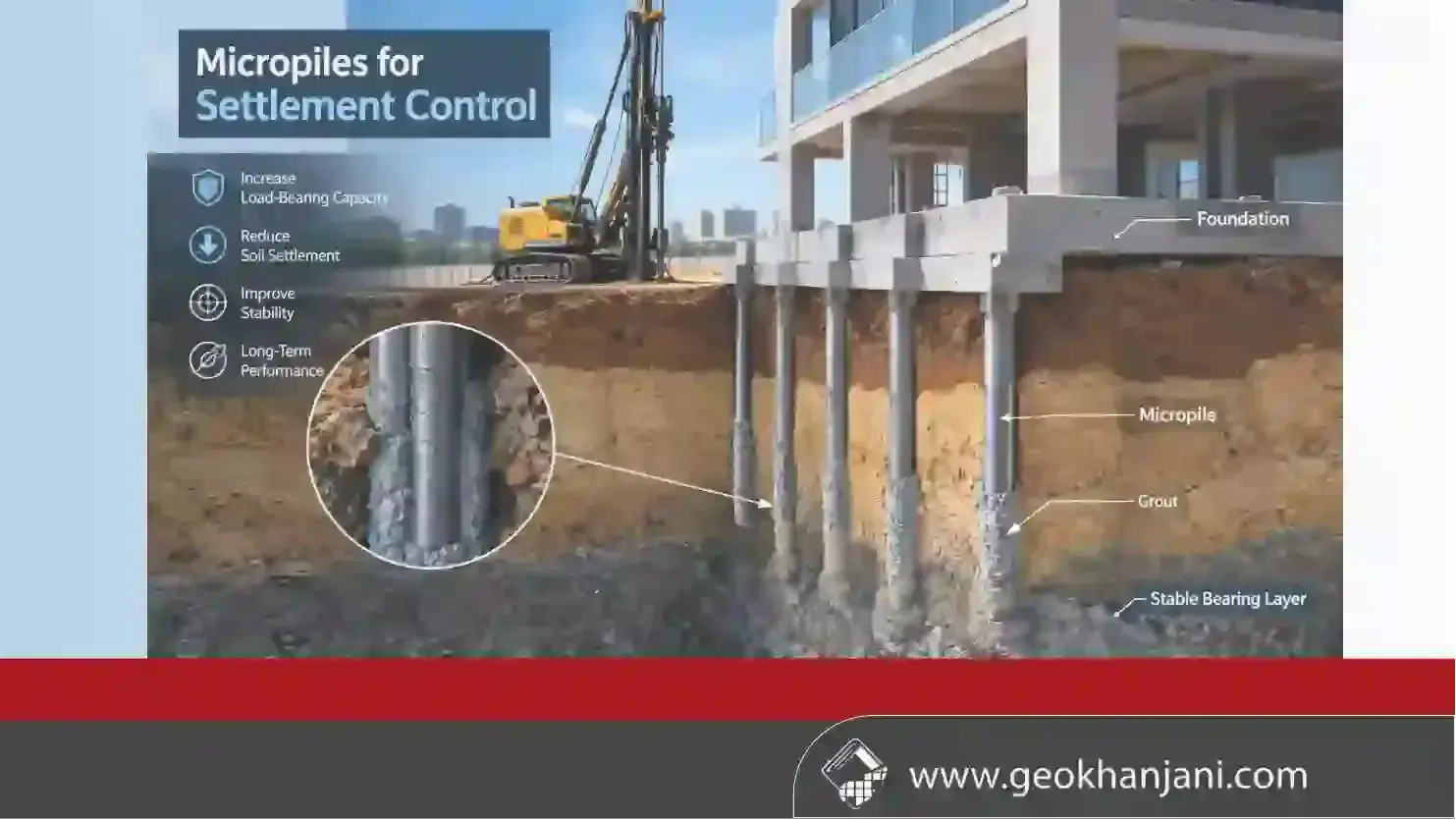
One of the most important applications of micropiles is controlling total and differential settlement.
Consider a structure founded on a weak compressible layer. Under structural loading, the soil experiences increased stress, resulting in deformation and settlement. Installing micropiles can change the load path — instead of transferring most of the structural load through the weak near-surface soil, part of the load moves through the micropile system toward deeper, stronger soil or rock. The resulting system behaves as a composite: structure, then pile cap or foundation, then micropiles, then the grout–soil interface, then competent ground.
This mechanism can substantially reduce deformation when properly designed. However, micropiles don't automatically eliminate settlement — the designer still has to consider compression of the micropile itself, elastic deformation, soil deformation around the bonded zone, group effects, foundation stiffness, differential settlement, and load redistribution between soil and micropiles.
 Micropiles for Settlement Control
Micropile Groups and Group Effects
Using multiple micropiles creates a soil–pile interaction problem rather than a simple collection of independent piles. When micropiles are installed close to one another, their stress zones can overlap, so the capacity of a group isn't necessarily equal to the number of micropiles multiplied by the capacity of a single one.
Group efficiency can be influenced by micropile spacing, diameter, bonded length, soil stiffness, soil stratification, installation sequence, load direction, pile inclination, and cap rigidity. For this reason, micropile spacing should be determined through geotechnical analysis rather than by applying a universal spacing value.
Micropiles for Foundation Underpinning
One of the most effective applications of micropiles is underpinning existing foundations.
Traditional underpinning methods may require extensive excavation around existing foundations, but micropiles can often be installed through or adjacent to existing structures using relatively small drilling equipment.
A typical underpinning sequence might involve geotechnical investigation, assessment of the existing foundation, determination of the required load transfer, drilling of the micropiles, installation of reinforcement, grouting, installation of the pile-to-foundation connection, load testing, and controlled transfer of the structural load.
This advantage is particularly significant in confined urban environments where large piling rigs simply can't operate. FHWA identifies micropiles as a practical technology for foundation support and stabilization, including in situations where conventional equipment or construction approaches would be difficult to use.
Micropiles in Seismic Ground Improvement
The seismic behavior of micropile-reinforced soil has become an increasingly important research topic.
During earthquakes, loose saturated granular soils may experience rapid buildup of excess pore-water pressure and a reduction in effective stress; if the effective stress approaches zero, liquefaction can occur.
Recent experimental research has examined micropile behavior under controlled shaking-table conditions. A 2025 study found that micropile performance under seismic loading was influenced by excitation frequency and micropile spacing, and also investigated micropile arrangements as a way to mitigate liquefaction-related effects. Another 2025 comparative study, examining stone columns, micropiles, and geosynthetic-encased stone columns, found that micropiles can be particularly effective at resisting lateral deformation in mildly sloping liquefiable ground, while other systems may have stronger effects on excess pore-pressure generation.
These findings point to an important engineering principle: micropiles shouldn't be evaluated solely on vertical bearing capacity when they're intended for seismic ground improvement. Their contribution to lateral resistance, soil–pile interaction, deformation control, and cyclic response can matter just as much.
Micropiles and Liquefaction Mitigation
The role of micropiles in liquefaction mitigation requires careful interpretation. Micropiles don't generally "densify" loose sand the way vibrocompaction or dynamic compaction does.
Instead, their potential benefits may include increasing structural load-transfer capacity, providing reinforcement within the liquefiable layer, limiting lateral ground deformation, reducing foundation displacement, and providing a more stable load path during cyclic loading.
Recent physical testing has shown that micropile configuration and excitation characteristics can influence pore-pressure response and ground motion within liquefiable soil. So micropile-based liquefaction mitigation should be evaluated through site-specific seismic response analysis rather than by assuming a universal improvement factor.
Micropile Design Parameters
A comprehensive micropile design should consider both structural and geotechnical parameters.
Diameter influences bond surface area, grout volume, structural capacity, drilling requirements, and installation cost. The bonded length is one of the most important parameters controlling axial resistance — increasing it generally increases shaft resistance, provided the surrounding soil or rock can mobilize the required bond stress.
The steel reinforcement needs to be checked for axial compression, tension, bending, buckling where applicable, corrosion allowance, and connection requirements. Important grout properties include compressive strength, water–cement ratio, bleeding, durability, injectability, and setting characteristics. And the available soil–grout bond depends on soil type, rock quality, drilling technique, grouting procedure, confinement, groundwater, and installation quality.
Structural and Geotechnical Design Must Be Integrated
A common mistake in micropile design is treating the micropile exclusively as a steel structural element. In reality, the system consists of steel, grout, ground, and the foundation connection all together.
So the design has to satisfy both geotechnical limit states — shaft resistance, end bearing, group effects, settlement, lateral resistance, ground instability — and structural limit states, including steel strength, grout strength, buckling, bending, shear, connection capacity, and corrosion durability. The governing capacity is generally set by whichever mechanism is weakest.
Installation Methods
Micropiles can be installed using several drilling techniques, and the method chosen depends on the soil profile, rock condition, groundwater, borehole stability, site access, required inclination, and environmental constraints.
Rotary drilling suits many soil and rock formations and works well where relatively controlled drilling is needed. Rotary-percussive drilling combines rotation and percussion and is particularly useful in harder formations. Casing-supported drilling uses temporary or permanent casing to maintain borehole stability in loose or unstable formations.
The drilling method chosen can significantly affect the quality of the grout–ground interface, and consequently the final micropile capacity.
Quality Control and Load Testing
Because micropile performance depends so strongly on installation quality, construction control is essential. A suitable quality assurance program might include verification of borehole depth, casing inspection, reinforcement inspection, grout quality testing, grout volume monitoring, injection pressure monitoring, verticality checks, installation records, and load testing.
Load tests are particularly important because theoretical bond parameters can carry substantial uncertainty. The FHWA reference manual includes specific guidance on micropile inspection and load testing procedures.
Micropiles vs. Other Ground Improvement Methods
Micropiles should be selected based on the actual failure mechanism and project requirements, not chosen by default.
Micropiles work through deep load transfer and reinforcement, and suit weak bearing strata, settlement problems, and underpinning. Stone columns work through reinforcement and drainage, suited to soft or loose granular soils. Deep soil mixing modifies the soil with a binder, suited to soft cohesive soils. Jet grouting works through in-situ cementation, suited to localized strengthening and cutoff walls. Dynamic compaction and vibrocompaction both work through densification, suited to loose granular fills and loose clean sands respectively. Geosynthetic reinforcement provides tensile confinement, suited to embankments, slopes, and weak subgrades. Vertical drains accelerate consolidation, suited to soft saturated cohesive soils.
The critical point is that micropiles aren't a universal substitute for conventional ground improvement techniques. If the fundamental problem is very high excess pore pressure and consolidation of a thick soft clay layer, vertical drains or deep mixing may be more appropriate. But if the primary problem is inadequate foundation support or excessive differential settlement, micropiles can be highly effective.
Advantages of Micropile Ground Improvement
Micropiles offer several technical advantages. Small drilling rigs allow installation in restricted spaces, and compared with driven piles, drilled micropiles generate low vibration, which matters where vibration-sensitive structures are nearby. They adapt well to difficult ground, including heterogeneous soil profiles and rock, and they can be installed beneath or adjacent to existing foundations for underpinning.
Their load capacity is high relative to their diameter, strongly influenced by bonded length and grout–ground interaction, and in seismic environments they can provide additional lateral resistance and structural reinforcement.
Limitations and Engineering Challenges
Despite their advantages, micropiles have real limitations. They can involve high installation costs, extensive drilling operations, and dependence on drilling quality. They're sensitive to the grout–ground bond, and group interaction can get complex — estimating soil–grout bond isn't always straightforward. They also need specialized equipment and can run into groundwater or borehole stability problems.
It's also worth noting that installing more micropiles doesn't necessarily mean proportionally higher performance. The optimal design comes from the interaction between spacing, diameter, bonded length, soil properties, foundation stiffness, and loading conditions — not from simply adding more piles.
Advanced Approach: Micropiles as a Composite Ground-Reinforcement System
Modern geotechnical design increasingly moves away from treating ground improvement techniques as isolated components, considering instead the entire system: soil, micropiles, foundation, groundwater, structural loading, and seismic loading together.
Numerical methods such as three-dimensional finite-element analysis can be used to investigate soil–pile interaction, differential settlement, lateral displacement, stress redistribution, pore-pressure response, seismic deformation, and group effects.
Recent research comparing micropiles with other liquefaction mitigation techniques shows that parameters such as spacing, diameter, and permeability can strongly affect performance under seismic loading — which suggests future micropile design is likely to become increasingly performance-based rather than relying solely on simplified empirical assumptions.
When Should Micropiles Be Selected?
Micropiles tend to be particularly attractive when several of these conditions apply: weak near-surface soil, existing foundation settlement, restricted construction access, high structural loads, deep competent bearing layers, sensitive surrounding structures, a need for underpinning, slope stabilization requirements, seismic loading, difficult drilling conditions, or limited tolerance for vibration.
The decision should always follow a site-specific geotechnical investigation rather than a general rule of thumb.
Conclusion
Micropiles represent a versatile technology for foundation reinforcement, settlement control, slope stabilization, and selected ground improvement applications. Their effectiveness doesn't come simply from their small diameter — it comes from the interaction between the steel reinforcement, cement grout, surrounding soil or rock, and structural foundation.
For settlement-sensitive projects, micropiles can redirect structural loads toward deeper competent strata and reduce deformation. In seismic applications, they can contribute to lateral resistance and deformation control, and recent experimental and numerical studies indicate that micropile spacing and configuration can significantly influence their effectiveness in liquefiable soils.
Even so, micropiles shouldn't be confused with soil densification techniques. They're fundamentally reinforcing and load-transfer elements, and their effectiveness depends on soil conditions, installation quality, grout–ground interaction, and system-level design.