Reinforced Geomembrane: Structure, Properties, Applications and Installation
144
0
This technical article explains reinforced geomembrane, including its structure, reinforcement materials, manufacturing process, mechanical and waterproofing properties, major applications, thickness selection, installation procedures, welding and quality-control methods.
- • What Is a Reinforced Geomembrane?
- • How Is Reinforced Geomembrane Manufactured?
- • Structure of Reinforced Geomembrane
- • Key Properties of Reinforced Geomembranes
- • Reinforced vs. Non-Reinforced Geomembrane
- • Applications of Reinforced Geomembrane
- • Landfill and Environmental Containment
- • Reinforced Geomembrane for Industrial Containment
- • Reinforced Geomembrane Thickness
- • Reinforced Geomembrane Installation
- • Role of Geotextile with Reinforced Geomembrane
- • Advantages of Reinforced Geomembrane
- • Limitations and Design Considerations
- • How to Select a Reinforced Geomembrane?
- • Quality Control of Reinforced Geomembranes
- • Conclusion
Reinforced geomembrane is an engineered waterproofing and containment material designed to provide both fluid impermeability and enhanced mechanical strength. Unlike conventional homogeneous geomembranes, reinforced geomembranes incorporate an internal reinforcement layer, commonly made from polyester or other high-strength polymeric materials.
This reinforcement improves dimensional stability, tensile performance and resistance to deformation, making the material suitable for applications where the liner may be exposed to mechanical stresses, movement, puncture risks or demanding installation conditions.
Reinforced geomembranes are used in a wide range of civil engineering, environmental, agricultural, mining and industrial projects, including water reservoirs, irrigation ponds, wastewater facilities, landfill systems, secondary containment structures and waterproofing applications.
What Is a Reinforced Geomembrane?
A reinforced geomembrane is a flexible synthetic liner consisting of one or more polymer layers combined with an internal reinforcement mesh or fabric.
The polymer layer provides the primary barrier against water, chemicals and other liquids, while the reinforcement layer increases the mechanical properties of the membrane.
Depending on the product design, reinforced geomembranes may be manufactured using materials such as PVC, PE-based polymers, HDPE or LLDPE-based structures, flexible polymeric compounds, polyester reinforcement, or high-strength polymer fabrics.
The exact structure depends on the intended application and required performance.
A typical reinforced geomembrane can be thought of as a polymer layer, a reinforcement layer, and another polymer layer, stacked together. The reinforcement is generally positioned inside the membrane so that it remains protected from direct environmental exposure.
How Is Reinforced Geomembrane Manufactured?
The manufacturing process varies depending on the polymer and reinforcement system used. In many products, a high-strength fabric or mesh is incorporated between polymer layers through coating or lamination.
A simplified manufacturing process starts with preparation of the polymer material and preparation of the reinforcement fabric, followed by application or extrusion of polymer layers and integration of the reinforcement. The membrane then goes through cooling and stabilization, thickness and dimensional inspection, surface and mechanical testing, and finally roll formation and packaging.
The quality of the bonding between the reinforcement and polymer layers is important. Poor bonding can reduce the overall performance of the membrane and may lead to separation between layers under mechanical stress.
Structure of Reinforced Geomembrane
The structure of a reinforced geomembrane can vary considerably according to the application.
The outer polymer layer provides environmental protection and contributes to the membrane's waterproofing and chemical resistance.
The reinforcement layer is responsible for improving mechanical stability. Polyester fabric is commonly used because of its high tensile strength and dimensional stability.
The inner polymer layer provides additional protection for the reinforcement and contributes to the impermeable barrier.
Some products may contain additional coatings, surface treatments or multiple reinforcement layers.
Key Properties of Reinforced Geomembranes
The performance of a reinforced geomembrane depends on its polymer composition, reinforcement material, thickness and manufacturing process.
High tensile strength is one of its defining traits. The reinforcement provides significantly greater tensile resistance than many unreinforced flexible membranes of comparable construction. This characteristic is particularly useful where the liner is subjected to stretching or localized mechanical forces.
Dimensional stability also improves. Reinforced structures can reduce dimensional changes caused by installation, temperature variations or mechanical loading.
Waterproofing performance stays strong, since the polymer layers create a continuous barrier that limits the passage of water and many other liquids.
Tear resistance improves too, since the reinforcement can help control tear propagation and improve the membrane's resistance to mechanical damage.
Puncture resistance also benefits. Depending on the membrane structure and thickness, reinforcement can improve resistance to puncture caused by handling, substrate movement or localized loads.
Flexibility is preserved to a good degree. Although reinforcement increases mechanical strength, many reinforced geomembranes remain flexible enough to conform to irregular surfaces.
Chemical resistance, meanwhile, depends primarily on the polymer formulation. Compatibility with the stored or contained material should be evaluated before selecting a membrane.
Reinforced vs. Non-Reinforced Geomembrane
The main difference is the presence of an internal reinforcement layer.
A reinforced geomembrane includes internal reinforcement, which gives it high tensile stability and generally higher dimensional stability. It stays flexible depending on construction, offers enhanced tear control thanks to the reinforcement, and suits high-stress and specialized projects. Installation depends on the membrane type.
A non-reinforced geomembrane has no internal reinforcement. Its tensile stability depends on the polymer and thickness, and its dimensional stability depends on the material. It's usually very flexible, its tear control depends on the polymer, and it suits general containment applications. Installation, again, depends on the membrane type.
The choice between reinforced and non-reinforced geomembrane should be based on project requirements rather than simply selecting the material with the highest nominal strength.
Applications of Reinforced Geomembrane
Reinforced geomembranes are used in many applications where waterproofing must be combined with mechanical stability.
Water Reservoirs
Reinforced geomembranes can be used as liners for agricultural reservoirs, irrigation ponds, water storage basins, artificial lakes, and industrial water reservoirs.
The membrane reduces water infiltration into the surrounding soil and can help preserve stored water.
Agricultural Ponds
Agricultural water storage facilities may experience ground movement, equipment traffic and installation stresses.
A reinforced geomembrane can provide a flexible waterproof barrier while improving mechanical stability. Typical applications include irrigation ponds, farm reservoirs, rainwater harvesting basins, agricultural storage tanks, and water conservation systems.
Fish Farming and Aquaculture
Aquaculture ponds require a reliable waterproofing system that can limit water loss and provide a controllable pond environment.
Depending on the product formulation and regulatory requirements, reinforced geomembranes can be used for fish farming ponds, aquaculture basins, hatchery facilities, and water storage areas
Material compatibility should always be evaluated when the liner is intended for contact with aquatic organisms or water used in sensitive applications.
Wastewater Treatment
Reinforced geomembranes may be used in wastewater containment systems where resistance to moisture and mechanical stress is required. Applications can include wastewater ponds, treatment lagoons, sludge containment, industrial wastewater basins, and evaporation ponds.
Chemical compatibility is especially important in wastewater applications because wastewater composition can vary significantly.
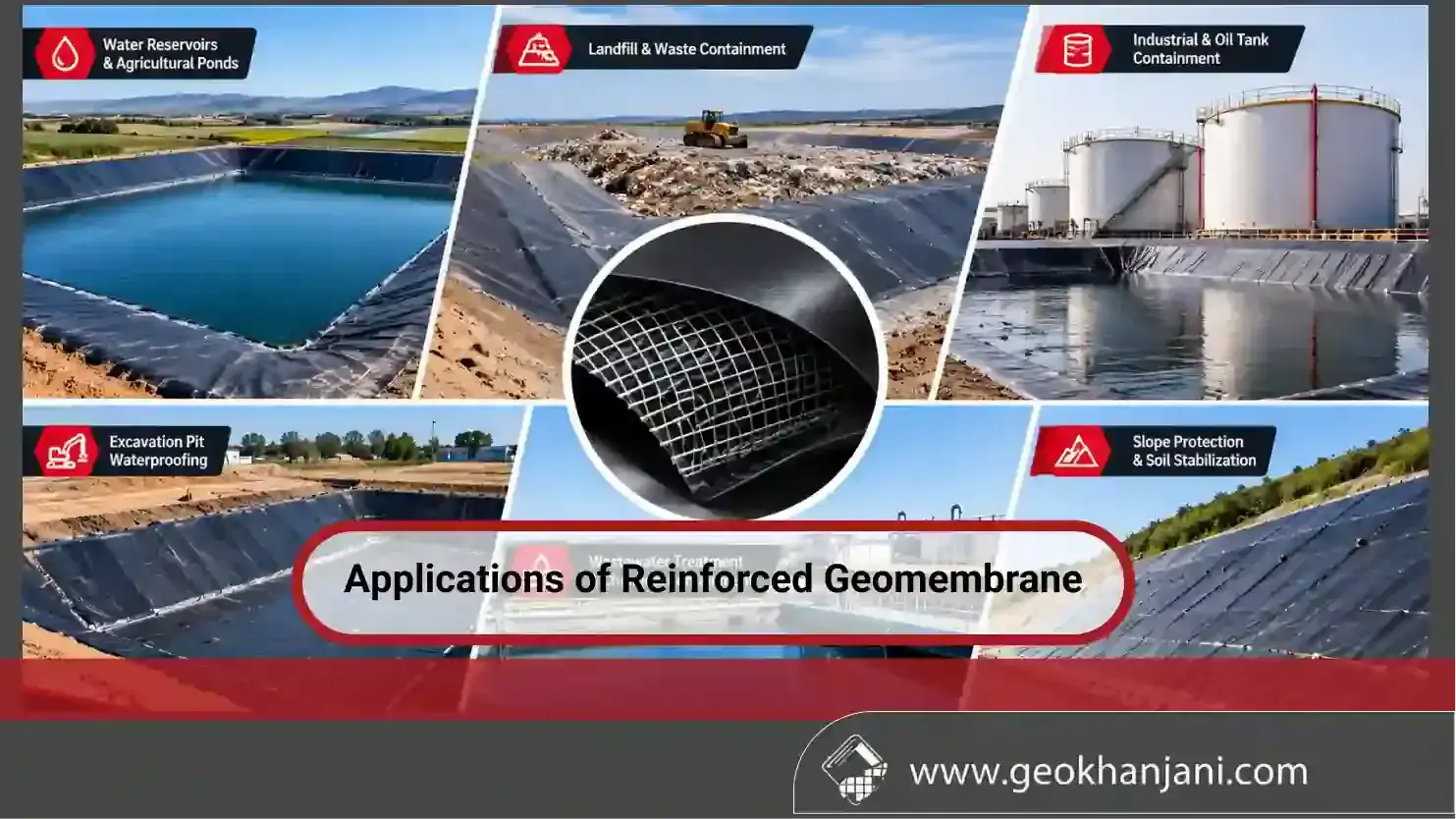 Applications of Reinforced Geomembrane
Landfill and Environmental Containment
Geomembranes are widely used as low-permeability barriers in landfill engineering.
Reinforced membrane products can be considered for certain specialized containment and waterproofing applications where their mechanical characteristics meet the project specifications.
A landfill liner system may also include a geotextile, a drainage layer, a geonet, a geocomposite, clay or a GCL, and protective layers.
The geomembrane is therefore usually only one component of a complete engineered containment system.
Reinforced Geomembrane for Industrial Containment
Industrial facilities may require secondary containment systems for liquids such as process water, chemicals, industrial wastewater, oils and hydrocarbons, and fertilizer solutions.
In these applications, polymer compatibility is critical. Before selecting a reinforced geomembrane, engineers should evaluate chemical concentration, operating temperature, exposure duration, liquid composition, required service life, and mechanical loading.
A membrane should not be selected solely according to its thickness.
Reinforced Geomembrane Thickness
Thickness is one of the important design parameters, but it should not be considered independently from the reinforcement structure.
Available thicknesses vary according to the manufacturer and product type.
Common considerations include mechanical loading, subgrade condition, installation method, expected service life, liquid pressure, temperature, chemical exposure, and the protection system in place.
For example, a membrane installed over a properly prepared and protected substrate may experience substantially different stresses from a membrane installed in a demanding industrial environment.
Therefore, the appropriate thickness should be determined through project-specific engineering requirements.
Reinforced Geomembrane Installation
Correct installation is essential for achieving the expected performance. A typical installation process includes the following steps.
The first step is subgrade preparation. The installation surface should be properly prepared and cleared of sharp stones, roots, construction debris, protruding objects, and any materials that could damage the liner. The substrate should provide adequate support and should be inspected before membrane placement.
The second step is membrane deployment. The rolls are positioned according to the approved installation layout, with care taken to prevent excessive stretching, folding, wrinkling, dragging over rough surfaces, or mechanical damage.
The third step is seaming. Depending on the membrane type, seams may be produced using hot-air welding, hot-wedge welding, extrusion welding, high-frequency welding, or specialized adhesive systems. The correct joining method depends on the polymer composition and membrane construction.
The fourth step is seam inspection. Welded seams should be inspected using appropriate testing methods, which may include visual inspection, peel testing, shear testing, air-pressure testing, vacuum testing, or spark testing where applicable. The exact testing method depends on the membrane and project specifications.
Role of Geotextile with Reinforced Geomembrane
A geotextile may be installed beneath or above a geomembrane to provide protection and separation.
For example, a nonwoven geotextile can help protect the membrane from sharp particles within the substrate.
The selection of geotextile should consider mass per unit area, puncture resistance, tensile strength, opening size, subgrade characteristics, and expected loading.
In demanding containment systems, the protective layer can be an important part of the overall liner design.
Advantages of Reinforced Geomembrane
Internal reinforcement brings several practical advantages.
It improves mechanical performance by increasing tensile strength and dimensional stability. It helps control deformation by limiting excessive elongation under mechanical loads. It still delivers good waterproofing, since the polymer layers provide an effective liquid barrier when properly manufactured and installed. It suits large areas well, since reinforced membrane systems can be supplied in rolls and installed over large surfaces. Construction stays flexible, since many reinforced membranes can adapt to moderate substrate movement without becoming excessively rigid. And the applications are versatile, spanning agricultural, industrial, environmental and civil engineering projects.
Limitations and Design Considerations
Despite their advantages, reinforced geomembranes are not automatically suitable for every application.
Engineers should consider polymer compatibility, temperature resistance, UV exposure, chemical exposure, installation conditions, seam compatibility, subgrade quality, and expected mechanical loads.
Another important consideration is that reinforced geomembranes should not be selected only according to tensile strength. Waterproofing performance, seam behavior, chemical compatibility and long-term durability must also be evaluated.
How to Select a Reinforced Geomembrane?
A systematic selection process can work through a few key parameters.
First, identify the application: determine whether the membrane will be used for water storage, wastewater, agriculture, aquaculture, industrial containment, environmental protection, or waterproofing.
Second, determine mechanical requirements: evaluate expected tensile loads, puncture risks, tear forces, settlement, and equipment loads.
Third, select the polymer, since different polymers have different chemical and environmental resistance.
Fourth, determine thickness, which should be selected according to project loading, expected service life and installation conditions.
Fifth, check the reinforcement type: the reinforcement material and construction should meet the required mechanical performance.
Sixth, verify welding compatibility: the membrane should be compatible with the selected installation and seaming technology.
Quality Control of Reinforced Geomembranes
Quality control should cover both the raw materials and the finished membrane
Important tests may include thickness measurement, tensile strength, elongation, tear resistance, puncture resistance, dimensional stability, seam strength, peel resistance, chemical resistance, and accelerated aging tests.
Project specifications may refer to relevant ASTM, ISO or other applicable standards. The specific test standard should be selected according to the membrane type and intended application.
Conclusion
Reinforced geomembrane combines the impermeability of a polymeric liner with the additional mechanical stability provided by an internal reinforcement layer. This construction makes it suitable for projects where conventional waterproofing performance must be combined with greater resistance to tensile loads, deformation and mechanical stresses.
Selecting the appropriate reinforced geomembrane requires consideration of the polymer type, thickness, reinforcement structure, chemical compatibility, environmental exposure, substrate conditions and installation method.
For large-scale reservoirs, agricultural ponds, wastewater facilities, industrial containment and other engineering applications, proper design and professional installation are essential to achieve reliable long-term performance.
For technical consultation, product specifications and purchasing reinforced geomembrane and other geosynthetic products, you can visit Geokhanjani and review the available solutions according to your project requirements.