This article provides a practical and engineering-focused overview of blockage in construction, explaining its role as a granular sub-base for ground-contact floors. It covers suitable materials, ground preparation, compaction, drainage considerations, common installation mistakes, and the differences between blockage, blinding concrete, and waterproofing.
- • What Is Blockage in Construction?
- • Why Is Blockage Used Beneath Floors?
- • What Materials Are Suitable for Blockage?
- • How Is a Blockage Layer Constructed?
- • Is Blockage a Waterproofing System?
- • The Role of Geotextile Beneath Blockage
- • Can Geomembrane and Blockage Be Used Together?
- • Blockage vs. Blinding Concrete
- • Does a Thicker Blockage Layer Prevent Settlement?
- • Blockage in Wet or Groundwater-Affected Areas
- • Common Blockage Installation Problems
- • Blockage and Modern Geosynthetic Systems
- • Where Is Blockage Commonly Used?
- • Engineering Checklist Before Installation
- • Final Thoughts
Blockage, commonly known in construction as a stone bedding or granular sub-base layer, is a practical method used to prepare the ground before constructing floor systems. It generally involves placing suitable coarse aggregates, broken stones, or cobbles over prepared soil and compacting them to create a more stable and functional foundation layer.
Although blockage may look like a simple layer of stone, its performance depends strongly on the condition of the underlying soil, aggregate characteristics, compaction quality, drainage requirements, and the layers installed above it.
In modern construction, blockage can also form part of a larger floor assembly that includes geotextiles, drainage layers, waterproofing membranes, concrete blinding, and final floor finishes.
What Is Blockage in Construction?
Blockage is a granular layer installed over prepared soil, typically below the structural or finishing layers of a floor. The basic concept is straightforward: coarse, durable aggregate is spread across the prepared ground and compacted to form a relatively stable working platform, creating a more uniform surface for the construction stages that follow.
A properly designed blockage layer shouldn't be viewed as simply a way of filling available space. Its engineering performance depends on ground preparation, aggregate quality, particle size distribution, layer thickness, moisture conditions, compaction method, drainage requirements, and the type of floor system installed above it. For this reason, blockage is better understood as a ground preparation and sub-base component rather than merely stone filling.
Why Is Blockage Used Beneath Floors?
The use of blockage beneath floors can offer several practical benefits.
One of its primary purposes is creating a stable working layer. After unsuitable soil has been removed and the ground graded and compacted, the granular layer can provide a suitable platform for subsequent work — particularly useful where the existing ground surface is irregular and needs additional preparation before concrete or other flooring layers go in.
It also reduces direct contact between the floor and the soil. Natural soil may contain moisture, fine particles, organic matter, or other materials that are undesirable beneath a floor system, and a properly constructed granular layer creates physical separation between the prepared ground and the upper floor layers. That separation, though, shouldn't be confused with waterproofing — blockage alone cannot be considered a waterproof barrier.
Blockage can also support drainage management to some extent. Coarse granular materials contain interconnected voids that allow water to move through the layer, and under appropriate site conditions this can contribute to subsurface water management. Still, a stone layer shouldn't automatically be treated as an engineered drainage system — where groundwater or persistent moisture is expected, additional components such as filter geotextiles, drainage aggregates, drainage composites, or dedicated drainage pipes may be needed.
Finally, blockage often prepares the ground for concrete blinding. A typical arrangement might run from compacted soil, to granular blockage, to a leveling layer, to blinding concrete, to waterproofing, and then floor construction — though the exact sequence depends on the structural drawings and project requirements.
What Materials Are Suitable for Blockage?
The performance of blockage is closely tied to the quality of its aggregate. Depending on the project, suitable materials may include crushed stone, durable cobbles, well-graded aggregates, coarse gravel, quarry-produced granular materials, or other suitable materials for filling voids between larger particles. Whatever is chosen should be compatible with the project's engineering requirements.
A few properties matter in particular. The aggregate needs sufficient resistance to crushing and degradation under expected construction and service conditions. Its particle size distribution influences compaction, void content, drainage behavior, and the stability of the completed layer. Cleanliness matters too — materials containing excessive clay, organic matter, construction waste, or other contaminants can negatively affect performance. And compaction characteristics are important, since a material that can't be adequately compacted may leave excessive voids or lead to future settlement.
Using random construction debris or unsuitable waste material as blockage is not an appropriate substitute for properly specified aggregate.
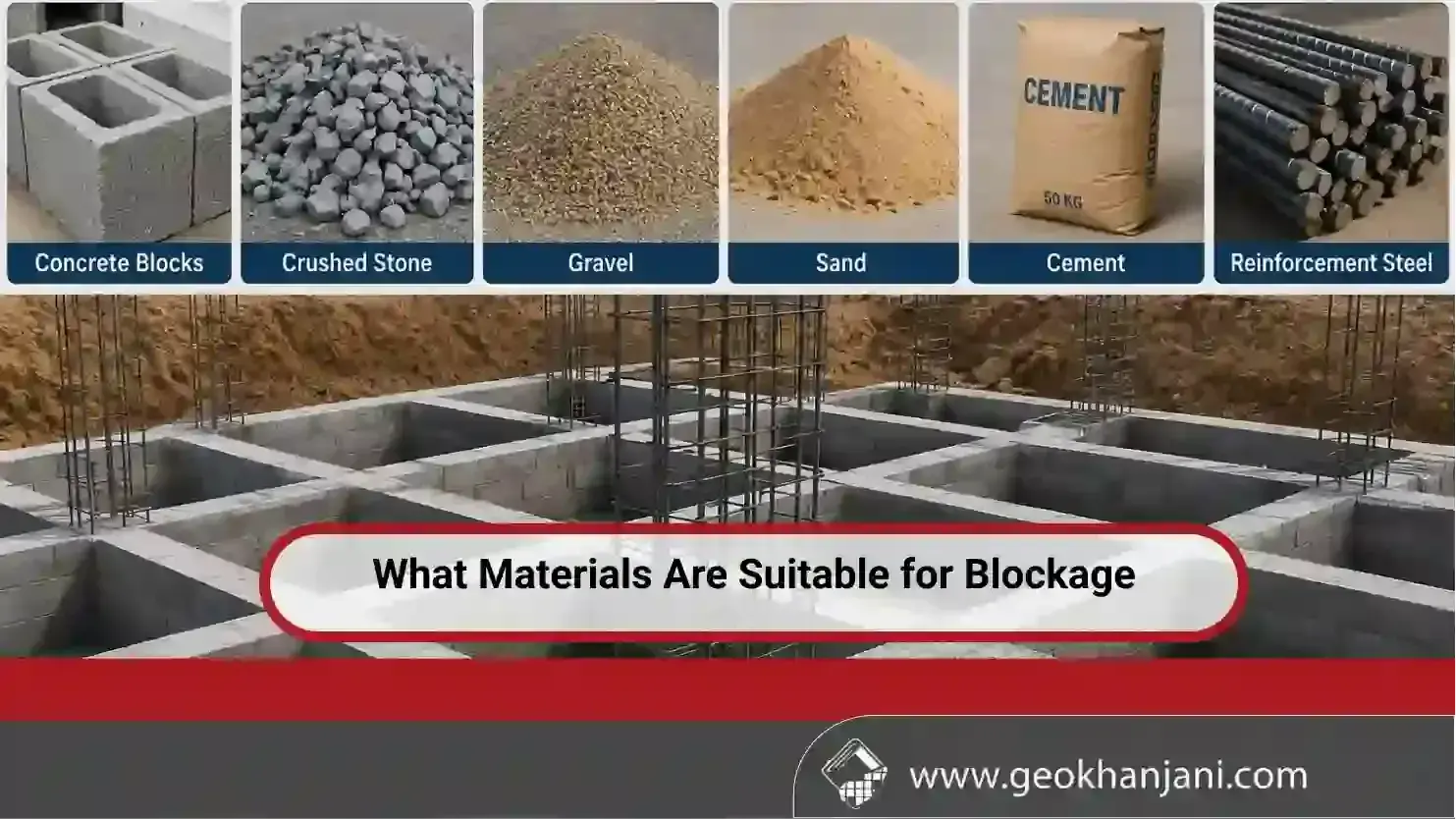 What Materials Are Suitable for Blockage
How Is a Blockage Layer Constructed?
The exact procedure varies between projects, but a typical installation runs through several stages.
The first step is ground investigation and preparation — determining whether the existing soil is suitable, removing weak soil, organic material, loose fill, debris and other unsuitable materials, and excavating to the required level. If the soil itself has inadequate bearing capacity, simply increasing the thickness of blockage may not solve the underlying problem.
Next comes grading and compaction of the exposed soil to the required elevation. This stage is critical, since the granular layer can't fully compensate for significant weakness or uncontrolled settlement in the soil beneath it.
The selected stone or granular material is then placed across the prepared surface — for thicker layers, this is often done in multiple lifts rather than all at once, allowing more effective compaction and better control of the final elevation. Mechanical compaction follows, performed according to project requirements; adequate compaction improves layer stability and reduces the risk of excessive post-construction settlement.
Finally, the completed layer is checked against the specified construction levels. Accurate elevation control matters because the blockage layer affects the position and thickness of everything installed above it.
Is Blockage a Waterproofing System?
No — and this distinction is essential when designing a floor or ground-contact construction system.
Blockage can contribute to ground preparation and, under certain conditions, allow water to move through the granular layer, but it doesn't create a continuous impermeable barrier. Where protection against water infiltration is required, a dedicated waterproofing system should be considered — waterproof membranes, geomembranes, geotextile protection layers, drainage composites, drainage pipes, protective concrete layers, or other waterproofing technologies, depending on the project.
A geomembrane, for example, performs a fundamentally different function from blockage. While blockage forms a granular structural or preparatory layer, a geomembrane is designed to provide a controlled barrier against the passage of water and other fluids.
The Role of Geotextile Beneath Blockage
One important consideration in some granular systems is the interaction between coarse aggregate and fine-grained soil. If fine soil particles migrate upward into the voids of the stone layer, the hydraulic and mechanical characteristics of the granular layer can change over time.
A geotextile can sometimes be installed between the soil and aggregate to provide separation and filtration — a conceptual cross-section might run from natural soil, to geotextile, to blockage aggregate, to the upper floor layers. The geotextile helps limit the mixing of fine soil with the granular layer while still letting water pass, provided a suitable filter design is chosen. Selecting the right geotextile should be based on project-specific requirements rather than simply picking a material by weight.
Can Geomembrane and Blockage Be Used Together?
Yes, but they perform different functions. Blockage primarily provides a granular sub-base and preparation layer, while a geomembrane serves as a waterproofing or fluid-containment component.
In projects where moisture control is particularly important, a multi-layer system might run from compacted soil, to geotextile, to a granular layer, to a concrete or protective layer, to the geomembrane, and then the upper construction layers. Where exactly the geomembrane sits depends on the waterproofing design and the potential sources of water.
Mechanical protection matters here too, since geomembranes can be damaged by sharp stones, protrusions, or uncontrolled construction activity — a suitable geotextile protection layer may be needed as a result.
Blockage vs. Blinding Concrete
Blockage and blinding concrete are often used within the same floor system, but they aren't interchangeable. Blockage is primarily a granular layer made from stone or aggregate, while blinding concrete is a relatively low-strength concrete layer used to provide a cleaner, more uniform and stable surface for subsequent construction.
A project may use both in sequence — prepared soil, then blockage, then blinding concrete, then waterproofing, then the floor structure. The design engineer determines whether both layers are needed and specifies their dimensions and properties.
Does a Thicker Blockage Layer Prevent Settlement?
Not necessarily. Increasing the thickness of a granular layer doesn't automatically solve problems caused by weak or compressible soil. If the underlying ground has poor bearing capacity or significant settlement potential, the appropriate solution may involve ground improvement rather than simply adding more aggregate.
Depending on site conditions, possible techniques include mechanical soil compaction, removal and replacement of unsuitable soil, soil stabilization, geogrid reinforcement, geocell reinforcement, engineered granular fills, or other ground improvement methods. The right method should follow a geotechnical assessment.
Blockage in Wet or Groundwater-Affected Areas
Moisture conditions should be evaluated before installing a blockage layer. If groundwater is present, several questions need answers: where is it coming from, what level is expected, can water migrate toward the floor, is drainage required, is waterproofing required, could fine soil migrate into the aggregate, and does the floor need protection against hydrostatic pressure?
In these situations, blockage may end up being only one component of a larger system. A combination of aggregate, geotextile filtration, drainage components, and geomembrane waterproofing can provide a more appropriate solution than relying on stone alone.
Common Blockage Installation Problems
Several mistakes can reduce the effectiveness of a blockage layer.
Using poor-quality aggregate — weak, contaminated, excessively weathered, or poorly graded material — can perform badly under load. Ignoring the subgrade is another issue, since a high-quality aggregate layer can't fully compensate for an unstable soil foundation. Insufficient compaction increases the risk of future settlement and uneven surfaces, and using an arbitrary thickness is a mistake too — there's no universal blockage thickness suitable for every project; thickness should be established according to ground conditions and floor design.
Treating blockage as waterproofing is one of the most significant misconceptions, since a granular layer is not equivalent to an impermeable waterproofing membrane. And ignoring soil–aggregate interaction can be a problem too — where fine-grained soil is present, filtration and separation may need to be addressed with a suitable geotextile.
Blockage and Modern Geosynthetic Systems
Traditional stone-based construction doesn't necessarily need to be replaced by geosynthetic materials — in many projects, the two approaches complement each other.
Different geosynthetics serve different engineering functions: geotextile handles separation and filtration, geomembrane provides waterproofing and fluid containment, geogrid reinforces soil and aggregate, geocell offers confinement and stabilization, and drainage composites handle water conveyance and drainage.
This functional approach is more useful than asking whether blockage or geosynthetics are inherently "better" — the right solution depends on what the project actually needs the layer to accomplish.
Where Is Blockage Commonly Used?
Depending on the project design, blockage may be used in residential buildings, commercial buildings, warehouses, industrial facilities, ground-floor construction, external paving areas, walkways, access areas, and various other ground preparation applications. The design should account for expected loads, soil conditions, moisture, drainage, and the construction system above the granular layer.
Engineering Checklist Before Installation
Before beginning blockage work, it's worth reviewing the condition of the existing soil, the required excavation depth, and the finished floor elevation. Aggregate type and grading, required layer thickness, and compaction requirements should also be confirmed.
Groundwater conditions, drainage requirements, and waterproofing requirements need to be checked, along with whether geotextile separation or filtration is needed. Finally, the type of upper floor system and expected loading conditions round out the picture. Reviewing these factors before construction can reduce rework, uneven settlement, and unnecessary material costs.
Final Thoughts
Blockage is a simple but important component of many ground-contact floor systems. Its primary value lies in ground preparation, granular support, leveling, and integration with subsequent construction layers — but its performance should always be considered as part of the complete floor and ground system.
Blockage is not a substitute for waterproofing, engineered drainage, or specialized soil improvement. Where project conditions demand additional performance, materials such as geotextile, geomembrane, geogrid, geocell, and drainage composites can be incorporated into the design.
The most effective solution, then, isn't simply choosing a thicker stone layer — it's designing the complete ground-floor assembly according to soil conditions, water exposure, loading, drainage requirements, and the building's intended service life.