This article explains how polyethylene grade, molecular structure, density, mechanical properties, chemical resistance, UV stability and manufacturing quality affect performance in engineering and geosynthetic applications. It focuses on the selection of HDPE and LLDPE geomembranes, ..
- • Engineering Selection of Polyethylene: How Polymer Grade Affects Performance in Geosynthetic Applications
- • Short Introduction to Polyethylene
- • Why Polymer Grade Matters in Engineering Applications
- • The Relationship Between Density and Mechanical Performance
- • HDPE and LLDPE in Geomembrane Applications
- • Environmental Stress Cracking: An Important Design Consideration
- • The Importance of Melt Flow Rate
- • UV Stability in Outdoor Polyethylene Products
- • Chemical Resistance and Material Compatibility
- • Why Geomembrane Thickness Isn't the Only Quality Indicator
- • Polyethylene Selection for Long-Term Infrastructure
- • Processing Quality and Final Product Performance
- • A Practical Approach to Selecting Polyethylene
- • Conclusion
Engineering Selection of Polyethylene: How Polymer Grade Affects Performance in Geosynthetic Applications
Polyethylene is one of the most widely used thermoplastic polymers in modern engineering, but it's a mistake to treat it as a single material with fixed properties. Molecular structure, density, molecular weight, crystallinity, additives and processing conditions all shape how a polyethylene product actually performs once it's in service.
This matters most in geosynthetic applications. Products like geomembranes stay exposed to mechanical loads, temperature swings, chemicals, moisture and general environmental stress for years, sometimes decades. Choosing polyethylene based on its general polymer type isn't enough here. The material grade and the performance requirements of the finished product need to be evaluated together.
Short Introduction to Polyethylene
Polyethylene (PE) is one of the most widely used thermoplastic polymers in the world. It is valued for its low weight, chemical resistance, moisture resistance, flexibility, durability, and relatively easy processing.
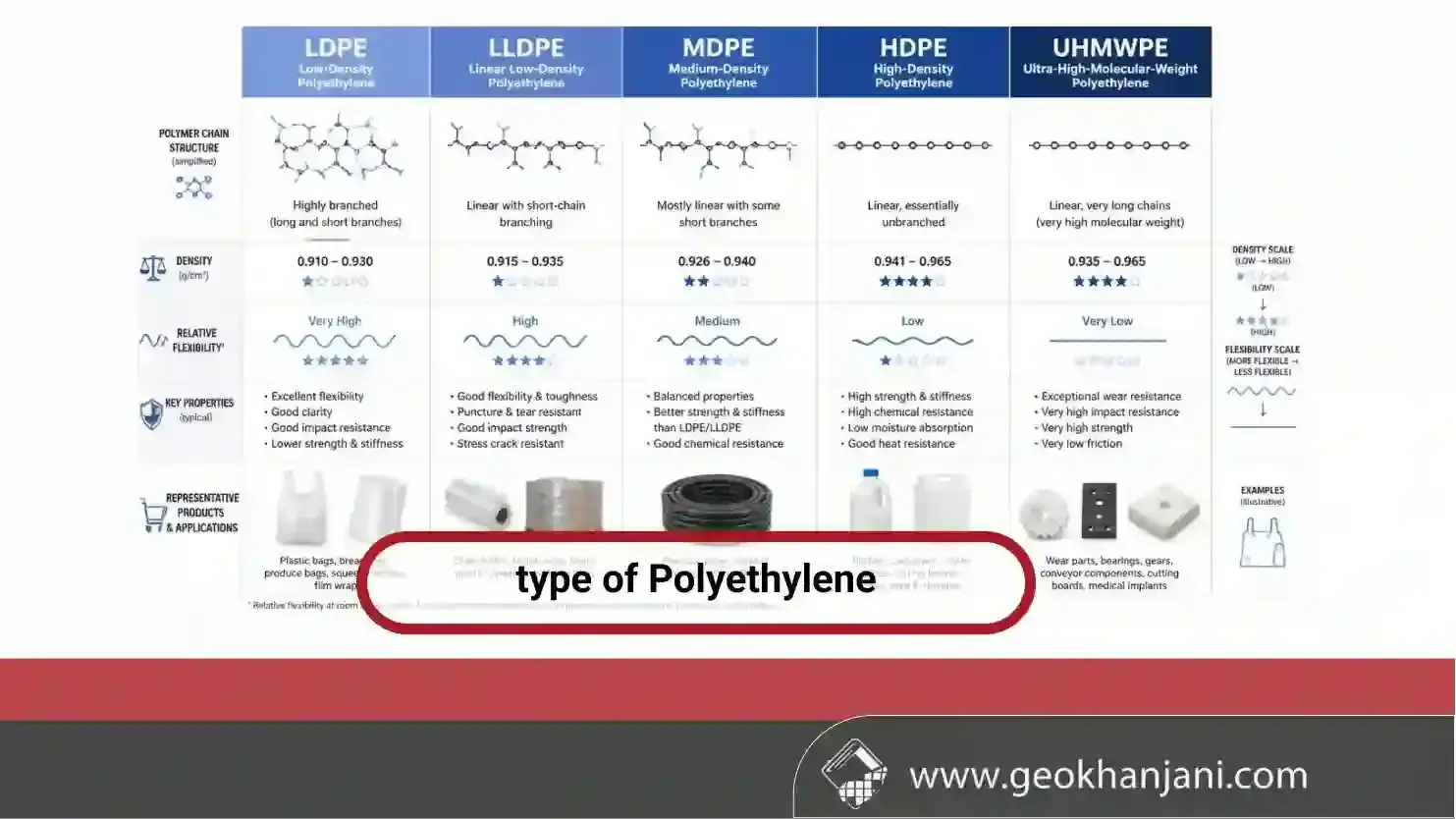 Polyethylene
 is available in several grades, including LDPE, LLDPE, HDPE, MDPE, VLDPE, and UHMWPE .
Each grade has different mechanical and processing characteristics, making it suitable for specific applications.
Depending on the grade, polyethylene is used in packaging films, agricultural products, pipes, tanks, industrial sheets, cable insulation, and geosynthetic products such as geomembranes In engineering applications, selecting the appropriate polyethylene grade is important because factors such as density, mechanical strength, flexibility, UV resistance, chemical compatibility, and long-term durability can significantly affect product performance.
Why Polymer Grade Matters in Engineering Applications
Polyethylene grades are developed to balance stiffness, flexibility, processability, chemical resistance, impact resistance and long-term durability differently. A grade built for film production will prioritize melt processability and flexibility. A grade meant for pipes or engineering sheets needs higher stiffness and stress crack resistance instead. Same polymer family, very different end results.
The parameters worth checking when selecting polyethylene include density and molecular structure, melt flow rate, tensile properties, elongation, impact resistance, environmental stress crack resistance, thermal stability, UV resistance, chemical compatibility and long term creep behavior. These should be judged against real service conditions rather than a product's commercial name alone.
The Relationship Between Density and Mechanical Performance
Density is one of the core traits used to distinguish polyethylene grades. As density rises, crystallinity, stiffness and mechanical behavior generally shift with it. Higher density grades tend to offer more stiffness and strength, which is why they show up in pipes, tanks, sheets and geomembranes.
That said, density alone doesn't tell the whole story. Two products with similar density can still perform quite differently depending on molecular weight distribution, additives, processing and formulation. For engineering use, density is one data point in a fuller specification, not a standalone quality marker.
HDPE and LLDPE in Geomembrane Applications
HDPE and LLDPE are the two polyethylene families most relevant to geomembrane manufacturing, and each tends to suit different applications.
HDPE geomembranes get chosen where stiffness, mechanical strength, chemical resistance and long term dimensional stability matter most. Common uses include agricultural water reservoirs, industrial containment ponds, waste containment systems, mining facilities, wastewater treatment systems and secondary containment structures.
LLDPE geomembranes offer more flexibility instead, which helps when a liner needs to conform to substrate movement or irregular geometry.
Neither material is universally better. The choice comes down to what the specific project actually needs.
Environmental Stress Cracking: An Important Design Consideration
Environmental stress cracking is a failure mechanism worth taking seriously in polyethylene products under sustained mechanical stress combined with certain environmental conditions. Pipes, tanks, liners and geomembranes are all vulnerable since they carry loads over long service periods.
Material selection should weigh the expected combination of mechanical stress, temperature, chemical exposure, installation conditions and exposure duration together. A grade with solid environmental stress crack resistance, paired with sound product design and proper installation, goes a long way toward long term reliability.
The Importance of Melt Flow Rate
Melt flow rate describes how molten polymer flows under specific test conditions. It's especially useful during extrusion and injection molding since it signals how the material will behave in processing.
It's not, however, a direct measure of overall quality. A higher or lower MFR doesn't automatically make one grade better than another — the right value depends on the manufacturing process, product geometry, required mechanical properties and other material characteristics. MFR is best read alongside mechanical and rheological data, not on its own.
UV Stability in Outdoor Polyethylene Products
Many polyethylene products sit outdoors for extended periods, exposed to solar radiation that gradually degrades polymer performance over time. Manufacturers typically address this by building UV stabilizers or carbon black into the formulation for outdoor grades, which matters particularly for geomembranes, agricultural products and pipes exposed during installation or service.
UV stabilization is only one piece of the durability picture, though. Thickness, formulation, processing quality, installation and actual exposure duration all factor into how a product holds up long term.
Chemical Resistance and Material Compatibility
Polyethylene's resistance to many chemicals is one of its real strengths, but that resistance isn't universal. Compatibility depends on the chemical type involved, its concentration, operating temperature, exposure duration, mechanical stress and the specific polymer grade in use.
This becomes especially important in industrial containment, mining, wastewater and chemical storage projects. For critical applications, compatibility should be confirmed against manufacturer data and relevant technical documentation, and tested under representative conditions when the stakes call for it.
Why Geomembrane Thickness Isn't the Only Quality Indicator
It's tempting to compare geomembranes purely on thickness, but thickness only tells part of the story. Depending on the project, tensile strength, elongation, tear resistance, puncture resistance, stress crack resistance, dimensional stability, oxidative stability, UV resistance, weldability and long term durability can all matter just as much.
Weld quality deserves particular attention too — a liner system won't perform as intended if field seams have defects, no matter how good the sheet itself is. Geomembrane specifications are best evaluated as a complete system rather than reduced to a single number.
Polyethylene Selection for Long-Term Infrastructure
Selecting polyethylene for a short-lived product and selecting it for decades-long infrastructure are two different exercises. For packaging and disposable goods, processing efficiency, flexibility, appearance and cost often carry the most weight.
Infrastructure is a different game. Pipes, tanks, liners and geomembranes face sustained mechanical and environmental loading over the long run. For these, engineers need to weigh initial mechanical performance together with long term behavior, environmental exposure and installation conditions — not just how strong a material looks on day one.
Processing Quality and Final Product Performance
Polyethylene's performance isn't just about the resin — manufacturing conditions shape the finished product too. Extrusion temperature, melt homogeneity, cooling conditions, thickness uniformity, additive dispersion, surface quality and dimensional control all leave their mark.
For geomembranes specifically, uniform thickness and consistent properties matter a lot since the liner has to perform continuously across large areas. Good quality control covers both the raw material specification and the finished product's actual properties.
A Practical Approach to Selecting Polyethylene
For an engineering project, the selection process breaks down into a few clear steps.
First, define the service environment: temperature, moisture, UV exposure, chemicals, mechanical loads and expected service life.
Second, determine the required properties: the mechanical, thermal, chemical and durability characteristics the product needs to meet.
Third, select the right polymer family: HDPE, LLDPE, or another polyethylene grade, based on what the application actually calls for.
Fourth, review the technical data: compare verified material and product properties rather than leaning on product names alone.
Fifth, evaluate manufacturing requirements: confirm the material can be processed into the needed product with consistent quality.
Sixth, consider installation conditions: for products like geomembranes and pipes, installation quality can make or break final system performance.
Seventh, verify compliance: for critical applications, check specifications and test results against project requirements and applicable standards.
Conclusion
Polyethylene is far more than a general-purpose plastic. Its range of molecular structures and grades lets manufacturers build everything from flexible films to demanding infrastructure products. In geosynthetic engineering, the distinction between grades matters a great deal — HDPE and LLDPE geomembranes each bring their own mix of stiffness, flexibility, mechanical performance and resistance to environmental stress.
Choosing the right one means weighing polymer grade, formulation, mechanical properties, environmental exposure, chemical compatibility, manufacturing quality, installation conditions and expected service life together. The technically right product isn't necessarily the one that wins on a single spec. It's the one whose overall performance actually matches what the project needs.