Slow drainage does not automatically mean a geotextile has clogged. This guide explains how to investigate the complete water pathway, review soil-filter compatibility, and connect findings to a suitable replacement or maintenance decision.
- • Geotextile Clogging: Diagnose Drainage Problems Before Replacement
- • 1. Understand the filter’s actual job
- • 2. Do not diagnose performance from GSM alone
- • 3. Distinguish clogging from surface blinding
- • 4. Compare dry weather and rainfall behaviour
- • 5. Inspect accessible components before disturbing the filter
- • 6. Request testing that answers the project question
- • 7. Separate filtration from drainage capacity
- • 8. Define the remedy before specifying replacement fabric
- • 9. Build a useful purchasing and maintenance record
- • Conclusion
Geotextile Clogging: Diagnose Drainage Problems Before Replacement
A drainage system that once worked well can gradually become slower, leaving persistent wet areas or increasing maintenance demands. The geotextile is often blamed first because it sits between soil and drainage material. However, poor discharge does not automatically prove that the fabric has clogged. The problem may involve the outlet, drainage core, surrounding soil, installation details, or changing water conditions. Before ordering replacement material, investigate the complete drainage path. A structured diagnosis helps separate a filter compatibility problem from a system problem and supports a more useful specification.
1. Understand the filter’s actual job
A geotextile filter must allow water movement while limiting soil migration into the drainage system. These requirements work together: choosing extremely small openings does not automatically create a better filter, and selecting very open fabric does not automatically improve performance. The soil and geotextile need to function as a compatible system. FHWA guidance identifies soil retention, permeability, clogging potential, and installation survivability as important considerations. Start by establishing what the fabric was intended to do. A protective cushion beneath a liner should not automatically be treated as a correctly designed soil filter.
2. Do not diagnose performance from GSM alone
Mass per unit area describes one characteristic of a geotextile, not its entire filtration behaviour. Two fabrics with similar GSM can have different opening characteristics and water transmission properties. Comparing only their weights can therefore conceal the information needed for drainage selection. Review the original specification and product data, including the properties relevant to the intended flow direction. Our geotextile selection guide explains the broader selection process. For an existing drainage problem, use that overview as a starting point, then investigate the actual soil, filter, and operating conditions rather than simply choosing a heavier replacement.
3. Distinguish clogging from surface blinding
Fine particles can affect the filter in different ways. FHWA describes clogging as a reduction in the fabric’s ability to transmit water and distinguishes surface blinding, where particles form a coating that restricts flow. These descriptions help frame an investigation, but appearance alone is not a complete diagnosis. Soil movement, opening characteristics, and the formation of a stable soil filter must be considered together. Solmax technical guidance also discusses pore size distribution as a way to evaluate soil retention. No single visible stain or generic opening size proves compatibility for every soil.
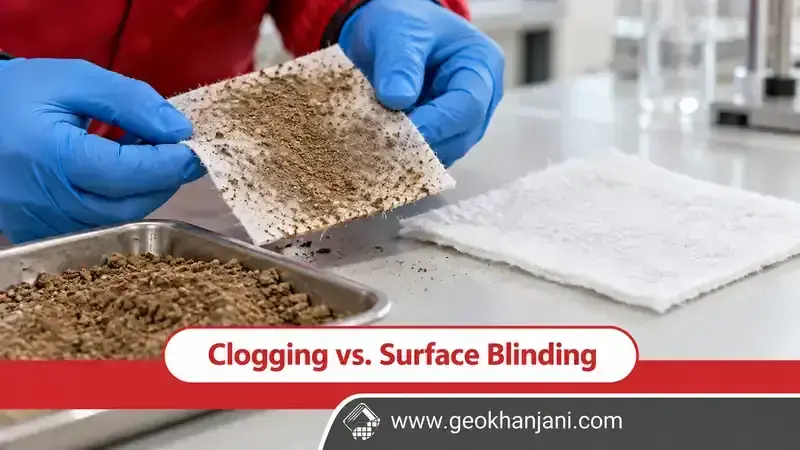 Geotextile Clogging vs. Surface Blinding
4. Compare dry weather and rainfall behaviour
Record when the symptoms occur. Does water accumulate only during heavy rainfall, remain after surrounding areas have drained, or appear throughout the year? Compare current observations with earlier conditions and note changes in surface runoff or nearby construction. This record helps the project team define the investigation rather than assuming one cause. Our article on geotextiles for wet climates explains why exposure conditions matter. The practical question is whether the drainage system still matches the water conditions it faces, not whether the selected fabric carries a general label suitable for rainy regions.
5. Inspect accessible components before disturbing the filter
Check accessible outlets, collection points, and inspection facilities first. Record obstructions, sediment deposits, visible damage, and the route water must follow. Avoid interpreting a clear section of pipe as proof that every upstream component works correctly. Where drainage supports a retaining structure, unexpected movement or distress requires assessment by the responsible engineer. The article on retaining wall failure provides background on why drainage deserves attention. Inspection should produce a location map and observations, not an immediate instruction to excavate or remove material without understanding the structure and its access constraints.
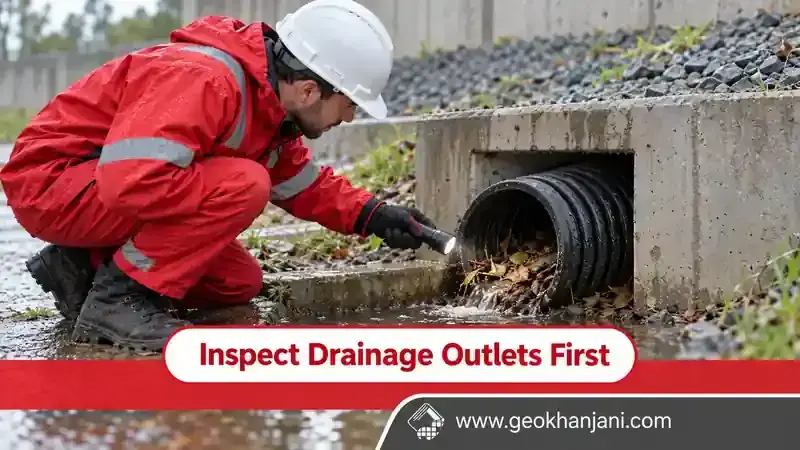 Drainage Outlet Inspection
6. Request testing that answers the project question
If filter compatibility remains uncertain, agree on the investigation with the designer and an appropriate laboratory. Provide representative soil information, available product identification, the intended application, and observations from the site. Relevant checks may include opening characteristics and hydraulic properties, interpreted alongside soil gradation. A manufacturer’s clean material data sheet does not, by itself, establish how the installed combination behaves after service. Ask what each proposed test can demonstrate and what it cannot. Avoid turning one result into a universal replacement rule, especially when the sample does not represent the affected location.
7. Separate filtration from drainage capacity
A filter can meet its intended requirements while another component limits discharge. Review the drainage core, collection arrangement, outlets, and the conditions under which the system operates. For excavation projects, the construction excavation waterproofing and drainage guide explains the relationship between different layers. Waterproofing controls unwanted passage through the barrier; drainage provides a route for collected water. Changing the geotextile cannot automatically resolve an undersized or obstructed downstream path. Keep the investigation focused on the function of each component, and document where the evidence indicates a restriction rather than treating the installation as one interchangeable product.assessing geonet drainage capacity under load
8. Define the remedy before specifying replacement fabric
The proposed remedy should follow the findings. An accessible outlet obstruction calls for a different response from an incompatible soil filter or damaged drainage layer. If replacement is justified, prepare a specification that addresses the identified mechanism, product performance, installation conditions, and inspection requirements. Do not simply copy the original GSM and expect a different outcome. Confirm that interfaces, joints, and surrounding materials will maintain the intended filtration arrangement. FHWA rockery guidance illustrates the importance of compatibility checks and preventing gaps that bypass filter protection. Application-specific details must remain specific to the project.
9. Build a useful purchasing and maintenance record
Before requesting quotations, assemble the confirmed soil information, required geotextile functions, project drawings, and relevant test results. Ask suppliers for documented properties and installation instructions, with clear identification of the offered product. Record assumptions that still require the designer’s confirmation. For maintenance, define accessible observation points and the information to collect when symptoms return. The explanation of why excavations need waterproofing and drainage systems can support communication with project stakeholders. A purchasing record that connects the diagnosis to the proposed material is more valuable than an isolated comparison of price or weight.
Conclusion
Successful troubleshooting begins with evidence, not a heavier fabric. Identify the water pathway, inspect accessible restrictions, review soil and geotextile compatibility, and test only where the results will support a decision. Then connect the remedy to verified product properties and installation requirements. This approach turns a drainage complaint into a documented technical decision and helps prevent the same misunderstanding from being repeated during the next purchase. Retain photographs, inspection dates, and supporting documents for future technical reviews.