Geomembrane in Water Management and Environmental Protection
100
0
This technical article explains the role of geomembranes in water management and environmental protection, covering their applications in agricultural reservoirs, irrigation ponds, wastewater treatment, landfill liners, leachate containment, rainwater harvesting, mining and industrial facilities.
- • What Is a Geomembrane?
- • Why Are Geomembranes Important in Water Management?
- • Applications of Geomembranes in Water Management
- • Geomembranes and Environmental Protection
- • Geomembranes in Landfill Engineering
- • Geomembrane for Leachate Containment
- • Geomembranes in Mining and Industrial Water Management
- • Geomembrane for Rainwater Harvesting
- • Role of Geotextiles in Geomembrane Systems
- • Geomembrane Selection for Water and Environmental Projects
- • Geomembrane Installation in Water Management Projects
- • Advantages of Geomembranes in Environmental Protection
- • Limitations and Important Considerations
- • Geomembrane vs. Traditional Waterproofing Methods
- • Environmental Sustainability and Geomembranes
- • Quality Control and Testing
- • Conclusion
Geomembranes play an important role in modern water management and environmental protection systems. These synthetic membranes are designed to provide a low-permeability barrier between liquids, soil and surrounding environments. Their ability to control water infiltration and contain potentially harmful liquids has made geomembranes an important component of many civil engineering, agricultural, industrial and environmental projects.
From irrigation reservoirs and water storage ponds to wastewater treatment facilities and landfill containment systems, geomembranes help engineers manage water resources while reducing uncontrolled seepage and environmental contamination.
The selection of a geomembrane, however, should be based on project-specific factors such as the type of liquid, temperature, mechanical loading, substrate conditions, expected service life and installation method.
What Is a Geomembrane?
A geomembrane is a flexible synthetic liner manufactured from polymers with very low permeability. Common geomembrane materials include:
HDPE — High-Density Polyethylene
LLDPE — Linear Low-Density Polyethylene
PVC — Polyvinyl Chloride
EPDM — Ethylene Propylene Diene Monomer
RPP — Reinforced Polypropylene
Each material has different mechanical, chemical and environmental characteristics.
Geomembranes are generally supplied in rolls or panels and installed over prepared surfaces. Adjacent panels are joined using an appropriate seaming technique to create a continuous containment system.
Why Are Geomembranes Important in Water Management?
Effective water management requires controlling where water is stored, transported, infiltrated or discharged.
Uncontrolled seepage from reservoirs and ponds can result in:
- Water loss
- Soil saturation
- Groundwater impacts
- Structural instability
- Increased maintenance requirements
- Reduced storage efficiency
A properly designed geomembrane liner creates a low-permeability barrier that can significantly reduce unwanted water infiltration.
This makes geomembranes particularly useful in areas where water conservation is important or where the underlying soil does not provide adequate natural containment.
Applications of Geomembranes in Water Management
1. Agricultural Water Reservoirs
Agricultural reservoirs are commonly constructed to store water for irrigation.
Without an effective liner, water can infiltrate into surrounding soil depending on the geological and hydraulic conditions.
Geomembrane liners can be installed in:
- Irrigation ponds
- Agricultural reservoirs
- Rainwater storage basins
- Farm water storage facilities
- Seasonal water reservoirs
The appropriate membrane thickness and protection system depend on the site conditions and expected mechanical loads.
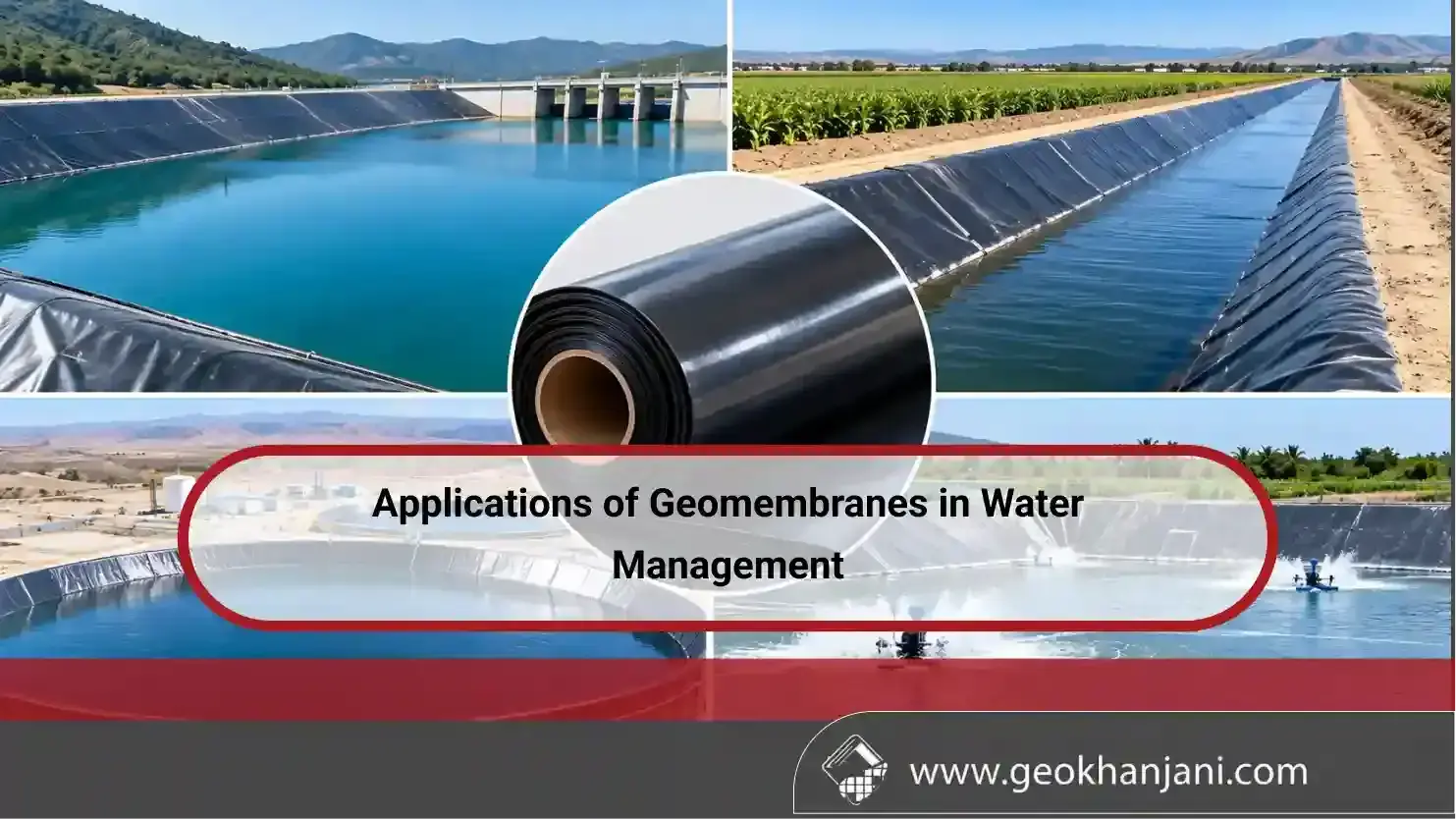 Applications of Geomembranes in Water Management
2. Irrigation Ponds
Irrigation ponds require reliable water containment throughout their operating life.
Geomembranes can provide a continuous barrier between stored water and the soil.
A typical system may consist of:
Prepared subgrade → Geotextile protection → Geomembrane → Protective or ballast layer
The exact configuration depends on project design.
3. Drinking Water Storage
Geomembranes may be used in certain potable-water storage applications, provided that the selected membrane is specifically manufactured, tested and certified for contact with drinking water under the applicable regulations.
Material selection is particularly important because not every geomembrane is suitable for potable-water applications.
Factors to evaluate include:
- Regulatory approval
- Chemical composition
- Water compatibility
- Temperature
- UV exposure
- Expected service life
4. Wastewater Treatment Facilities
Wastewater management is one of the major environmental applications of geomembranes.
Geomembranes can be used in:
- Wastewater lagoons
- Treatment ponds
- Anaerobic lagoons
- Sludge containment areas
- Industrial wastewater basins
- Evaporation ponds
The membrane acts as a barrier designed to limit uncontrolled migration of wastewater into the surrounding soil.
Chemical compatibility should always be evaluated because wastewater composition can vary significantly.
Geomembranes and Environmental Protection
Environmental protection applications require containment systems that reduce the migration of potentially harmful liquids into soil and groundwater.
Geomembranes can be incorporated into engineered containment systems for:
- Landfills
- Leachate ponds
- Industrial waste facilities
- Mining operations
- Contaminated sites
- Chemical containment areas
In these systems, the geomembrane is usually combined with other engineered layers rather than being used as an isolated component.
Geomembranes in Landfill Engineering
Modern landfill facilities require systems capable of controlling leachate and limiting its migration into the surrounding environment.
A landfill liner system may incorporate several components, such as:
- Compacted clay
- Geosynthetic clay liner (GCL)
- Geomembrane
- Geotextile
- Geonet
- Geocomposite drainage layer
The geomembrane provides a low-permeability barrier, while drainage layers can collect and transport liquids toward designated collection systems.
The exact liner configuration depends on local regulations, waste characteristics, site geology and engineering requirements.
Geomembrane for Leachate Containment
Leachate is a liquid generated when water passes through waste materials and interacts with decomposing substances.
Because leachate can contain dissolved contaminants, controlling its migration is an important environmental objective.
Geomembranes can be used to line:
- Leachate collection ponds
- Storage basins
- Treatment facilities
- Landfill containment structures
The membrane material must be selected according to the chemical characteristics of the leachate and expected operating conditions.
Geomembranes in Mining and Industrial Water Management
Mining and industrial facilities frequently require large containment areas for process water and other liquids.
Geomembranes can be used in:
- Process-water ponds
- Tailings-related containment systems
- Evaporation ponds
- Industrial reservoirs
- Chemical storage areas
- Secondary containment systems
For industrial applications, chemical compatibility is one of the most important selection criteria.
HDPE, for example, is widely used in many containment applications because of its combination of chemical resistance and mechanical performance, but the suitability of any material must be verified against the specific chemical environment.
Geomembrane for Rainwater Harvesting
Rainwater harvesting systems can use geomembranes to create lined storage basins.
A lined rainwater reservoir can help reduce infiltration losses and retain collected water for later use.
Applications include:
- Agricultural rainwater harvesting
- Industrial water storage
- Landscape irrigation
- Emergency water storage
- Remote-area reservoirs
The liner should be selected according to the intended water use and applicable regulations.
Role of Geotextiles in Geomembrane Systems
Geomembranes can be vulnerable to puncture from sharp particles or irregularities in the underlying soil.
A geotextile may therefore be installed beneath the geomembrane as a protective layer.
The geotextile can help:
- Reduce puncture risk
- Separate materials
- Distribute localized stresses
- Protect the geomembrane from rough substrates
In some systems, geotextiles may also be used above the geomembrane to provide additional protection.
The required geotextile characteristics depend on the project loading and substrate conditions.
Geomembrane Selection for Water and Environmental Projects
Selecting a geomembrane should involve more than simply comparing prices or nominal thickness.
Important design parameters include:
Polymer Type
The polymer determines many of the membrane's fundamental characteristics.
Thickness
Typical thickness requirements vary according to mechanical loading, substrate quality, expected service life and application.
Chemical Resistance
The membrane should be compatible with the liquid being contained.
Tensile Properties
Mechanical properties are important when the liner may experience settlement, installation stresses or other loads.
Puncture and Tear Resistance
These properties are particularly important for applications involving rough substrates or construction traffic.
UV Resistance
Exposed geomembranes may experience long-term ultraviolet radiation. The membrane formulation and stabilization system should therefore be appropriate for the expected exposure.
Geomembrane Installation in Water Management Projects
Professional installation is essential for achieving the intended performance of a geomembrane system.
1. Subgrade Preparation
The foundation should be properly graded and compacted where required.
Sharp objects, roots, debris and other potential sources of membrane damage should be removed.
2. Geomembrane Deployment
Membrane panels are positioned according to the approved installation layout.
Excessive stretching and unnecessary dragging should be avoided.
3. Seaming
Adjacent membrane panels are joined using a method appropriate for the material.
Common techniques include:
- Hot-wedge welding
- Hot-air welding
- Extrusion welding
- Other manufacturer-approved joining systems
4. Seam Testing
Welded seams should be inspected and tested according to the applicable project specifications.
Possible quality-control methods include:
- Visual inspection
- Peel testing
- Shear testing
- Vacuum testing
- Air-pressure testing
5. Final Inspection
The completed liner should be inspected for visible defects, damage, wrinkles and installation problems before the system is placed into service.
Advantages of Geomembranes in Environmental Protection
Geomembranes provide several important engineering benefits.
Reduced Water Loss
In water-storage applications, a low-permeability liner can reduce uncontrolled infiltration.
Environmental Containment
Geomembranes can help isolate wastewater, leachate and other liquids from surrounding soil.
Flexible Installation
They can be installed over large areas and adapted to different basin geometries.
Controlled Leakage
When properly designed, welded and tested, geomembrane systems can provide highly effective liquid containment.
Integration with Geosynthetics
Geomembranes can be combined with geotextiles, geonets, GCLs and geocomposites to create multilayer containment systems.
Limitations and Important Considerations
Geomembranes are not a universal solution for every water-management project.
Their performance depends heavily on:
- Correct material selection
- Subgrade preparation
- Seam quality
- Installation practices
- Environmental exposure
- Mechanical loading
- Chemical compatibility
- Drainage design
- Quality control
For example, a geomembrane may have excellent chemical resistance but still fail prematurely if it is installed over an inadequately prepared substrate or if seams are improperly constructed.
Geomembrane vs. Traditional Waterproofing Methods
Traditional waterproofing systems may include compacted clay, concrete, asphalt-based systems or other construction materials.
Geomembranes differ in several ways:
Characteristic | Geomembrane | Traditional Liner |
Permeability | Very low | Depends on material |
Installation | Roll/panel based | Depends on system |
Flexibility | Generally high | Varies |
Large-area application | Suitable | May require more construction work |
Chemical resistance | Polymer dependent | Material dependent |
Seam requirements | Requires controlled seaming | Depends on system |
Quality control | Material and seam testing | Construction-specific |
The appropriate system should be selected according to the engineering requirements of the project.
Environmental Sustainability and Geomembranes
Geomembranes can contribute to environmental management by helping conserve water and contain potentially contaminated liquids.
However, sustainability should be evaluated across the entire life cycle of the system, including:
- Raw material production
- Transportation
- Installation
- Service life
- Maintenance
- Removal
- End-of-life management
Long service life and effective containment can reduce the need for repeated reconstruction, but environmental performance ultimately depends on the specific material and project conditions.
Quality Control and Testing
Quality assurance is a critical part of geomembrane installation.
Depending on the application, testing may include:
- Thickness measurement
- Tensile strength
- Elongation
- Tear resistance
- Puncture resistance
- Carbon black or additive analysis where applicable
- Seam peel strength
- Seam shear strength
- Leak detection
- Vacuum testing
- Air-channel testing
Relevant ASTM, ISO or project-specific standards should be selected based on the geomembrane type and intended application.
Conclusion
Geomembranes are an important component of modern water management and environmental protection systems. Their low permeability and adaptable installation characteristics make them useful for water reservoirs, irrigation ponds, wastewater treatment facilities, landfill containment, leachate management and industrial liquid containment.
However, successful performance depends on more than selecting a membrane with a suitable thickness. Polymer type, chemical compatibility, mechanical properties, substrate preparation, seam quality, protective layers and installation quality must all be considered during system design.
When properly engineered and installed, geomembrane systems can provide an effective barrier for managing water resources and reducing the uncontrolled migration of liquids into the surrounding environment.
For technical consultation, product specifications and purchasing geomembranes and other geosynthetic products, visit Geokhanjani and select the appropriate solution according to your project requirements.