Polyethylene, or PE, is one of the most widely used thermoplastic polymers in the world. Its combination of low density, chemical resistance, moisture resistance, flexibility, durability, and relatively simple processing has made it an essential material in packaging, agriculture, construction, piping, industrial manufacturing, and geosynthetic engineering.
Although the term polyethylene refers to a broad family of polymers, different grades can behave quite differently from one another. Variations in molecular structure, density, molecular weight, crystallinity, additives, and processing conditions allow manufacturers to produce materials ranging from highly flexible films to rigid engineering components.
Understanding these differences matters when selecting polyethylene for an industrial or construction application.
What Is Polyethylene?
Polyethylene is a thermoplastic polymer produced through the polymerization of ethylene. As a thermoplastic, it softens when heated and can be shaped using manufacturing methods such as extrusion, injection molding, blow molding, and film production.
One of its major advantages is that its properties can be tuned to the intended application. Depending on the polymer structure and grade, polyethylene can offer different levels of flexibility, stiffness, tensile strength, impact resistance, chemical resistance, moisture resistance, environmental stress crack resistance, thermal stability, and UV resistance.
This versatility is why polyethylene shows up in both everyday consumer products and demanding infrastructure projects.
Main Types of Polyethylene
Polyethylene comes in several major grades, each with a characteristic set of properties suited to particular applications.
LDPE, Low-Density Polyethylene
LDPE is known for its flexibility and good processability. It's commonly used for films, bags, flexible packaging, coatings, and select agricultural products. Its flexibility makes it useful anywhere the material needs to bend or deform without breaking easily.
LLDPE, Linear Low-Density Polyethylene
LLDPE offers a useful combination of flexibility, tensile performance, and resistance to puncture and tearing. It's widely used in flexible films, stretch films, packaging products, agricultural films, and some flexible liner applications.
HDPE, High-Density Polyethylene
HDPE generally provides greater stiffness and mechanical strength than lower-density grades, along with good resistance to many chemicals. It's widely used for water and wastewater pipes, industrial tanks, plastic sheets, containers, industrial components, geomembranes, and chemical containment applications. This is why HDPE plays such an important role in infrastructure and geosynthetic engineering.
MDPE, Medium-Density Polyethylene
MDPE strikes a balance between stiffness and flexibility. It's used in select piping systems, fittings, protective applications, and other products where an intermediate property profile fits best.
VLDPE, Very Low-Density Polyethylene
VLDPE is defined by high flexibility and is used mainly in soft films, flexible packaging, multilayer structures, and specialized flexible products.
UHMWPE, Ultra-High-Molecular-Weight Polyethylene
UHMWPE has an exceptionally high molecular weight and stands out for its wear and abrasion resistance. It's used in specialized industrial components, sliding surfaces, wear-resistant parts, and certain medical applications.
PEX, Cross-Linked Polyethylene
PEX is produced by cross-linking polyethylene molecules, which changes its thermal and mechanical behavior and makes it suitable for hot-water piping and underfloor heating systems.
These differences show why the word polyethylene on its own doesn't tell you whether a product fits a specific engineering application.
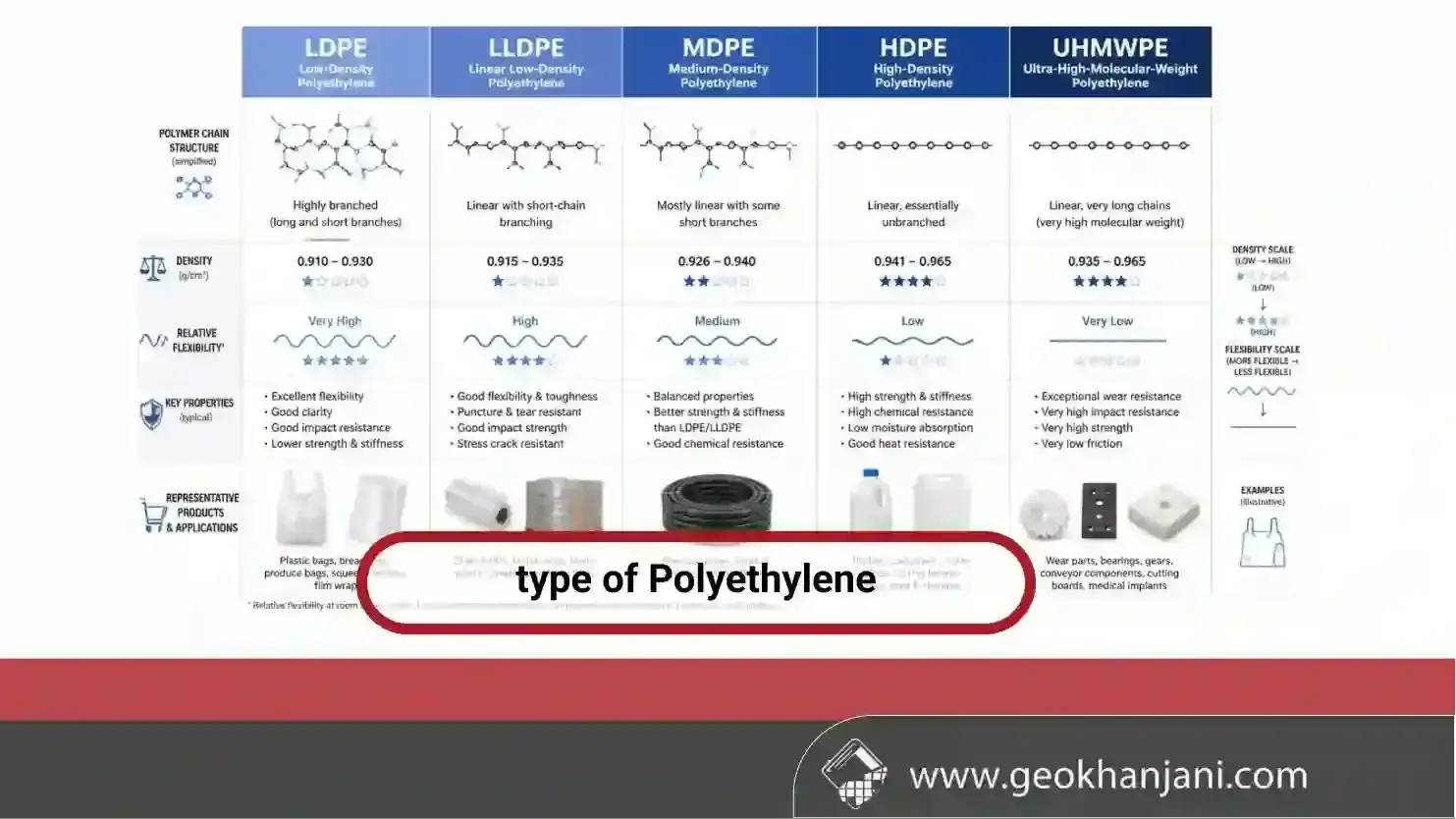 Types of Polyethylene
Why Is Polyethylene Used So Widely?
Polyethylene's popularity comes down to a useful combination of properties working together.
Chemical Resistance
Many polyethylene grades resist a wide range of acids, bases, salts, and aqueous solutions well, which is why the material shows up in pipes, tanks, liners, and containment products. That resistance isn't universal, though. Compatibility should be judged against the specific chemical, concentration, temperature, exposure duration, and mechanical conditions involved.
Low Weight
Polyethylene is relatively light compared with many traditional engineering materials, which reduces transportation and handling demands and can simplify installation.
Moisture Resistance
With low water absorption and a hydrophobic nature, polyethylene suits many applications that involve water and moisture.
Processability
PE can be processed through several industrial techniques, letting manufacturers turn it into films, pipes, sheets, containers, tanks, profiles, and a long list of other products.
Adjustable Flexibility
By choosing the right grade and formulation, manufacturers can produce anything from highly flexible films to fairly rigid engineering components.
What Are the Main Uses of Polyethylene?
Polyethylene's applications range from short-term consumer products to long-term infrastructure systems.
Packaging Industry
Packaging is one of the largest applications of polyethylene. LDPE and LLDPE commonly go into flexible films, bags, wrapping materials, and other packaging products, while HDPE shows up in containers, bottles, and relatively rigid packaging. What matters most here is flexibility, tear resistance, puncture resistance, sealability, moisture resistance, and processability, with the right grade depending on required film thickness, mechanical properties, packaging process, and final application.
Polyethylene Pipes and Fluid Transportation
HDPE is extensively used in pipe manufacturing because of its low weight, corrosion resistance, flexibility, and mechanical performance. Polyethylene pipes handle water distribution, raw water transportation, wastewater systems, drainage, industrial fluids, and select gas distribution systems.
For pressure applications, pipe selection needs to account for diameter, wall thickness, SDR, pressure rating, material grade, operating temperature, and expected service life. Polyethylene pipes can also be joined using butt fusion and electrofusion, depending on the pipe system and project requirements.
Agricultural Applications
Polyethylene plays an important role in modern agriculture, used in irrigation pipes, greenhouse films, agricultural mulch films, water storage liners, and protective films. Greenhouse films can incorporate additives that improve UV stability, condensation behavior, and light transmission.
In agricultural water reservoirs, polyethylene geomembranes serve as low-permeability liners that reduce water loss through the soil. HDPE and LLDPE geomembranes are both options here, with the choice depending on geometry, substrate movement, flexibility requirements, and project conditions.
Geomembranes and Geosynthetic Engineering
One of the most important specialized uses of polyethylene is in geomembranes, synthetic barrier materials used to control the movement of liquids and, in certain systems, gases.
HDPE geomembranes are common in agricultural ponds, water storage reservoirs, industrial containment ponds, wastewater systems, landfill liners, mining applications, evaporation ponds, and waste containment systems. LLDPE geomembranes can be the better fit where flexibility matters more, including projects with complex geometries or potential substrate deformation.
A geomembrane's performance depends on far more than polymer type. Thickness, tensile properties, puncture resistance, stress crack resistance, thermal stability, UV resistance, manufacturing quality, substrate preparation, and seam quality all play into how the liner system actually performs.
Landfill and Environmental Protection
Polyethylene geomembranes are also used in engineered landfill systems to help control leachate movement and reduce the risk of contamination to surrounding soil and groundwater.
A landfill liner system can include a geomembrane, a geotextile protection layer, a drainage layer, a geosynthetic clay liner, and compacted clay or other engineered barrier layers. How the full system is designed depends on waste characteristics, site conditions, groundwater conditions, regulatory requirements, and engineering criteria. Seam quality and field inspection deserve particular attention, since defects in geomembrane joints can compromise the whole containment system.
Industrial Tanks and Containers
HDPE is widely used to manufacture tanks and containers through rotational molding, blow molding, and injection molding, covering water tanks, industrial storage tanks, chemical containers, process water tanks, drums, industrial boxes, and storage containers.
For chemical storage, polyethylene shouldn't be assumed compatible with every substance. Chemical concentration, operating temperature, exposure time, and mechanical loading all need evaluation before the material is chosen.
Construction and Building Applications
Polyethylene also appears in construction as pipes, sheets, films, moisture-control layers, and waterproofing-related products. In some foundation and basement systems, polyethylene sheets or geomembranes form part of a waterproofing or moisture-control system, though the complete system still needs to address drainage, joints, penetrations, mechanical protection, and hydrostatic pressure where relevant. Polyethylene products also find their way into building plumbing and select drainage applications.
Electrical and Cable Applications
Certain polyethylene grades offer useful electrical insulation properties and are used in wire and cable manufacturing, including cable insulation, cable jackets, communication cables, and specialized electrical components. Cross-linked polyethylene, or XLPE, is particularly important in power cable applications because cross-linking changes its thermal and mechanical behavior.
Medical and Specialized Applications
Select polyethylene grades are used in medical and healthcare products, including medical packaging, disposable components, fluid-transfer components, specialized medical parts, and certain orthopedic applications. UHMWPE in particular is used in specific orthopedic applications thanks to its wear resistance and low-friction characteristics. Medical applications call for specialized grades and strict control over raw materials, manufacturing conditions, contamination, biocompatibility, and sterilization.
Mining and Industrial Applications
Polyethylene is also used in mining and mineral-processing projects, including slurry pipelines, industrial tanks, process water systems, containment liners, and mining ponds. Material selection for slurry transportation needs to account for particle concentration, flow velocity, pressure, abrasion, temperature, and expected service life. Polyethylene geomembranes are also used to line mining ponds and process containment areas where chemical and mechanical resistance are needed.
How Do You Choose the Right Polyethylene?
Selecting polyethylene for an engineering application takes more than comparing the names of different grades.
Density relates to molecular structure and crystallinity and can influence stiffness and mechanical performance. Melt flow rate describes melt flow behavior under defined test conditions and matters most for processing, but it shouldn't be treated as a standalone indicator of quality. Environmental stress crack resistance matters especially for pipes, tanks, liners, and other products under long-term mechanical and environmental stress. Thermal performance matters too, since operating temperature can significantly affect polyethylene's mechanical and dimensional behavior, so both continuous and peak temperatures should be considered. UV resistance matters for outdoor products, which may need suitable UV stabilizers or formulations to reduce solar degradation. And chemical compatibility needs to be checked against the actual chemical environment, factoring in concentration, temperature, exposure time, and mechanical stress.
Polyethylene vs. Application Requirements
No single polyethylene grade is ideal for every application. A flexible packaging film needs very different properties from a high-pressure water pipe, and a geomembrane used in a landfill or mining facility may need different long-term performance characteristics than a polyethylene container.
For short-life products, processing efficiency and cost tend to dominate the decision. For infrastructure products, long-term durability, resistance to environmental exposure, mechanical stability, and quality control matter far more. This is why engineers and manufacturers should choose polyethylene based on the actual service environment rather than a general classification alone.
Is Polyethylene Recyclable?
Many polyethylene products can be mechanically recycled, though how feasible and how good that recycling turns out depends on product type, contamination, additives, material composition, collection systems, and available technology.
Agricultural films and industrial products get harder to recycle when contaminated with soil, organic materials, sediments, or chemicals. For large infrastructure projects, it helps to think about end-of-life management at the design stage, so collection, separation, reuse, or disposal can be planned properly from the start.
Final Thoughts
Polyethylene is a versatile engineering polymer, not a single material with identical properties across the board. Its different grades make it possible to produce everything from flexible packaging films and agricultural products to high-performance pipes, tanks, geomembranes, and specialized industrial components.
The right polyethylene for a given job depends on the required mix of mechanical performance, flexibility, chemical resistance, thermal stability, UV resistance, processing behavior, and expected service life. For applications involving geosynthetics and geomembranes, material selection should be considered alongside product design, substrate conditions, installation procedures, welding quality, and project-specific requirements.
Understanding what polyethylene is and how its different grades behave is the first real step toward picking the right material for a particular application.