Nano waterproofing includes advanced materials such as nano-silica, silane, siloxane, acrylic, silicone, polyurethane, cementitious, ceramic and hybrid systems. This guide explains how each type works, its main applications, advantages and limitations, ..
- • Types of Nano Waterproofing Materials: A Technical Guide to Modern Nano Insulation Systems
- • What Is Nano Waterproofing?
- • Main Types of Nano Waterproofing Materials
- • Nano Waterproofing vs. Traditional Waterproofing
- • How Nano Waterproofing Works
- • Advantages of Nano Waterproofing Materials
- • Limitations of Nano Waterproofing
- • How to Choose the Right Nano Waterproofing Material
- • Nano Waterproofing for Roofs
- • Nano Waterproofing for Concrete
- • Nano Waterproofing for Foundations and Basements
- • Nano Waterproofing for Pools and Water Tanks
- • What Makes a Nano Waterproofing Product Reliable?
- • Common Mistakes When Buying Nano Waterproofing
- • Final Conclusion
Types of Nano Waterproofing Materials: A Technical Guide to Modern Nano Insulation Systems
Nano waterproofing materials have become increasingly important in modern construction because they can provide water resistance while maintaining a relatively thin coating profile. Unlike conventional waterproofing systems that often rely on thick membranes, bituminous layers or cementitious barriers, nano-based products use engineered particles and advanced formulations to modify surface properties and reduce water penetration.
However, nano waterproofing isn't a single material or product category. Different formulations are designed for concrete, masonry, roofs, facades, metal surfaces, bathrooms, foundations and other applications. Choosing the right nano waterproofing system therefore requires more than looking for the word "nano" on a product label — the chemical composition, substrate, exposure conditions, crack movement, water pressure and application method all need to be evaluated.
This guide looks at the main types of nano waterproofing materials, their characteristics, applications, advantages and limitations.
What Is Nano Waterproofing?
Nano waterproofing refers to waterproofing or water-repellent systems that incorporate nanoscale particles or nano-engineered structures into their formulation. The purpose of these technologies can include reducing surface wettability, increasing water repellency, blocking or reducing capillary water absorption, improving penetration into porous substrates, enhancing surface durability, and modifying the interaction between water and the treated surface.
At the nanoscale, materials can exhibit surface and interfacial properties that differ significantly from conventional particles. That said, the actual performance of a nano waterproofing product depends on its complete formulation, not simply on the presence of nanoparticles.
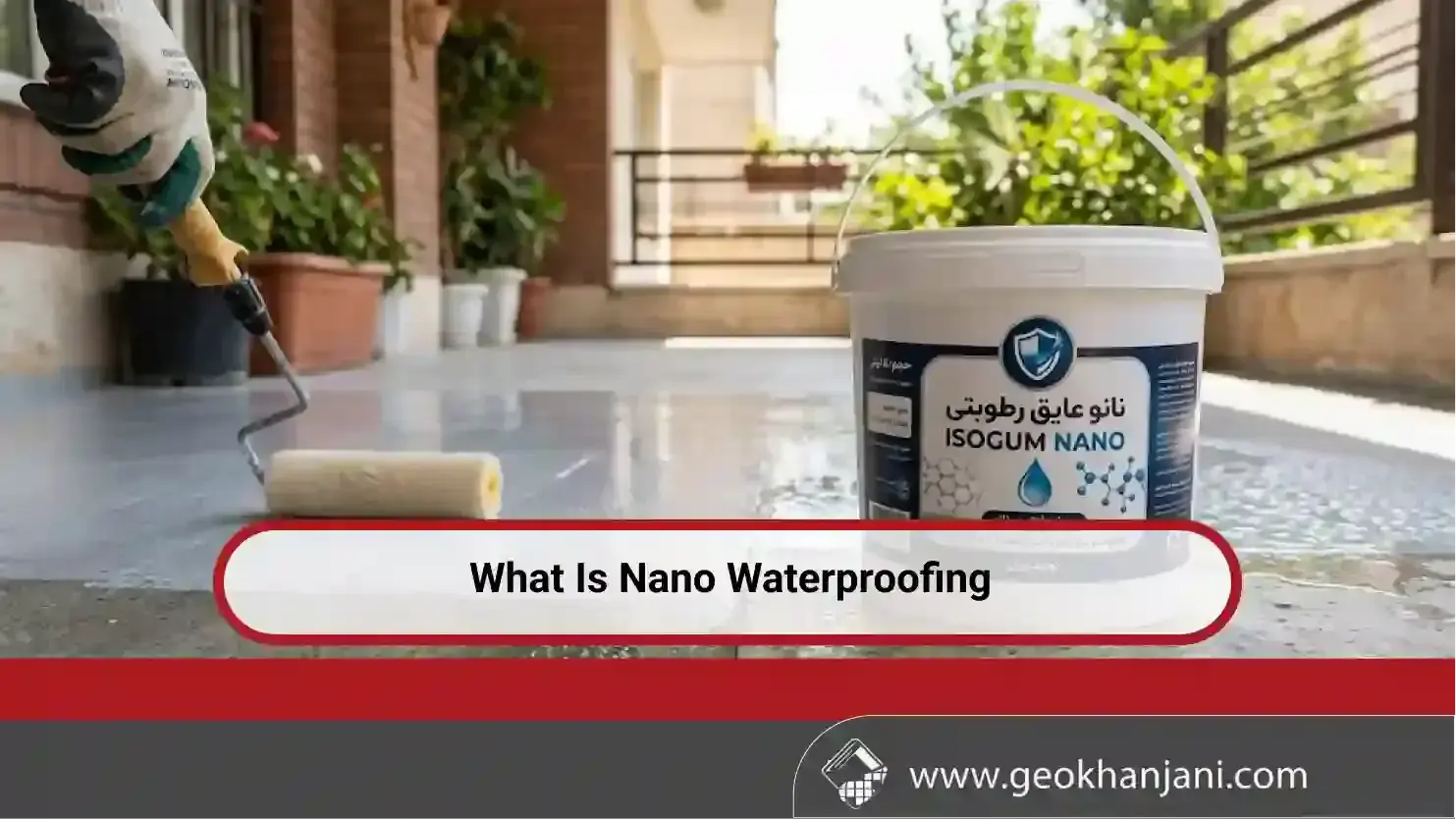 What Is Nano Waterproofing
Main Types of Nano Waterproofing Materials
Nano waterproofing systems can be categorized according to their chemistry, application method and intended function. The main categories include nano-silica waterproofing systems, silane and siloxane nano water repellents, nano acrylic waterproof coatings, nano silicone-based waterproofing materials, nano polyurethane coatings, nano-modified cementitious waterproofing, nano ceramic coatings and nano hybrid waterproofing systems. Each category has different performance characteristics and should be selected according to the substrate and environmental conditions.
Nano-Silica Waterproofing
Nano-silica is one of the most widely studied nanomaterials in cement-based construction applications. It consists of extremely fine silicon dioxide particles that can interact with cementitious materials. When incorporated into suitable cement-based formulations, nano-silica can contribute to refinement of the pore structure, reduction of capillary pathways, improved matrix density, increased resistance to water penetration, and in some formulations, improved mechanical characteristics. This type of technology is particularly relevant to concrete and cement-based substrates.
Nano-silica-based systems may be considered for concrete structures, foundations, basements, water-retaining structures, cementitious repair systems and industrial concrete surfaces. The formulation and application method are critical, because nano-silica isn't automatically equivalent to a standalone waterproof coating.
Silane and Siloxane Nano Water Repellents
Silane and siloxane products are widely used to give water repellency to porous mineral surfaces. Instead of forming a conventional thick film over the substrate, penetrating formulations can enter the pore structure and modify the material's surface characteristics. This can reduce the absorption of liquid water while allowing the substrate to retain a degree of vapor permeability, depending on the specific formulation.
These products are frequently used on concrete facades, masonry, bricks, stone, concrete walls, bridges and parking structures. They're particularly useful when the goal is reducing rainwater absorption rather than withstanding continuous hydrostatic pressure — a penetrating water repellent shouldn't automatically be treated as a substitute for a membrane waterproofing system. If a structure faces significant positive or negative hydrostatic pressure, a dedicated waterproofing system may be needed instead.
Nano Acrylic Waterproof Coatings
Nano-modified acrylic coatings combine acrylic polymer technology with fine-scale additives designed to improve coating performance. These coatings can form a continuous protective layer on the substrate, and depending on the formulation may provide water resistance, UV resistance, surface protection, improved adhesion, flexibility and weather resistance.
Potential applications include roof surfaces, exterior walls, facades, balconies, concrete surfaces and decorative waterproofing work. Their suitability depends heavily on substrate preparation and how much the surface is expected to move — for roofs exposed to repeated thermal expansion and contraction, elasticity is particularly important.
Nano Silicone Waterproofing
Silicone-based nano waterproofing products are primarily associated with hydrophobic surface treatment. Silicone chemistry can reduce the tendency of water to spread across a treated surface, so water tends to form droplets rather than readily penetrating the substrate.
Depending on the product, nano-silicone systems can offer strong water repellency, good weather resistance, low visual impact, resistance to outdoor exposure and penetration into porous materials. They're often suitable for stone, concrete, brick, exterior walls, facades and architectural surfaces. Again, water repellency and structural waterproofing aren't the same function — a hydrophobic treatment may prevent rain absorption but may not be designed to withstand standing water or hydrostatic pressure.
Nano Polyurethane Waterproofing
Polyurethane is already widely used in liquid-applied waterproofing systems. Nano-modified polyurethane formulations can incorporate advanced fillers or additives intended to improve properties such as mechanical resistance, adhesion, surface durability, water resistance, UV performance and crack-bridging behavior. These systems can create a continuous elastic membrane after curing.
Nano polyurethane waterproofing may be considered for roofs, balconies, terraces, concrete decks, industrial floors, wet areas and complex surfaces with multiple details. One of the advantages of liquid-applied polyurethane systems is their ability to form a continuous layer around many irregular details.
Nano-Modified Cementitious Waterproofing
Cementitious waterproofing materials are commonly used on concrete and masonry. When modified with nanoscale additives, the formulation may be designed to improve the density and water resistance of the cementitious matrix. These products are generally supplied as one-component powders, two-component systems, or polymer-modified cementitious coatings.
Nano-modified cementitious systems can offer good compatibility with concrete, strong adhesion to mineral substrates, simple application, resistance to water exposure and suitable performance in many below-grade applications — basements, foundations, concrete tanks, bathrooms, water-retaining structures and retaining walls among them. However, product selection should account for crack movement and hydrostatic pressure.
Nano Ceramic Waterproof Coatings
Nano ceramic coatings are built around very fine ceramic or inorganic particles incorporated into a coating system, with the main objective usually being a dense, highly protective surface. Depending on the formulation, ceramic nano coatings can provide resistance to water, UV radiation, abrasion, certain chemicals and surface contamination, and can be considered for specialized architectural and industrial applications.
That said, the term "nano ceramic" covers a wide range of formulations, so technical data should be reviewed carefully rather than relying on marketing terminology.
Nano Hybrid Waterproofing Systems
Hybrid nano waterproofing materials combine different technologies within one formulation — for example, polymer chemistry, silane or siloxane components, nano-silica, acrylic resins, silicone additives and mineral fillers together. The objective is usually to balance multiple performance characteristics at once: a hybrid coating may be designed to combine water repellency, adhesion, flexibility, UV resistance and surface durability. These systems can be particularly useful where a single traditional technology can't satisfy all project requirements on its own.
Nano Waterproofing vs. Traditional Waterproofing
Nano waterproofing shouldn't be treated as a universal replacement for conventional waterproofing materials. Traditional systems include bituminous membranes, cementitious waterproofing, PVC membranes, EPDM membranes, HDPE geomembranes and polyurethane coatings, and the correct solution really depends on the exposure conditions.
Nano coatings tend to run at a low application thickness, are often applied as a liquid or penetrating treatment, and usually preserve the surface's original appearance; conventional membranes are typically thicker, applied as sheet or liquid, and may cover the surface entirely. Nano coatings can be convenient around complex details, while membranes generally require more deliberate detailing. Hydrostatic pressure resistance in nano coatings is product-dependent, whereas membranes are often suitable when properly designed. Crack movement tolerance in nano coatings is highly formulation-dependent; it depends on the membrane type for conventional systems. Repair tends to be product-dependent for nano coatings and usually localized for membranes. For large containment ponds, nano coatings generally aren't the primary choice, while geomembranes are widely used.
The important distinction is between surface water repellency and full waterproofing under pressure.
How Nano Waterproofing Works
The mechanism depends on the technology. Some systems work by creating a hydrophobic surface; others penetrate pores and reduce capillary absorption. Some nano-modified cementitious systems improve the microstructure of the cement matrix, while polymer-based coatings can form a continuous physical barrier. So "nano waterproofing" really describes a technological approach rather than one single waterproofing mechanism.
Advantages of Nano Waterproofing Materials
Depending on the formulation, nano waterproofing products can offer several advantages. Many are designed to provide water resistance without adding a thick conventional membrane, keeping application thickness low. Some penetrating products preserve the original appearance of stone, brick or concrete, and hydrophobic nano treatments can significantly reduce surface water absorption.
Liquid products can also cover irregular surfaces and detailed areas more easily than some sheet materials, and certain polymer- and silicone-based formulations are designed specifically for exterior exposure, offering good UV and weather resistance. Penetrating systems, meanwhile, can reduce the movement of liquid water through porous substrates by lowering capillary absorption.
Limitations of Nano Waterproofing
Nano waterproofing isn't automatically suitable for every waterproofing problem. Limitations can include limited resistance to high hydrostatic pressure for some products, variable crack-bridging performance, sensitivity to substrate preparation, performance differences between formulations, potential degradation under unsuitable exposure conditions, limited suitability for large liquid-containment structures, and the need for periodic maintenance in some applications.
For this reason, product selection should always be based on technical specifications rather than the word "nano" alone.
How to Choose the Right Nano Waterproofing Material
The right product comes down to answering a few technical questions.
What's the substrate — concrete, brick, stone, metal, cement plaster, roof membrane or masonry? Different substrates require different adhesion and penetration mechanisms.
Where is the water coming from? There's a major difference between rain exposure, surface moisture, rising damp, capillary absorption, intermittent water, continuous immersion and hydrostatic pressure. A surface water repellent may work excellently against rain but be inappropriate for a submerged structure.
Is the surface expected to move? Roofs and exposed structures go through thermal expansion and contraction, so if cracks or movement are expected, the waterproofing system needs sufficient flexibility and crack-bridging capability.
And what's the expected service life? The product should be evaluated against the expected exposure period and maintenance strategy.
If you need more guidance on waterproofing materials,
read this article :Best Waterproofing Material: Types, Applications, and Complete Selection Guide
Nano Waterproofing for Roofs
Roof waterproofing has to resist several stresses at once — solar radiation, UV exposure, temperature changes, rain, ponding water, thermal movement and mechanical traffic. For this reason, a nano coating intended for a roof should have verified exterior performance. A hydrophobic treatment may help reduce water absorption, but it may not provide the continuous membrane needed for a roof with standing water or significant cracking.
Nano Waterproofing for Concrete
Concrete is naturally porous and can absorb water through capillary pathways. Nano-based treatments may reduce this water uptake by modifying the pore structure or creating hydrophobic characteristics. Potential applications include concrete walls, foundations, basements, parking structures, water-retaining structures and exterior concrete. The substrate generally needs to be clean, sound and free from contaminants that could interfere with penetration or adhesion.
Nano Waterproofing for Foundations and Basements
Below-grade structures can experience water pressure from the surrounding soil, and that's an important distinction — if water pressure is significant, the waterproofing system needs to be designed to resist that pressure rather than simply repel surface moisture.
For foundations and basements, engineers may consider combinations of cementitious waterproofing, liquid-applied membranes, sheet membranes, drainage systems, protective layers and waterstops. Nano-modified products can be part of such a system, but their pressure resistance needs to be verified for the specific application.
Nano Waterproofing for Pools and Water Tanks
Water-retaining structures require careful evaluation because the waterproofing system may face continuous immersion. Important parameters here include water pressure, chemical exposure, substrate movement, crack formation, adhesion and long-term immersion resistance.
For large agricultural reservoirs or industrial water ponds, geomembranes such as HDPE, LLDPE, PVC or other engineered membrane systems are often more appropriate than thin nano coatings. Nano coatings may have a role in specific concrete or surface-treatment applications, but they shouldn't automatically be treated as substitutes for engineered geomembrane liners.
What Makes a Nano Waterproofing Product Reliable?
A reliable product should have documented technical performance. Before purchasing, it's worth checking water absorption or water penetration performance, adhesion strength, crack-bridging capability, tensile properties where applicable, UV resistance, chemical resistance, temperature resistance, application thickness, coverage rate, curing time, substrate compatibility and expected service conditions.
Independent test data and manufacturer technical documentation are far more valuable than generic marketing claims.
Common Mistakes When Buying Nano Waterproofing
Choosing a product simply because it says "nano" is a common trap — the term alone doesn't guarantee superior performance. Using a water repellent where a membrane is actually required confuses two different functions: water repellency and pressure-resistant waterproofing aren't the same thing.
Ignoring surface preparation can undermine even high-performance coatings if they're applied over contaminated, weak or unsuitable substrates. Applying the wrong thickness is another frequent issue, since liquid-applied products are generally designed for a specified coverage rate or dry-film thickness. Ignoring cracks is risky too — a rigid coating may fail if applied over a substrate with significant movement. And selecting a product without considering chemical exposure can be a problem in industrial or wastewater environments that call for specialized chemical resistance.
Final Conclusion
Nano waterproofing materials represent a broad family of advanced surface treatments, coatings and modified construction materials rather than a single waterproofing product. The main categories include nano-silica, silane/siloxane, nano acrylic, nano silicone, nano polyurethane, nano-modified cementitious, nano ceramic and hybrid systems, each with a different mechanism and application range.
The best choice depends on the substrate, water exposure, hydrostatic pressure, crack movement, chemical environment, UV exposure and expected service life. For simple moisture protection or water repellency, a penetrating nano treatment may be highly effective. For roofs or surfaces requiring a continuous elastic barrier, a polymer-based nano coating may be more appropriate. For large water-storage ponds and engineered containment systems, however, a dedicated geomembrane system may offer a more suitable long-term solution.
Ultimately, the best nano waterproofing material isn't the one with the most advanced marketing claims — it's the one whose verified technical properties actually match the demands of the structure.