GeoBag is a geotextile-based containment system built for handling water-rich materials like wastewater sludge, dredged sediment, industrial slurry, and fine-grained solids. By combining controlled containment with water drainage, GeoBag systems give you a practical way to reduce free water and make material easier to handle before further treatment, transportation, or disposal.
Unlike conventional storage bags, GeoBags are manufactured from engineered geotextile fabrics selected specifically for the mechanical and hydraulic demands of each application.
What Is a GeoBag
A GeoBag is a large-scale geotextile dewatering container that retains solid particles while letting water pass through the fabric. During filling, slurry or sludge is pumped into the bag, and water gradually drains through the engineered pores of the geotextile while most of the solid material stays contained inside. The result is a difficult-to-handle wet material turned into a far more manageable solid mass.
Actual dewatering performance depends on several factors: material composition, particle size distribution, initial solids concentration, geotextile characteristics, filling conditions, site drainage conditions, and the specific environmental and project requirements involved.
Main Applications
Wastewater Sludge Dewatering
GeoBags handle sludge generated by municipal and industrial wastewater treatment facilities. Their large capacity makes them a strong fit for projects where conventional dewatering methods would require significant infrastructure investment.
Dredged Material Management
Sediments removed during dredging operations often carry a considerable amount of water. GeoBag systems provide containment and dewatering for dredged materials from rivers, canals, reservoirs, lagoons, harbors, and water treatment basins.
Industrial Slurry Handling
Certain industrial processes generate slurry containing a mix of solids and water. Depending on the material characteristics and chemical conditions, a suitable GeoBag system can be worked into the material management process.
Environmental Applications
Geotextile dewatering bags also come into play for selected environmental remediation and sediment-management projects. Where contaminated material is involved, the geotextile, drainage system, and treatment of discharged water need to be evaluated as part of the overall project design.
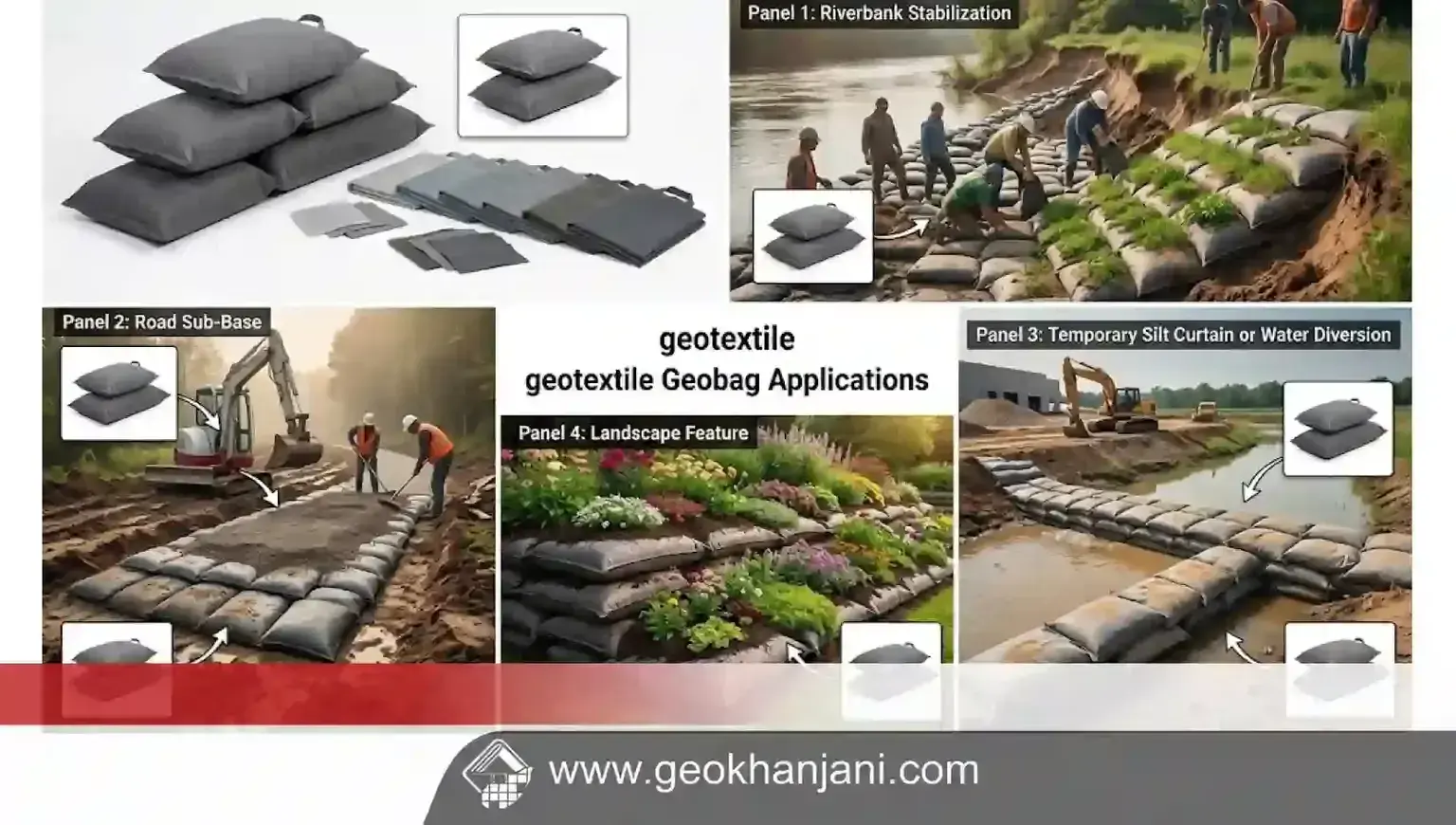 Main Applications
How a GeoBag Works
The operating principle comes down to solid-liquid separation through a specially selected geotextile fabric, and the process generally follows five stages.
Slurry filling comes first, where wet material is introduced through an appropriate inlet system. Water drainage follows, as free water migrates through the geotextile structure. Solid retention happens simultaneously, with most of the targeted solid fraction staying inside the containment unit. As drainage continues, consolidation takes place and the retained material becomes denser and easier to manage. Finally, in the material management stage, the dewatered material can be transported, covered, treated, stabilized, or managed in place, depending on the project.
Performance should always be verified for the specific material at hand rather than assumed solely from the product name or fabric weight.
Key Technical Characteristics
Selecting a GeoBag takes more than just picking a bag based on its dimensions. The geotextile has to be matched to the material and the expected loading conditions.
Tensile strength matters because the fabric has to withstand the stresses generated as the GeoBag fills and the contained material settles. Puncture resistance is important too, since handling, filling equipment, granular particles, and contact with the underlying surface can create localized stresses. Tear resistance becomes critical when the bag is exposed to tensile forces during filling, handling, or consolidation.
Apparent opening size affects particle retention and drainage behavior, so the fabric needs to match the particle-size distribution of the material being treated. Water permeability is a critical consideration for dewatering applications specifically, since the geotextile needs to let water escape while still holding onto the required level of solids retention. And chemical compatibility deserves a close look whenever the GeoBag is headed for an aggressive or unusual environment, since industrial and contaminated materials can contain chemicals that affect polymeric materials.
Benefits of GeoBag Technology
Depending on the application, a properly designed GeoBag system offers real operational advantages: efficient containment of wet materials, reduction of free water, improved material handling, and potential reduction in transportation volume. Large containment capacity and flexible installation options add practical value, and in suitable applications, GeoBags reduce dependence on permanent dewatering infrastructure altogether. They also adapt well across different sludge and sediment management projects.
The economic benefit should always be weighed against the complete project picture, including filling, drainage, handling, transportation, disposal, and site preparation costs.
GeoBag for Dredging Projects
Dredging operations often generate large quantities of fine sediment mixed with water, and direct transportation of this material can be inefficient since a significant share of its initial volume is often just water. A GeoBag system gives dredged-material management a designated containment area while letting excess water drain through the geotextile.
The right fabric and bag dimensions depend on sediment characteristics, expected filling volume, available site area, and drainage requirements.
GeoBag Selection Guide
Before ordering a GeoBag, it helps to work through a few key questions. What's the material type, primarily wastewater sludge, dredged sediment, industrial slurry, or another kind of wet solid? What's the solids concentration, since the initial percentage of solids significantly affects filling and dewatering? What's the particle size, since fine particles behave differently from coarse sediment and may call for a different geotextile structure?
Required capacity matters too, since the size and number of GeoBags should match the expected material volume. Site conditions, including available area, ground bearing capacity, drainage arrangement, access for equipment, and the surrounding environment, all need assessment. And fabric performance, both mechanical and hydraulic, should be selected according to the actual loading and dewatering requirements of your project.
GeoBag vs Conventional Bags
A standard industrial bag is generally built for storage or transportation. A GeoBag is a different animal entirely, an engineered geosynthetic product designed to perform a specific containment and drainage function.
Its performance comes down to the interaction between geotextile structure, contained material, water, loading conditions, and site environment. For that reason, ordinary bags shouldn't be treated as automatic substitutes for engineered GeoBag systems.
Dimensions and Customization
GeoBag systems come in different dimensions depending on project requirements and manufacturing specifications. The right size should be determined based on expected slurry volume, filling method, available installation area, required dewatering capacity, handling requirements, and project duration.
Using an appropriately sized bag improves filling control and simplifies site management considerably.
GeoBag for Sludge Dewatering
For sludge management applications, the performance of a dewatering bag depends heavily on sludge characteristics. Two sludges with the same initial volume can behave very differently because of differences in particle size, organic content, solids concentration, and viscosity.
For that reason, GeoBag selection should be based on project-specific testing and engineering assessment whenever required, particularly for large-scale or critical projects.
Buying a GeoBag
When purchasing a GeoBag, focus on the technical requirements of your application rather than choosing a product based only on size or fabric weight.
At GeoKhanjani, GeoBag solutions are evaluated according to your project requirements, including the type of material, required capacity, geotextile characteristics, and intended application. Reach out to our technical team to determine the right GeoBag configuration for your sludge, sediment, or dewatering project.